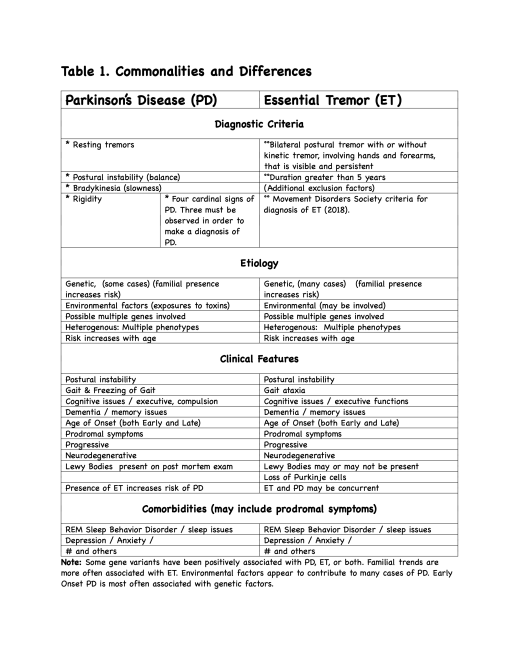
This is a continuation of the last post, which presented the RESULTS section of this article, as Table 1. This is the Abstract.
Living Well With (a Misdiagnosis of) Parkinson’s Disease
ABSTRACT
GOAL:
To review research related to
· Difficulty of diagnosis among and between movement disorders,
· Factors leading to misdiagnosis,
and
· Quality of Life issues experienced
BACKGROUND:
Single Subject Case Study of a 76 year old male. First reported Essential Tremor (ET) symptoms dating to teenage years. ET became disabling after five decades. ET refractory to treatment by a neurologist. Deep Brain Stimulation (DBS) chosen by subject as a last resort. Prior to DBS implants, a diagnosis of Parkinson’s Disease (PD) was made, due to rigidity observed A DATScan performed seven years after diagnosis reportedly showed abnormal dopamine transport..
Thirteen years after PD diagnosis, subject relocated and was referred to a Movement Disorders Specialist (MDS). On examination, no PD symptoms were observed. MDS began differential diagnosis based on symptoms of tremors, fatigue, and gait abnormality.
At this time, it appears that the subject’s initial presentation and diagnosis of ET (in 2010) was accurate. The later diagnosis of PD was vulnerable to confirmation bias, apparently the neurologist treating for ET had identified gait abnormality as rigidity, and failed to rule out other possible causes for arm swing asymmetry (Navarro-López et al., 2022). Heterogeneity of tremors (Fekete & Li, 2013) apparently was not investigated. Interestingly, in one of the case studies reported by Fekete & Li, a patient had been diagnosed as PD by a different neurologist, and was later determined to have ET without concurrent PD. It is not lost on this author that the references noted are later than the misdiagnosis (in December 2011). “If I knew then what I know now…”
METHODS:
Review of research articles available on PubMed Center relevant to
· Diagnostic criteria,
· Prodromal symptoms,
· Accuracy of diagnoses,
· Differentiating symptoms between ET, ET and PD, and PD.
In addition, discussion includes observable and subjective data regarding subject’s
Quality of life (QOL), including but not limited to:
· Side effects of medications,
· Dosages of medications,
· costs of medications
· Impacts of side effects, dosage, and costs for unnecessary medical interventions on other aspects of individual and social quality of life.
· Factors related to diagnosis and misdiagnosis.
Next: Quality of Life and Factors Affecting Misdiagnosis
###