Asclepias sp – milkweed

Asclepias species - Butterfly Weed

Asclepias species – Milkweed

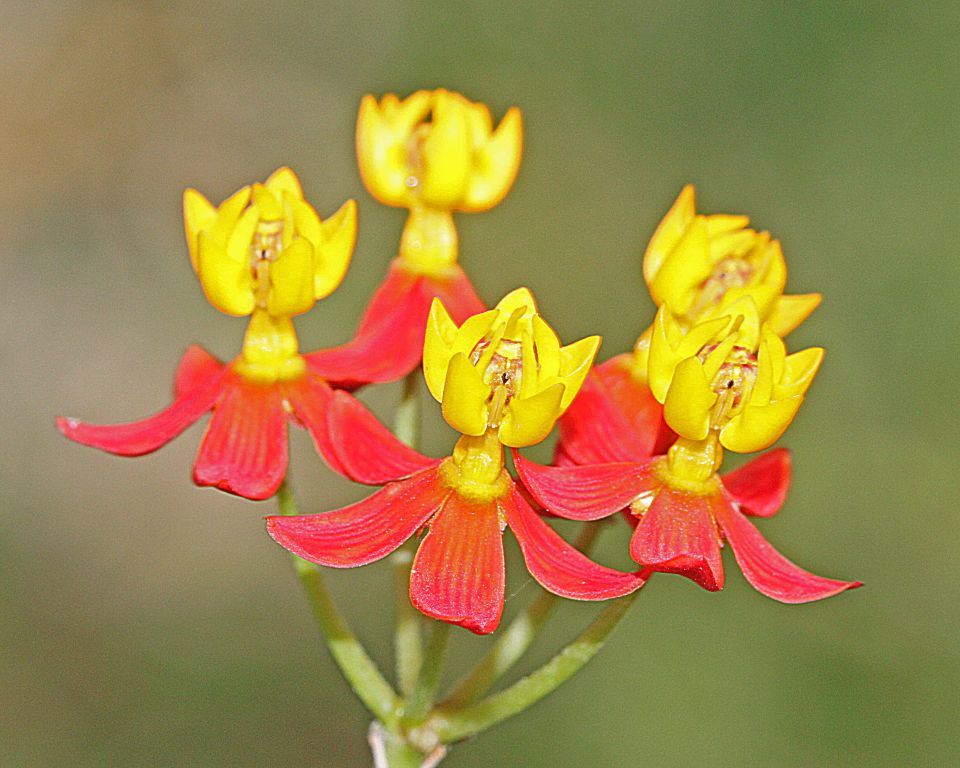
When I called the local nursery I specifically asked if they had Asclepias tuberosa, Butterfly milkweed…and they said yes. What I found was this, which as it turns out is most likely Asclepias currasavica, Tropical or Mexican Milweed.  That was last year, and they have managed to survive, and even to have been visited by Monarch Butterflies during their migrations.

Although I generally post species that are native to Central Texas and Williamson County in particular, an exception has been made here for the educational possibilities.  First, even though you ask for a species by name, you may not get that species, especially if  the plants are poorly or not labelled. Second, it’s probably best to ask to see the Texas Natives if you go into a nursery. That way you’ll find out just how aware the staff are of Texas Native plants and if they possess any knowledge in addition. Finally, its for good reason that one of the common names for Asclepias tuberosa is Orange Milkweed – the flowers are orange, not red and yellow.
Anisacanthus quadrifidus var wrightii – Hummingbird Bush

Anisacanthus quadrifidus var wrightii - Hummingbird Bush

Anisacanthus quadrifidus var wrightii – Hummingbird Bush

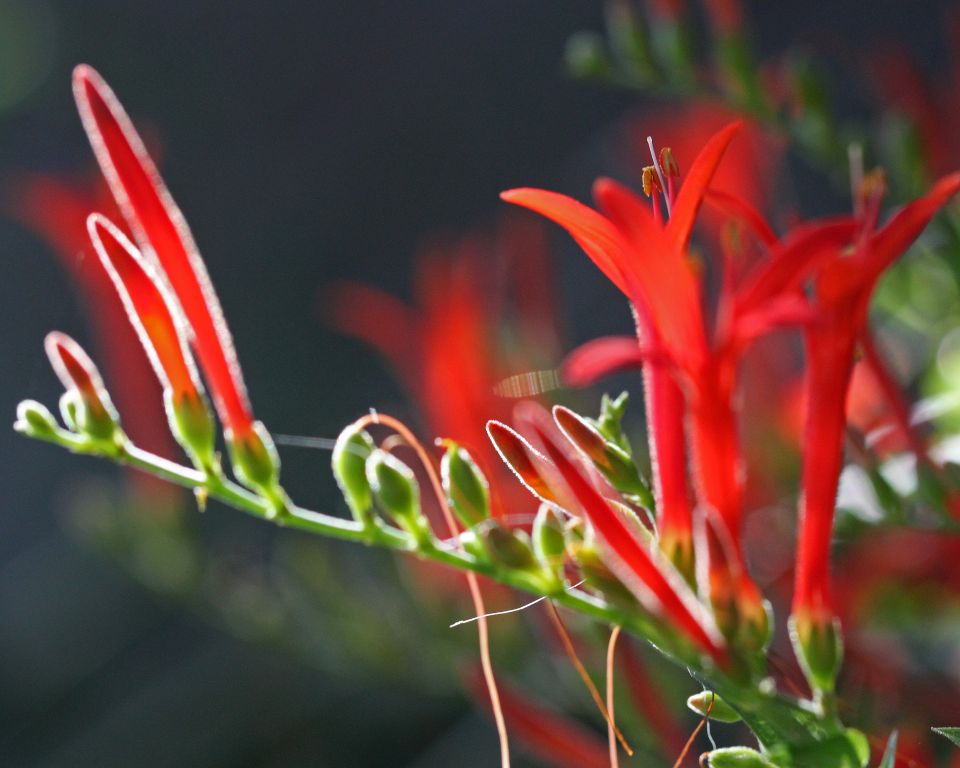
Also known as Flame Acanthus, this post goes with the Hummingbird Bush appellation because that’s what has been appearing in the yard lately. I believe that they are Black-throated Hummingbirds. Apparently this is the time for migration for these little feathered jewels.

Proboscidea louisianica – Devil’s Claw

Proboscidea louisianica - Devil's Claw

Proboscidea louisianica – Devil’s Claw


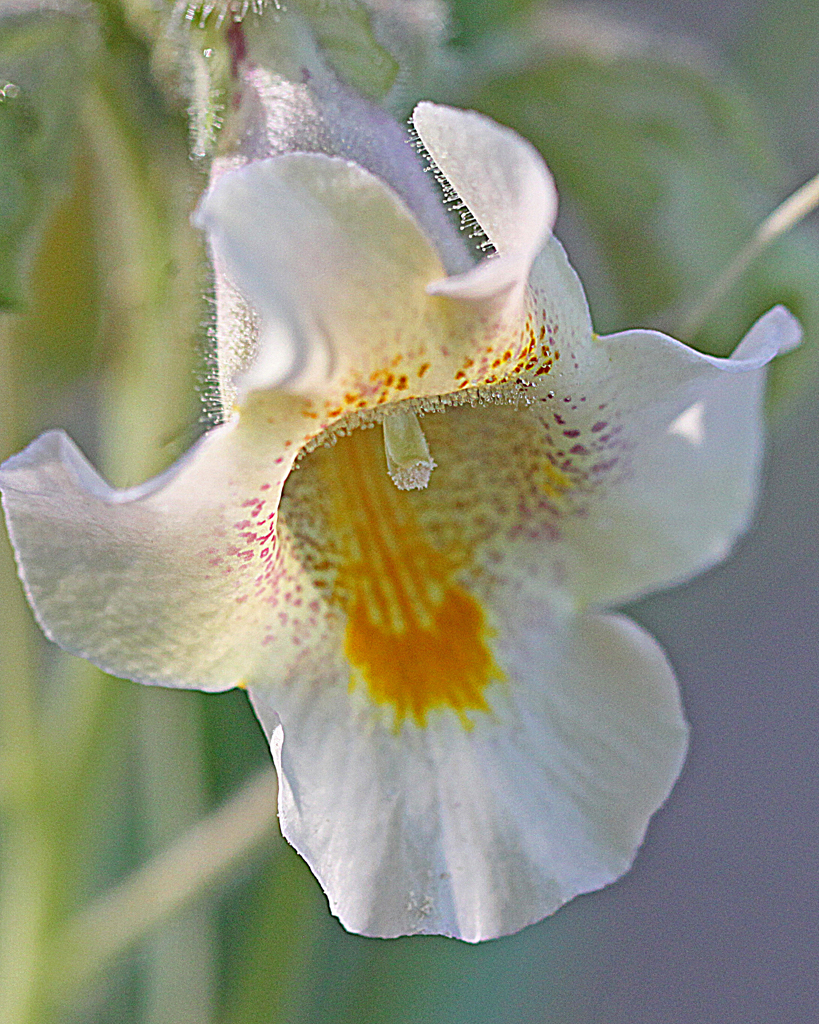
Can’t tell you how pleased I am that this plant, which has popped up in the greenbelt behiind the fence, is a native rather than an exotic or invasive. According to Enquist, this is an occasional plant of roadsides and wastes., common only in Mason County. The seeds apparently attach themselves to bypassing animals, thus spreading and propagating the species. Apparently the seed pods were used for food by various native tribes of the Southwest, as well as plant fibers which were used for weaving. The plant has a rather strong unpleasant odor, which means that the photograph is more pleasant than the taking of the photograph.  Ajilvsgi recommends it for the xeriscape garden, if there is room. It blooms from June to September, usually only a few flowers at a time.

Bouteloua gracilis – Blue Grama

Bouteloua gracilis - Blue Grama

Bouteloua gracilis – Blue Grama

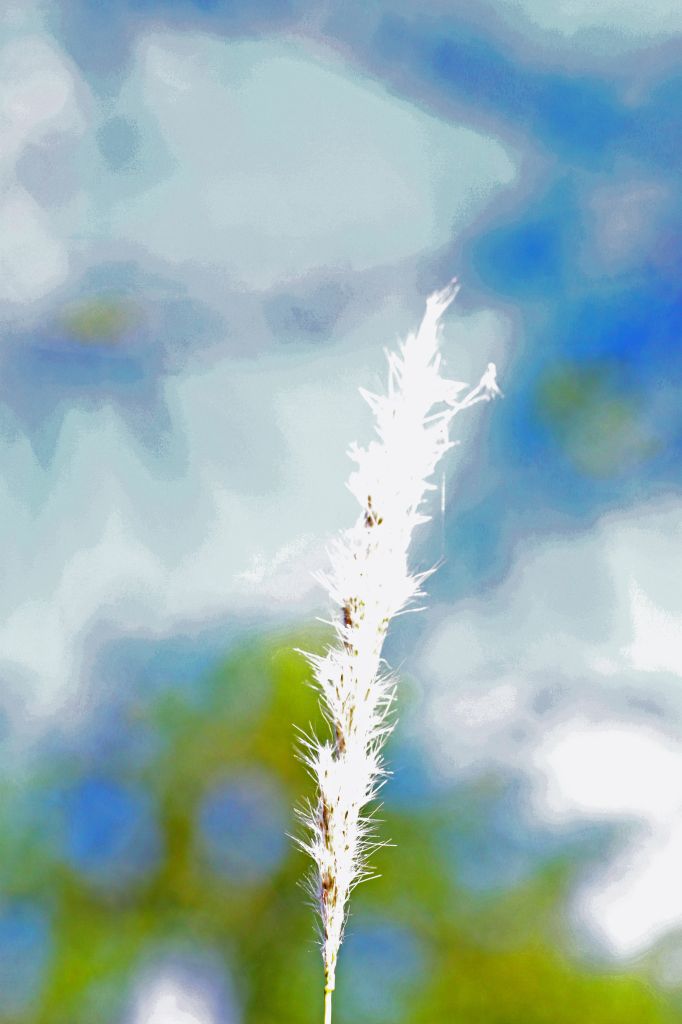
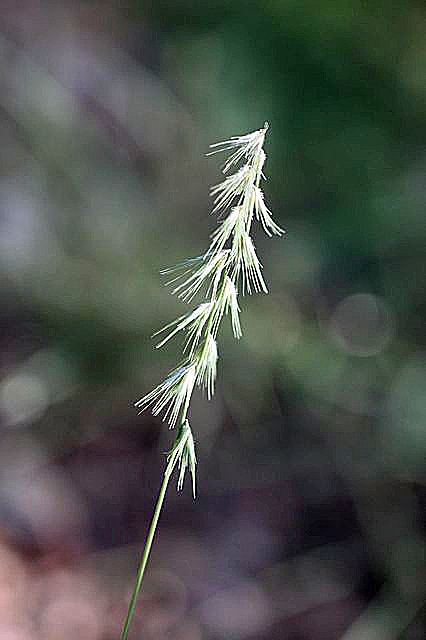
Blue Grama is one of several native grasses that is being pushed as a native turf alternative to St. Augustine or Bermudagrass.  It grows in bunches and forms mats. Hairy Grama is similar in appearance, but has a “stinger” at the end of the seedhead, which Blue Grama lacks.

This particular specimen was photographed alongside the curb, where I have tried, mostly unsuccessfully, to establish Buffalograss between the sidewalk and the curb. I’ve used the Blue Grama seed to attempt to fill in the patchy spots that the Buchloe dactyloides seems to be prone to.

Bouteloua rigidiseta var rigidiseta – Texas Grama

Bouteloua rigidiseta va rigidiseeeta - Texas grama

Bouteloua rigidiseta var rigidiseta – Texas Grama

Texas Grama is a weedy grass, often a sign of disturbed soils. It grows on dry plains, rocky hills, and overgrazed land throughout all of Texas except for the northeast. This particular specimen was photographed in Burnet County, although it is common in Williamson County as well, the home base for this blog. Texas Grama also goes by the aliases Bell Grama and Mesquite Grass, showing once again that you just can’t depend on common names. So Bouteloua rigidiseta will continue to wave its bell-shaped seedheads in the wind, providing aesthetic pleasure to those who pay attention.

Desmanthus illinoensis – Illinois Bundleflower

Desmanthus illinoensis - Illinonis Bundleflower

Desmanthus illinoensis – Illinonis Bundleflower


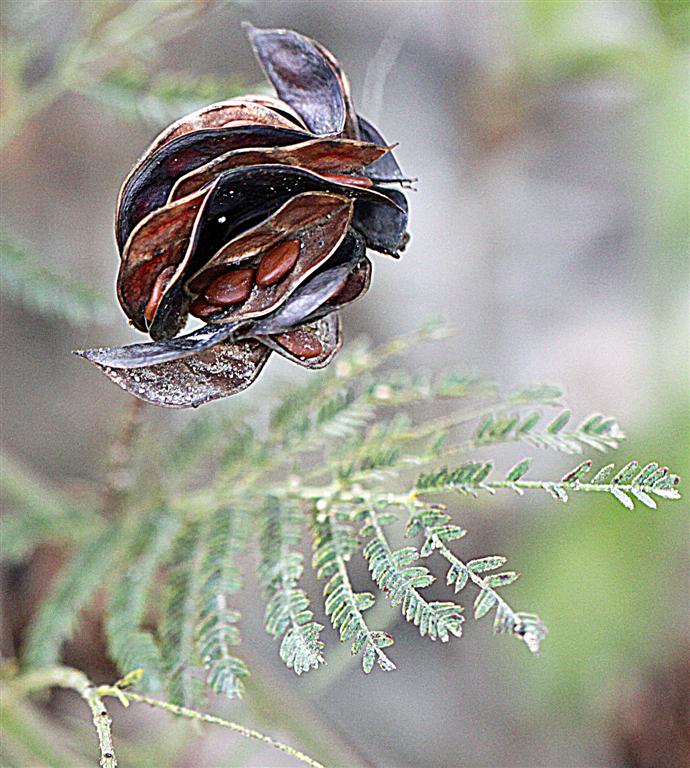
Another shot from Lake Granger/Taylor Park back in mid-July, this time from the shoreline, of the seedpod of the Illinois Bundleflower.

Since the Desmanthus illinoensis usually blooms in May and June, we saw none of the little creamy white flowers, and the seed pods had already turned from green to black.  The leaves have been described as almost fernlike – decide for yourself. Together, they  are a distinctive combination that should be easy to recognize in the field.

Convolvulus equitans – Texas Bindweed

Convolvulus equitans - Texas Bindweed

Convolvulus equitans – Texas Bindweed

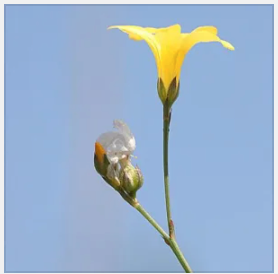
Back to flowering plants, this time a small vine that grows close to the ground and has fairly small flowers which are less than a inch and a half  across, if that much. A member of the Morning Glory family, it resembles other members of the family.  Its leaves are distinctive as seen in this photo just above the blossom. It likes partial shade and is in general easy to overlook.

Danaus plexippus – Monarch Butterfly

Danaus plexippus - Monarch

Danaus plexippus – Monarch Butterfly

After posting photos of  Monarch mimic Viceroy Butterfly and the Queen Butterfly, it seems only appropriate to post the iconic Monarch Butterfly. if only to distinguish among them.

In Central Texas, both Monarchs and Queens can be found hovering over and feeding on Gregg Mistflower Conoclinium Greggii, shown here alongside the Monarch.  Of course, while Queen can be found here in the middle of July and August,  Monarchs tend to hang in Ohio and Canada until maybe September and October. This particular photo was taken in May a few years ago, probably a second generation new hatched, as Monarchs tend to clear out of Central Texas by May.

Around October, it would be helpful to be able to distinguish between the Monarch and the Queen. One thing is size – Monarchs tend to be larger.  With folded wings, the Monarch has a much lighter orange on its hindwing, while the Queen’s orange is much more saturated. On the upper wing,  the Monarch continues the “stained-glass” like pattern of black lines separating panels of orange, while the Queen has no lines. When the wings are opened, the Queen lacks any lines, with a solid orange, while the Monarch has the same pattern on both sides of its wings. And of course, the Viceroy has the horizontal line across the hindwing and is smaller than the monarch.

Queen Butterfly – Danaus gilippus

Queen Butterfly - Danaus gillippus

Queen Butterfly – Danaus gillippus

In contrast  to the Viceroy Butterfly that was shot 2 weeks ago, this Queen Butterfly was located in my front yard just  morning. You can see in this view the loose arrangement of white dots across the top of the wing and the lack of the horizontal black line across the hindwing. It isn’t very noticeable, but part of the “black spot” on the lower wing can be seen with a white dot in the middle of it.

The black spotwhich is more vixible in this other picture with spread wings, is used to attract members of the oppsoite sex.   Note also that when it spreads its wings out that the inner side of the wing doesn’t have the mosaic-like   “staned glass” effect of the outer wings disappears.

Queen Butterfly- Danaus gilippus

Queen Butterfly- Danaus gilippus

Viceroy Butterfly – Limenitis archippus

Viceroy Butterfly - Limenitis archippus

Viceroy Butterfly – Limenitis archippus

The first tip-off that this might not be a Monarch Butterfly was the size – it wasn’t nearly as large as a Monarch usually is. And it wasn’t a Queen – they have a looser arrangement of spots and a dark spot near the tail. The clincher was the black line  crossing the hind wing in the lower right hand corner of the picture. Sure enough, a Viceroy! Though not an endangered species, they are not seen nearly as often as the Monarch and Queen. And another thing, Monarchs are not seen in Williamson County in mid-July… In fact, the Butterflies and Moths of North America website at http://www.butterfliesandmoths.org/checklists?species_type=All&tid=3013 doesn’t even list the Viceroy among the confirmed sightings for Williamson County. Quite the feather in the cap for our little field trip party. Too bad I didn’t have a telephoto lens with me at the time…