
Participants needed for Narrative Study in Parkinson’s Disease – study starts February 26, 2022

Robert Cochrane is recruiting participants for a new Parkinson’s Disease study. See below. Note the three categories of PD people needed:
” We are recruiting male and female persons diagnosed with idiopathic (unknown cause) Parkinson’s disease between and fit ONE of the following criteria:
– They have been diagnosed within the last year,
– are early onset (diagnosed before the age of 50)
– are active or former members of the U.S. military. “”
Here’s the full recruitment flyer:
Participants needed for Narrative Study in Parkinson’s Disease Principal Investigator, Dr. Gabriele Wulf, and Robert Cochrane, PhD student at UNLV, are looking for persons with Parkinson’s disease to participate in an online research study of heroic narrative upon Parkinson’s disease. Study participants will be asked to share their perceptions and experiences about Parkinson’s from the time they were diagnosed to today, and how they feel about their future quality of life expectations. They will be taught heroic storytelling structure and practical tools of how to explore and incorporate it into their own lives. Heroic storytelling is based on the works of Joseph Campbell’s monomyth. Campbell’s work is broken into a 12-step journey for this class that participants will follow and use to write their own heroic journey with Parkinson’s disease. Participation in this study will require completion of 12 sessions, meeting once a week on Saturday mornings from 9a-10:30a (Pacific Time). Participants Will also be required to write a one-page personal assessment each week outside of class. Finally,online surveys at the beginning, middle and end of the 12-session period will be required. All sessions will take place online via Zoom. All sessions will be recorded. Participants must have a WiFi enabled device in a safe location (e.g. participants’ home) for these sessions. Sessions will include writing, theatrical improvisation and lectures from guest subject matter experts in fields such as dance, art and mythology. We are recruiting male and female persons diagnosed with idiopathic (unknown cause) Parkinson’s disease between and fit ONE of the following criteria:
– They have been diagnosed within the last year,
– are early onset (diagnosed before the age of 50)
– are active or former members of the U.S. military. Participants must be between 1-3 on the Hoehn and Yahr scale. This assessment should be given by participants’ neurologist or movement disorder specialist prior to acceptance into the program. We cannot accept persons who have an inability to communicate verbally, are uncomfortable writing, or are unable using the Zoom platform. Please email Robert Cochrane at cochra58@unlv.nevada.edu with questions or to express your interest in participating.This program was made possible, in part, by a grant from the Parkinson’s Foundation. Thank you!

Keep on moving to (and making) music

The evidence that rhythm, movement, and making music continues to accumulate as a therapeutic approach to address the symptoms and Quality of Life issues related to Parkinson’s Disease (PD).

Today we look at an article just out in Frontiers of Human Neuroscience, titled

Rhythm and Music-Based Interventions in Motor Rehabilitation: Current Evidence and Future Perspectives  

Over the last quarter of a century, increasing research results point to rhythm and music as effective and useful tools for treatment and rehabilitation of people with neurological disorders. This article reviews the evidence for four different approaches, what the consensus is at the present time, and, of course, suggests future directions.

The authors look at four different approaches:

  1. Rhythmic Auditory Stimulation (RAS)
  2. Music-Supported Therapy (MST)
  3. Therapeutic Instrumental Music Performance therapy (TIMP) and
  4. Patterned Sensory Enhancement (PSE)

The consensus of recent meta-analyses and systematic reviews is that, for Parkinson’s Disease (PD), is that RAS is an effective tool for improving gait, stride, and speed – folks walk faster and with longer steps with RAS. Additionally, evidence is showing that it also reduces freezing of gait (FOG), improves balance and reduces the occurrence of falls.

Neither MST nor TIMP have been studied much beyond the rehabilitation of stroke patients. They involve practicing on a keyboard or drums, beginning with the patient’s comfort level and increasing in difficulty. Some studies have begun to be used to investigate effectiveness as treatments for PD.  Some have shown improvements in motor dexterity. More research is needed, but in the meantime, learning to play drums or keyboards can’t hurt, and may enrich one’s quality of life (QOL).

Growing evidence in neurological and brain imaging have shown increased activity in the auditory and motor areas of the brain, indicating that brain plasticity might be achieved through music and rhythmic interventions. The authors note that RAS has been well studied with stroke and PD populations, but not with other movement disorders and Alzheimer’s populations. In addition MST and TIMP have only begun to be investigated as a means of restoring fine motor coordination.

The authors also call for neuroimaging use in studies, to better understand the physiological basis of the rehabilitation process. They point out the gaps in research and hope to provide a framework for future research – not so much a roadmap, I would think, but a laying out of what we know and what we don’t know, and what kinds of studies are needed to answer the questions about what we don’t know..  They state that “musical rhythm is a powerful tool” for therapy, and our understanding and exploration of how it modulates brain networks is in the initial stages.

 In other words, “We’ve only just begun.”

Meanwhile: Don’t stop moving to the music.


Citation:
Braun Janzen T, Koshimori Y, Richard NM and Thaut MH (2022) Rhythm and Music-Based Interventions in Motor Rehabilitation: Current Evidence and Future Perspectives. Front. Hum. Neurosci. 15:789467. doi: 10.3389/fnhum.2021.78946


RBD and other things PD-related

Diagnosis of PD is often not made until a person is in their 60s. With all the attention that has been focused on the disease(s) in the last 20 years or so, I suspect that more people are getting diagnosed at an earlier age, although most cases of young onset PD are likely to be genetic in origin.

However, an “early” diagnosis may not be a timely diagnosis, as  the title of one opinion piece I read some time ago said (see link below).

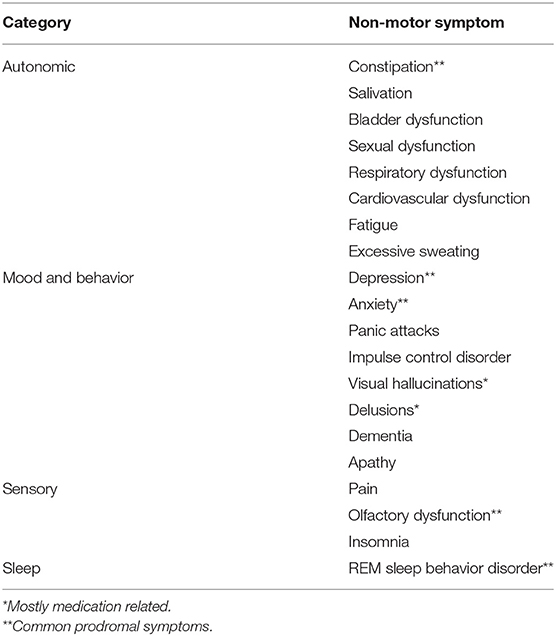
It is now becoming apparent that “Parkinson’s”includes several categories of symptoms, not just rigidity, tremors, and gait, as shown in the table below::

Source for the following table, accessed 11/28/2021:  URL=https://www.frontiersin.org/article/10.3389/fneur.2020.00686

The problem is that treatment and diagnosis are often delayed until PD has already reduced Quality of Life for many folks.

Good evidence for the quality-of-life benefits of existing symptomatic treatment supports the argument for earlier diagnosis at a time when symptoms are already present (emphasis added). This argument would be significantly bolstered by the development of disease-modifying treatments. Benefits of early diagnosis and treatment would affect not only the individual (and their families) but also the wider society and the research community. Ultimately, however, shared decision-making and the principles of autonomy, beneficence, and non-maleficence will need to be applied on an individual basis when considering a “timely” diagnosis.

Therefore, the earlier one can predict the probability or inevitability of PD the sooner one can use treatments – whether pharmacological, surgical, nutritional, or lifestyle in nature – that can either reduce, delay, or defer (and possibly reverse?) the symptoms of PD.

Of all the symptoms associated with PD: tremors, bradykinesia, depression & anxiety, posture, gait issues (difficulties walking), REM Sleep Behavior Disorder (RBD), anosmia (loss of ability to smell), cognitive issues, facial masking, and micrographia (small handwriting) – RBD is the one which is most highly predictive of a later PD diagnosis.

The predictive ‘specificity’ is so strong that if someone has RBD, the chance of being diagnosed with Parkinson’s or related conditions over the next 15 years or more is over 80%

If an 18-21 year old person walked into a physician’s office with RBD, essential tremors, and depression as main symptoms, what would happen? In 1970, probably nothing – one might get treated for depression, but essential tremors are also called “benign”tremors, and were ignored, even if the patient reported being able to feel the tremors while resting, though invisible to the external observer. As for RBD, it would probably also be ignored.

By “a physician,” we are talking about a General Practitioner, or “family doctor,” and not s specialist like a  Movement Disorders Specialist who would be trained to identify varied symptoms, including those that are prodromal. And, of course, the identification of prodromal symptoms has only been investigated within the last decade or so, and are identified as for “research only” purposes – not for clinical diagnosis. A recent survey article (not referenced below) indicated that a majority of general practitioners were either unaware of the Movement Disorders Society’s list of prodromal symptoms, or were not using them to make referrals to Movement Disorders Specialists.

But thanks to the dedication and generosity of folks like Michael J. Fox and others, PD has become a respectable disease for which the person who has it has no reason to be apologetic or ashamed, and can hold their head up (and they ought to, since one symptom is to walk with shoulders stooped down) and proudly proclaim that they have Parkinson’s, which is why they walk funny. And so it goes.

Articles that were quoted above or which contributed to this article are found in the links below.

But first:

I See The Signs of PD

Perspective: Current Pitfalls in the Search for Future Treatments and Prevention of Parkinson’s Disease

An early diagnosis is not the same as a timely diagnosis of Parkinson’s disease

Prodromal REM Sleep Behavior Disorder and PD

10 Early Signs of Parkinson’s Disease / Parkinson’s Foundation

REM Sleep Behavior and Motor Findings in Parkinson’s Disease: A Cross-sectional Analysis

Current Update on Clinically Relevant Sleep Issues in Parkinson’s Disease: A Narrative Review

The prodromes of Parkinson’s disease

Exercise-Induced Neuroprotection of the Nigrostriatal Dopamine System in Parkinson’s Disease

###

Late Stage Parkinson’s (LSP): Undertreated?

This paper (or rather a chapter in a thesis) landed in my newsfeed recently. In it, the authors describe a study done to see whether people with Parkinson’s in the later stages are getting adequate treatment and whether they could benefit from more specific treatment. (A link to the PDf file is at the end of this post).

A person in Late Stage Parkinson’s has more than one of the following:

  • Motor symptoms not controlled despite medication.
  • Levadopa-related dyskinesias or dystonia,
  • PD dementia (defined according to MDS Task Force definition (Dubois et al. 2007), and
    not treated with cholinesterase inhibitors,
  • Depression not adequately treated,
  • Neuropsychiatric symptoms, such as agitation/ aggression; anxiety and irritability,
  • Orthostatic hypotension, pain, constipation, urinary symptoms, insomnia or daytime sleepiness (autonomic systems degeneration),
  • Falls on a regular basis,
  • Other symptoms related to risk of choking, speech issues, or producing too much saliva,
  • Inadequate Home environment.

Basically, the study provided a list of recommended activities and treatment on a sheet of paper (the control group) and actually providing the treatments and activities recommended, (the treatment group).

Not surprisingly, the treatment group did better at the end of the study than the controls. The conclusions were that people in late-stage Parkinson’s are often undertreated and could benefit from implementation of movement disorder specialists’ recommendations. (One would hope that the control group would also be provided with the treatments after the study ended. Perhaps, leading to another report)?

I’ve paraphrased the table used to describe late stage Parkinsonism in order not to infringe on their copyright. The title of the entire thesis is “Impairment and Disability in Late Stage Parkinsonism” and the overall author is Danny Hommel. I couldn’t find an email to ask for permission in writing to reproduce anything verbatim.

Other chapters include:

  • The late-stage of parkinsonism’s – motor and non-motor complications
  • The prevalence and determinants of neuropsychiatric symptoms in late-stage parkinsonism
  • Prevalence and prescribed treatments of orthostatic hypotension in institutionalized peoples with Parkinson’s disease (the chapter discussed in this post)
  • Optimizing treatment in undertreated late-stage parkinsonism: a pragmatic randomized trial
  • General discussion/English summary

Published as: ALAJ Hommel, MJ Meinders, NJ Weerkamp, C Richinger,
C Schmotz, S Lorenzl, R Dodel, M Coelho, JJ Ferreira, F Tison, T Boraud,
WG Meissner, K Rosqvist, J Timpka, P Odin, M Wittenberg, BR Bloem,
RT Koopmans, A Schrag and the CLaSP consortium.
Optimizing treatment in undertreated late-stage parkinsonism: a pragmatic
randomized trial.
J Parkinsons Dis. 2020;10(3):1171-1184.

Not a cure, but a biomarker

A biomarker for Parkinson’s?  Maybe… (If you don’t have a free ResearchGate account, yu might not be able t see this link):

A blood marker for Parkinson’s Disease: Neuronal exosome-derived α-synuclein

This isn’t in print yet, so I’ll just quote frm the abstract:

18 To date, no reliable clinically applicable biomarker has been established for Parkinson’s
19 disease (PD). Our results indicate that a long hoped blood test for Parkinson’s disease may
20 be realized. We here assess the potential of pathological α-synuclein originating from
21 neuron-derived exosomes from blood plasma as a possible biomarker. Following the
22 isolation of neuron-derived exosomes from plasma of PD patients and non-PD individuals
23 immunoblot analyses were performed to detect exosomal α-synuclein. Under native
24 conditions significantly increased signals of disease-associated α-synuclein forms in neuron25 derived exosomes were measured in all individuals with PD and clearly distinguished PD
26 samples from controls. By performing a protein misfolding cyclic amplification assay these
27 aggregates could be amplified and seeding could be demonstrated. Moreover, the
28 aggregates exhibited β-sheet-rich structures and showed a fibrillary appearance. Our study
29 demonstrates that the detection of pathological α-synuclein conformers from neuron-derived
30 exosomes from plasma samples has the potential of a promising blood-biomarker of PD.

Exosomes are small bundles of proteins  enclosed by a membrane (if I understand it correctly)(feel free to correct me- the Wikipedia article hd a note saying that it was too technical for most readers – and I agree).

Exosomes contain material from the cells from which they originated, so might be used as biomarkers. Obviously, it will take a while to fund the research and develop some way to determine how far along the way to developing PD someone is.  But the sooner a person can deal with it, the better the opportunity to live well with it. I look forward to the development of biomarkers that will help predict who might get Parkinson’s, so those folks can take preventive action.

I am fortunate that my symptoms did not appear in the usual sequence,and that I had DBS early after diagnosis, have had an outstanding medical team looking out for me and working with me, have a strong local community supporting people with Parkinson’s, and have a care partner who makes sure that my diet is full of organic foods, produce, and as few highly processed foods as possible. And I get lots of exercise, considering that I’m not athletic and I am not into weightlifting or bodybuilding.

Lucky me.

###

This is photography on Parkinson’s

This is photography on Parkinson’s… sometimes. Sometimes you accidentally hit the button due to herky-jerky movements, sometimes you manage to get the shot you envisioned in the viewfinder. Some days your vision is blurred and it’s hard to say whether or not you have the item you want in focus, in focus. More often than not, it’s blurred, and the background or foreground isn’t focused instead. Of course, one can always use autofocus, but that has the same issues as manual focus with blurry vision. The best one can do in that situation is to click the shutter as soon as the screen blinks red, indicating that everything’s in focus. And then, of course, somedays you get the focus right and the shutter speed and it all works. Then again, when life hands you bitter citrus, sometimes you can make a Margarita. Or better yet, KeyLime Pie.

Slow down… or speed up, that is the question…

This article isn’t about Parkinson’s, but since bradykinesia is one of the signature symptoms of parkinsonism, and the title is about the challenge of being slow, it interested me.

Birgitta Burger & Clemens Wöllner (2021): The challenge of being slow: Effects of tempo, laterality, and experience on dance movement consistency, Journal of Motor Behavior, DOI: 10.1080/00222895.2021.1896469

Basically, the authors found that people who were musically trained were better able to perform the given tasks consistently on both sides of their bodies. In other words, they are bilateral in terms of brain dominance, while other folks showed lower scores in terms of consistently performing the actions at different tempi (speeds). Because they were dominant on one or the other side of their brains. 

As an amateur musician, mostly untrained (or it didn’t take) I have found that during rhythm & drumming classes that I have been in that things like a simple paradiddle are much more difficult at a slower tempo than at a faster tempo. On the other hand, some combinations are more difficult at a faster tempo than at the slower tempo. Just trying to build those cross brain connections, as the prefrontal cortex to the back of the brain and the motor control and reward system parts fade out. So I will play at the piano at a slow speed, ’cause if I pick up the tempo my fingers get even more clumsier than they are.

Maybe difficulty with moving both sides consistently is part of the reason People with Parkinson’s have difficulty with balance and with falls?  From my own experience, can’t confirm or deny the hypothesis, since I’m not that good as a musician, but seem to have some bilateral skills, and until recently, when immersion in the moment took over the judgement and reason, have not experienced problems with balance or falls. Would be an interesting research question, though…

###

Attention, cyborgs: be aware of environmental electrical interference

I became aware through the news feed that some research is going on regarding electrical interference and DBS implants. Of all the websites and information I found, this page at UC-Davis is the most accessible:

DBS issues – UC-Davis health (PDF)

This next article isn’t accessible to me, but if anyone does have access and could shoot me a copy, it would be greatly appreciated. I might even get around to reading it. In fact, if anyone out there knows how I could get access to research journal subscriptions through an institution, please, please, please leave a note in the comments and I’ll get back to you.

Abstract

Deep brain stimulation (DBS) has evolved into an approved and efficacious treatment for movement, obsessive-compulsive, and epilepsy disorders that are refractory to medical therapy, with current investigation into other disease conditions. However, there are unintentional and intentional sources of external electromagnetic interference (EMI) that can lead to either malfunctioning or damaged DBS devices, as well as injury to human tissue. Comprehensive studies and guidelines on such topics in the medical literature are scarce. Herein, we review the principles behind EMI, as well as the various potential sources of interference, both unintentional (e.g. stray EMI fields) and intentional (e.g. MRI scans, “brainjacking”). Additionally, we employ the Manufacturer and User Device Facility Experience (MAUDE) database to assess real-world instances of EMI (e.g., airport body scanners, magnetic resonance imaging (MRI), and electrosurgery) affecting DBS devices commonly implanted in the United States (US).  (emphasis added above and below).

Highlights
• Electromagnetic equipment in our environment may interfere with implanted deep brain stimulation devices.

• Common EMI sources include airport security gates, antitheft and metal detectors, MRI, and electrosurgical or other medical equipment.

Intentional EMI to “hack” or “hijack” DBS systems is a growing cause for concern.

• Research on EMI and DBS devices is scarce, and deserving more attention given the gravity of potential adverse events.

Practical guidelines for patients, healthcare workers, and those who frequently handle electromagnetic devices are lacking.

Intentional EMI to “hack” or “hijack” DBS system?!?  I don’t know about my fellow cyborgs, but I am cautious about letting magnetic and electrical fields get close to the areas where I have my DBS electrodes, wiring, and programmer/battery. However, it sure would be nice. if they would at the least make the “practical guidelines” open access or available somewhere. Seems to be a contradiction. to make someone pay to find out how to protect oneself from harmful electrical interference. Isn’t  part of the Hippocratic oath “First, do no harm?” It seems to me that if you know the bridge is out, and some asks you for directions, and you tell them the directions but fail to mention that the bridge is out, that you are doing harm, The same goes with, “Yeah, I can tell you how to get there safely, but you’ll have to purchase a PDF file of the directions for $45.00 USD..”

Guess I’ll have to search for :”Practical Guidelines to Avoid Electrical Interference for DBS.” 

Boston Scientific has a nice page on EMIs, although it deasl with ICDs (which I take to mean (implanted Cardiac Device or something along those lines) basically a pacemaker for the heart.. So I guess this page will work folks who’ve become cyborgs due to PD DBS implants:  EMI safety

Another list of publicly available guidelines can be found at EMC Devices and risks on the Medtronics website. The list addresses risks related to cardiac devices,  but one can probably generalize to DBS devices (or one can look further than I did). Well, I looked a little further and found the DBS manuals for my model. Appendix A has the list of EMC guidelines. I also found the patient counseling information, which I’ll print here:

Patient information
Programming and patient control devices
Patient control devices may affect other implanted devices – Do not place the patient
control device over another type of active implanted medical device (eg, pacemaker,
defibrillator, another type of neurostimulator). The patient control device could
unintentionally change the operation of the other device.
Patient activities
Activities requiring excessive twisting or stretching – Patients should avoid activities
that may put undue stress on the implanted components of the neurostimulation system.
Activities that include sudden, excessive or repetitive bending, twisting, or stretching can
cause component fracture or dislodgement. Component fracture or dislodgement may
result in loss of stimulation, intermittent stimulation, stimulation at the fracture site, and
additional surgery to replace or reposition the component.
Component manipulation by patient – Advise your patient to avoid manipulating the
implanted system components (eg, the neurostimulator, the burr hole site). This can result
in component damage, lead dislodgement, skin erosion, or stimulation at the implant site.
Manipulation may cause device inversion, making a rechargeable neurostimulator
impossible to charge.
Patient activities and environmental warnings – Patients should exercise reasonable
caution in avoidance of devices that generate a strong electric or magnetic field. Close
proximity to high levels of electromagnetic interference (EMI) may cause a
neurostimulator to switch on or off. The system also may unexpectedly cease to function.
(emphasis added)- For these reasons, the patient should be advised about any activities that would be
potentially unsafe if their symptoms unexpectedly return. For additional information about
devices that generate electromagnetic interference, call Medtronic. Refer to the contacts
listed at the end of this manual.
Scuba diving or hyperbaric chambers (emphasis added)- Patients should not dive below 10 meters
(33 feet) of water or enter hyperbaric chambers above 2.0 atmospheres absolute (ATA).
Pressures below 10 meters (33 feet) of water (or above 2.0 ATA) could damage the
neurostimulation system. Before diving or using a hyperbaric chamber, patients should
discuss the effects of high pressure with their clinician.
Skydiving, skiing, or hiking in the mountains (emphasis added).- High altitudes should not affect the
neurostimulator, however, the patient should consider the movements involved in any
planned activity and avoid putting undue stress on the implanted system. Patients should
be aware that during skydiving, the sudden jerking that occurs when the parachute opens
may cause lead dislodgement or fractures, which may require surgery to repair or replace
the lead. (emphasis added).

My Practical Guidelines search uncovered another article, but it wasn’t open access. so I won’t even bother to link to it. I was going to add the Medtronics Appendix A, but it simply repeated the information above,

And there you have it. Don’t go putting strong magnets next to your brain, avoid Tesla Coils, and try not to get hit by lightning. 

And don’t let the EMS guys or ER folks stick you in an MRI machine.

###

So.. what’s new?

A couple of recently published reviews (for folks that want to stay on top of things) :

What do we know about PD and what can we do about it?   This one is more of a commentary piece, that is to say, it isn’t an experiment or a structured desk review of other papers. It covers PD in (almost) layman’s terms, the causes (genetic, environmental, and perhaps lifestyle choices – nicotine and caffeine seem to have a neuroprotective effect), and the signs and symptoms:

… symptoms appear in other diseases as well so that not everyone with one or more of these symptoms has
the disease. In some people, the disease evolves more quickly than in others and it is not possible to predict what course the disease will take.

According to the author, the younger the age at onset, the more likely it is to be genetically related. Later onset symptoms appear more gradually. ( my note: I had many of the prodromal symptoms beginning around age 16, including REM Sleep Behavior Disorder, depression (probably due to environmental (e.g., workplace management) factors), essential tremors,  and have the LINGO1 gene variant that has been linked to both essential tremors and Parkinson’s. A recent Michael J. Fox Foundation – 23AndMe study found another couple of dozen or more gene variants associated with a higher risk for Parkinson’s. Clearly, there is a need for earlier detection and mitigation of Parkinson’s and parkinsonism conditions).

PD dementia and dementia with Lewy bodies differ in when dementia occurs, among other things. In PD, dementia occurs after PD diagnosis, in the latter, dementia occurs before PD symptoms become apparent. 

The author continues to provide an overview. But for me the sentence that stuck out glaringly was “Scientists still do not know what causes cells that produce dopamine to die.” (I need to finish reading this one… Will have to put it on my to-do list). 

Parkinson’s patients’ needs during the pandemic   This was a survey study done in Northern Italy with PD patients. Findings included:

(i) fearing the risk of contracting coronavirus,

(ii) the reduction of physical activity,

(iii) perception of the risk of not being able to access outpatient clinics or support services, and

(iv) the suffering from the important reduction in socialization.

The authors also noted that the perception could be greater than the actual difference, especially for item iii.

Enhanced differentiation of human induced pluripotent stem cells toward the midbrain dopaminergic neuron lineage through GLYPICAN-4 downregulation    I just tossed this link in for kicks – it is way outside of my area of expertise, but might be of interest to someone who knows something about the workings of the brain.

A scoping review of the nature of physiotherapists’ role to avoid fall in people with Parkinsonism – Now, here’s something I have a little more experience with – having fallen 3 times in October 2020 while stepping backward off of boulders, or trying to step up onto a boulder, either in my yard or in a park/preserve. Fortunately, I was referred to an excellent Physical Therapist who zeroed in on the greatest source of pain and then has moved toward improving strength, balance and posture. She noted my habit of leaning back when stepping high, and suggested that this might have caused the last, and most painful fall. 

As for the review, it noted that PT can have a positive effect on many issues related to falls in Parkinsonism. But the many studies were so varied, that many more studies would have to be done to specify which therapy works best for which problem at what stage of the disease. (surprise, surprise).

And now, to sleep, perchance to dream (Shakespeare) and hopefully, not to be tossin’ and turnin’ all night (Phillip Upchurch).

###


Research on the arts and outcomes related to Parkinson’s – and more related research and hypotheses

For our first article, we have a review on group based dance, singing, music, and theatrical treatments on a variety show of outcomes. 

A systematic review of active group-based dance, singing, music therapy and theatrical interventions for quality of life, functional communication, speech, motor function and cognitive status in people with Parkinson’s disease

Basically, they found that the arts seemed to have positive effects for folks with PD – but that not all types of arts were evaluated against all of the outcomes listed. So “More research is needed” to look into all aspects. But it’s a good thing.

Next up is a review of the effects of oxytocin and the effects of music on the human brain. And on social behavior and bonding. While not specifically directed at Parkinson’s disease, it is certainly applicable to treatments for people with Parkinson’s.

Links Between the Neurobiology of Oxytocin and Human Musicality

 It is argued that many of these characteristics of oxytocin biology closely mirror the diverse effects that music has on human cognition and emotion, providing a link to the important role music has played throughout human evolutionary history and helping to explain why music remains a special prosocial human asset. Finally, it is suggested that there is a potential synergy in combining oxytocin- and music-based strategies to improve general health and aid in the treatment of various neurological dysfunctions.

Keywords: oxytocin, music, dance, reward, empathy, trust, therapy

If there is a link between neurobiology and music, then it stands to reason that music played a part in the evolution of modern Homo sapiens. That is the topic of the brief review of:

Music and the Meeting of Human Minds by Alan Harvey

The author addresses

  1. when and why  modern humans evolved musical behaviors,
  2. the evolutionary relationship between music and language, and 
  3. why humans, perhaps unique among all living species, universally
    continue to possess two complementary but distinct communication streams.

He argues that “early in our history, the unique socializing and harmonizing power of music acted as an essential counterweight to the new and evolving sense of self, to an emerging sense of individuality and mortality that was linked to the development of an advanced cognitive capacity and articulate language capability.”

Dopamine is one of the keywords, so it should be of interest to People with Parkinson’s.

Another article along similar lines is Music as a coevolved system for social bonding,  The authors put forth an hypothesis and

make testable predictions for future research, including neurobiological bases of musicality and relationships between human music, language, animal song, and other domains. The music and social bonding (MSB) hypothesis provides the most comprehensive theory to date of the biological and cultural evolution of music.

More materials on this area of interest:

Four principles of bio-musicology (2015)

Without it no music: cognition, biology and evolution of musicality (2015)

Motor constraints influence cultural evolution of rhythm 

Music and Language in Social Interaction: Synchrony, Antiphony, and Functional Origins

How to sum it all up?  In the words of James Brown: 

I Feel Good

###