Living with a misdiagnosis… (continued)

In two previous posts of part of this unpublished article we provided the results in the form of a table, which listed diagnostic criteria and some common features and symptoms of Essential Tremors (ET) and Parkinson’s Disease (PD), and the basic Abstract section.

Today, we will look at the Discussion section, beginning with Quality of Life (QOL) impacts, and the Conclusions, listed as a half dozen null hypotheses.

Discussion:

The subject reports the following impacts on QOL:

· Failure to correctly identify, diagnose, and treat underlying conditions in a timely manner resulted in career termination prior to 60 years.

· Human interactions, both person to person and in public speaking, were affected by presence of hand tremors as well as vocal tremors.

· Open disclosure of diagnosis affected interpersonal relations of all kinds – some for better, some not.

· Interactions and side effects of various medications and treatments. (Risks from DBS and chronic administration levodopa are of concern (Vyavahare, S, et al., (2025)), including:

· Mood disorders,

· Balance, gait, and fall risk issues,

· Excessive daytime somnolence,

· Weight gain and loss,

· Libido and sexual functioning,

· Functions of organs such as kidneys and liver.

· General anhedonia and dysphoria.

· Financial impacts due to costs of medical insurance, medical services, medications and treatments, and diminished earning ability

The subject asks the following questions regarding QOL:

· How does one measure the loss of over a decade of one’s life due to a misdiagnosis?

· How does one calculate the loss of earnings and savings spent to pay for DBS surgery and follow up treatments?

· How does one calculate the hours spent on purchasing, tracking, and dispensing medications and supplements over a decade?

· Which of the numerous falls over the years (including a fractured femur) may have been avoided if he had not been misdiagnosed, mistreated, and over medicated?

The subject admits his situation could have been worse: misdiagnosis or missed diagnosis did not result in death.

The subject also admits that following the misdiagnosis of PD after seeking treatment for ET, he read as much research as possible, and noted the multiple prodromal and other risk factors in his history. He embraced the diagnosis of PD, exhibiting his own confirmation bias, and failed to fully explore the research on ET and ET concurrent with PD. Failure to seek or to recommend a second opinion regarding diagnosis and treatment with DBS is a responsibility shared by both patient and physician.

Factors affecting Early, Timely, Accurate, and Effective Diagnoses and Treatments

The stigma of being “sick” in a society which values the lower two of Moses Maimonides’s four ways in which man seeks perfection, can have negative effects. (The four types of perfection are (1.) wealth, titles, and power over others, (2.) physique and personal appearance, (3.) ethical virtue (social behavior to benefit others), and (4.) development of rational virtue (logic, science, and metaphysics) (Maimonides, The Guide of the Perplexed, (1952) translated by Rabin, C., abridged version by Guttman, J,)

The lowest of these is the “perfection of wealth.” In a system in which health care is not considered a basic human right, and ethical virtue does not assist in the attainment of amassing of wealth, some people are drawn to careers related to medicine as a means to attain perfection of wealth.

Consider the following data:

· In 2024 alone, pharmaceutical and health products companies reported over 16 million transfers or payments totaling $13.18 Billion to health care providers (https://openpaymentsdata.cms.gov/about accessed 20 September, 2025).

· Over $388 Million was spent to lobby on behalf of these companies during the year 2024, with over $226 Million reported so far in 2025 (https://www.opensecrets.org/industries/lobbying?cycle=2024&ind=H04 accessed 21 September, 2025).

· Recorded contributions to political campaigns from the industry in 2023-2024 were over $86 Million (https://www.opensecrets.org/industries/totals?cycle=2024&ind=H04 accessed 21 September 2025).

Note: All of the above funds were legally spent and reported. How much of the $13.8 Billion total was in the form of discounts or free services to patients is not known. Unknown whether any of the money spent lobbying and donating to political entities reduced the cost of healthcare for patients with Parkinson’s Disease, or any individual patient’s medical cost burden.

In addition to the seductive influence of wealth on diagnosis and treatment options (such as DBS and new versions of carbidopa-levodopa medications), physicians may also delegate the actual provision of services to others under their supervision.

Some neurologists may, in the face of what has been dubbed a “Parkinson’s Pandemic” (Dorsey,R. & Okun, M. (2025)), expand their practice beyond their actual areas of expertise, whether motivated by the attainment of wealth or a genuine attempt to provide services in an area in which there are too few MDSs to meet the needs of the population.

The bottom line IS the bottom line. The health system is not focused on the needs of patients, but on the profits required to provide investors with the best possible return on investment. Reflecting on the QOL issues, it may be the case that an investment in providing services to patients would provide a greater return on investment in the long run than in considering people to be as fungible as funds.

Conclusions:

Null Hypotheses and expected conclusions are presented based on reviewed research articles and abstracts, primarily from PubMed Central (https://pmc.ncbi.nlm.nih.gov/).

Null hypothesis 1:

· PD and ET are distinct conditions and easily diagnosed by General Practitioners using the current diagnostic criteria.

Conclusion:

· Expect Rejection of Null Hypothesis (ERNH). Initial diagnoses of ET, PD, and other movement disorders are well below 100% in initial clinical presentations. (Joutsa et al., 2014, Adler et al. 2014, Khan et al. 2024)

Null hypothesis 2:

· PD and ET do not share any common features or symptoms.

Conclusion:

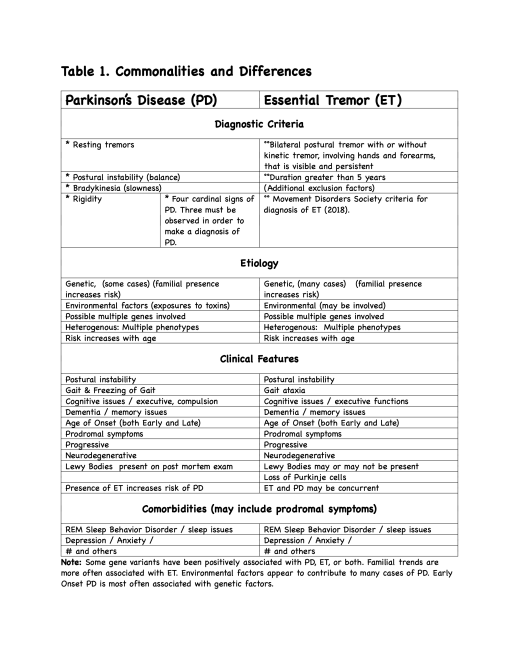
· (ERNH). Multiple common features and symptoms (See Table 1).

Null hypothesis 3:

· PD and/or ET are wholly due to genetic factors.

Conclusion:

· (ERNH). ET and PD cases are heterogenous in etiology. (See Table 1).

Null hypothesis 4:

· PD and/or ET are simply due to natural aging processes.

Conclusion:

· (ERNH). Age increases risk, but is not determining factor (See Table 1).

Null hypothesis 5:

· Interactions with medications, environmental factors, and genetics do not need to be considered when diagnosing or treating ET or PD.

Conclusion:

· (ERNH). Criteria for ET specifically notes certain drug interactions as a factor for exclusion. (Bhatia et al., 2018). (However, MDS criteria do not include genetics (presence in family members) as a criterion for diagnosis of ET.) Recommendation: MDS should consider adding family history and DNA analyses to diagnostic criteria for ET and PD.

Null hypothesis 6:

· History of ET diagnosis is unrelated to progression of PD symptoms following PD diagnosis.

Conclusion:

· (ERNH). ET history in patients with PD is associated with a benign prognosis with slower motor and non-motor symptoms progression.” (Ou, R.,et al., 2020; Cutrona et al., 2025).

Recommendations and implications for practice and research:

The low accuracy of initial diagnosis for PD should be noted when conducting research, reviews and metareviews. Although several initiatives to develop algorithms to predict risks for developing PD have been created, these mathematical models are vulnerable to missing or undocumented data, which reduces the accuracy of these tools.

Further longitudinal investigation to include subjects with

1. Existing diagnosis of ET to identify those who

1.1. Later develop PD (ET + PD),

1.2. Do not later develop PD (ET only), and

1.3. Subjects who do not have a diagnosis of either ET or PD (control group)

2. Investigate subjects with current family histories of

2.1. ET,

2.2. ET+PD, and

2.3. absence of either ET or PD.

3. Continue studies into relationship between tremors and disease progression.

4. Include DNA analysis and broaden genes included in correlation, as has been initiated.

Implications for practice:

Clinician education and patient education are in need of greater effort and attention in order to improve early identification and treatments.

Clinicians and Physicians

· Clinicians need to be conscious of and defend against confirmation bias which could lead to misdiagnosis and missed diagnoses, impacting the patient’s Quality Of Life or mortality, including inviting patients to seek

· Physicians and clinicians need to exercise caution to avoid iatrogenic symptoms, toxic medicine interactions, and other complications.

· Physicians need to put patient needs at the center of their practice.

· Or, in other words, FIRST, DO NO HARM (Consider hanging as a reminder poster in all physicians’ offices)?

• Patients (and caregivers) need to 

  • Seek second opinions before major operations such as DBS,
  • Educate self regarding conditions and treatments,
  • Check for side effects of treatments
  • Take responsibility to ensure all members of the medical care team are advised and kept up to date on treatments

More research into shared and concurrent symptoms of related movement disorders is needed, given the difficulty of diagnosis and concurrence of many prodromal and post onset symptoms

End of this post.

References may be posted later. Maybe not.

Living well with a misdiagnosis: abstract

This is a continuation of the last post, which presented the RESULTS section of this article, as Table 1. This is the Abstract.

Living Well With (a Misdiagnosis of) Parkinson’s Disease

ABSTRACT

GOAL:

To review research related to

· Difficulty of diagnosis among and between movement disorders,

· Factors leading to misdiagnosis,
and

· Quality of Life issues experienced

BACKGROUND:

Single Subject Case Study of a 76 year old male. First reported Essential Tremor (ET) symptoms dating to teenage years. ET became disabling after five decades. ET refractory to treatment by a neurologist. Deep Brain Stimulation (DBS) chosen by subject as a last resort. Prior to DBS implants, a diagnosis of Parkinson’s Disease (PD) was made, due to rigidity observed A DATScan performed seven years after diagnosis reportedly showed abnormal dopamine transport..

Thirteen years after PD diagnosis, subject relocated and was referred to a Movement Disorders Specialist (MDS). On examination, no PD symptoms were observed. MDS began differential diagnosis based on symptoms of tremors, fatigue, and gait abnormality.

At this time, it appears that the subject’s initial presentation and diagnosis of ET (in 2010) was accurate. The later diagnosis of PD was vulnerable to confirmation bias, apparently the neurologist treating for ET had identified gait abnormality as rigidity, and failed to rule out other possible causes for arm swing asymmetry (Navarro-López et al., 2022). Heterogeneity of tremors (Fekete & Li, 2013) apparently was not investigated. Interestingly, in one of the case studies reported by Fekete & Li, a patient had been diagnosed as PD by a different neurologist, and was later determined to have ET without concurrent PD. It is not lost on this author that the references noted are later than the misdiagnosis (in December 2011). “If I knew then what I know now…”

METHODS:

Review of research articles available on PubMed Center relevant to

· Diagnostic criteria,

· Prodromal symptoms,

· Accuracy of diagnoses,

· Differentiating symptoms between ET, ET and PD, and PD.

In addition, discussion includes observable and subjective data regarding subject’s

Quality of life (QOL), including but not limited to:

· Side effects of medications,

· Dosages of medications,

· costs of medications

· Impacts of side effects, dosage, and costs for unnecessary medical interventions on other aspects of individual and social quality of life.

· Factors related to diagnosis and misdiagnosis.

Next: Quality of Life and Factors Affecting Misdiagnosis

###

My Personal Journey with Medical Misdiagnosis

Or, What I did last Summer

We remember, fondly or not, typical school essay topics:

  • What I did last summer
  • How my family celebrates the winter holidays
  • What America means to me
  • My favorite (TV, movie, book, song, musical group)
  • Things my parents tell me not to tell other people
  • The greatest American President

I once wrote an essay about a relative. I actually took the question seriously, instead of offering the usual platitudes. I pondered on a negative experience: the untimely death of a child. This loss could have been prevented with more timely reliance on medical providers. Of course, this happened well before penicillin became widely available for treatment of appendicitis or peritonitis. As a parent, I promptly responded when my child complained of abdominal pain. She was treated for appendicitis and survived.

This past year, my summer was also related to a missed diagnosis. Fortunately, no one died, although I had been treated for the wrong condition for over a dozen years. It has been said that physicians bury their mistakes. Not this time. Instead, the differential diagnosis and removal of medications triggered research into the differentiation between Essential Tremors and Parkinson’s Disease. Another side effect was rewording this blog’s subtitle, replacing PD with Movement Disorder. 

I submitted an abstract to the World Parkinson’s Conference. It will be held in May of 2026. Unfortunately, the abstract didn’t make the cut. Perhaps the abstract failed to include enough information, perhaps it didn’t have a positive enough bias in its presentation. Whatever. The research found misdiagnosis of movement disorders is not uncommon. Therefore I’ve decided to share it through this medium. Some people will find value in it.

Below is a table from the article. In future posts, parts of the article will be shared, including the discussion, conclusions, and references by category.

A Table contrasting common and differentiating features of Essential Tremors and Parkinson's Disease
Table 1. Commonalities and Differences (from an unpublished article on Misdiagnosis and Missed Diagnosis of Parkinson’s Disease and Essential Tremor


Me and My PD – Misdiagnosis and Confirmation Bias

Non-Artificial Intelligence Summary: The author reveals that he was misdiagnosed with Parkinson’s Disease (PD) over 13 years ago, after initially seeking treatment for Essential Tremors (ET). The article concludes with a link to an open access article on Six Myths and Misconceptions about Essential Tremor.

_________________________

Over the summer of 2025, I’ve been undergoing review of my movement disorders, with a reduction in medications as well as no clinical observation of Parkinson’s Disease (PD) symptoms.

Some thirteen or so years ago, after a neurologist or nurse practitioner observed some slight rigidity, providing enough symptoms to make a clinical diagnosis, an old high school girlfriend called to express some concern and to wish me the best. Apparently, she was under the misconception that PD was equivalent to a slow death. Glad to say she must be mighty disappointed after all these years.

I had essential tremors (ET) from my teen years, in addition to several other prodromal conditions or symptoms relating to PD. In 2010 the ET had become somewhat disabling, and after many months of unsuccessful treatment for ET, I opted for Deep Brain Stimulation (DBS), which apparently had a great success rate with ET. However, in order to rule out PD, several months of tests were undergone, with the eventual three of four of the cardinal signs being observed. DBS was scheduled less than two months later. Seven years later, due to a lack of progressive neurological deterioration, a DAT Scan was ordered, with an interpretation that I apparently did have some form of parkinsonism. Apparently, the original diagnosis of PD was premature and made under the influence of confirmation bias. Or, to paraphrase Paul Simon, a person sees what they want to see and disregards the possibility of other underlying causes for a barely detectable symptom.

Finally, after moving to a different state and establishing care with a Movement Disorder Specialist, who conducted their own evaluation on and off PD medications, the original problem (ET) which brought me to a neurologist in 2010, was confirmed. The process of titrating off medications continues.

Naturally, I have been delving into the National Institutes of Health open access in order to learn more about what has been called “familial tremors” and “benign tremors” in the past.

One thing I have learned is the diagnosis of ET and PD can be difficult, due to many overlapping symptoms or conditions, they are linked genetically for some ET cases, and much of the material on PD doesn’t even investigate whether the two conditions are concurrent.

So another reason for me to go on living: educate and advocate for people who may or may not have a diagnosis appropriate to their condition.

We’ll start here, with a recent article on Six Myths and Misconceptions about Essential Tremor.

Exercise is good medicine

As several of my Power for Parkinson’s instructors are fond of repeating “Motion is the Lotion.”

As late as 2018, the society for Movement Disorders (or International Parkinson’s and Movement Disorder Society, to be more exact) had stated that there was insufficient evidence that exercise had any effect on the progression of the disease or its symptoms. (The exact reference can be found in an earlier post in which I included a presentation with references to studies linking the effects of music and dance as the best of the best forms of exercise (it goes without saying, however, that the best exercise is the one that you yourself find and enjoyable and reinforcing, and will therefore actually continue to do).)(Although I just said it, in contradiction to the previous sentence.)(Come to think of it, I should update that presentation with more current citations…)

Which brings us up to 2025, just seven years later, in which a review article concludes that:

These findings provide strong evidence that exercise, even light intensity, benefits general cognition, memory and executive function across all populations, reinforcing exercise as an essential, inclusive recommendation for optimising cognitive health.” (Singh B, Bennett H, Miatke A, et al, Effectiveness of exercise for improving cognition, memory and executive function: a systematic umbrella review and meta-meta-analysis, British Journal of Sports Medicine Published Online First: 06 March 2025. doi: 10.1136/bjsports-2024-108589

Results 133 systematic reviews (2,724 RCTs and 258 279 participants) were included. Exercise significantly improved general cognition (SMD=0.42), memory (SMD=0.26) and executive function (SMD=0.24). Memory and executive function improvements from exercise were greater for children and adolescents than for adults and older adults. Those with attention-deficit/hyperactivity disorder exhibited greater improvement in executive function than other populations. Effects were generally larger for low- and moderate-intensity interventions. Shorter interventions (1–3 months) and exergames (video games that require physical movement) had the largest effects on general cognition and memory. Findings remained statistically significant after excluding reviews rated as low and critically low quality.” (Emphasis added)

For the non-nerds out there, the review has also been been reported as Exercise of Any Kind Boosts Brain Power At Any Age in the Medical Express News by the University of South Australia.

In addition to several quotes from the lead author, Dr. Singh, the article mentioned Senior researcher Professor Carol Maher, who said exercise should be encouraged to boost cognitive health across all ages and fitness levels.

Cognitive decline and neurodegenerative disease are growing global health concerns, according to Professor Maher.

The review, which included over a quarter of a million subjects, presented compelling evidence that exercise should be integrated into health care and education settings to promote cognitive health.

Even small amounts of exercise can improve memory and brain function—especially for those at higher risk—means exercise should be included in clinical and public health guidelines.

You don’t maintain good cognitive health on a diet of hamburgers and diet soda, staying up late and sleeping until noon, one might conjecture. Riding around a golf course on a golf cart doesn’t exactly fit the description of the types of exercise reviewed in this study.

And, as fitting such an occasion, I’ll close out with a self-serving rendition of a “Parkinson’s Parody” of a song written by Christine McVie, originally. performed by Fleetwood Mac, and made even more famous by former President Bill Clinton’s campaign in the late 20th Century:

#Parkinson’s #PowerForParkinson’s #Reviews #Exercise #Cognitive #Memory #ExecutiveFunction #BenefitsOfExercise

###

Me and My PD – 14 Sept 2024

It’s been said that if you’ve met one person with Parkinson’s Disease (PD), then you’ve met one person with PD.

Today I saw a news segment about a guy who plays trombone, and how he had experienced a deterioration in his ability to play in the previous year. He was diagnosed with Essential Tremors (ET), also known as familial tremors or benign tremors. The point of the story was that he had opted for Deep Brain Stimulation (DBS), during which the patient is awake (at least part of the time), and that he played trombone during the operation.

I hope his physician got the diagnosis correct. As noted earlier in this blog, et-pd-is-there-is-or-is-there-aint-a-connection, a research paper was published that established a link between ET and PD: “LINGO1 rs9652490 is associated with essential tremor and Parkinson disease.” Having had essential tremors since my teenage years, I checked my DNA analysis and discovered that I did have that specific variation on the LINGO1 gene. As I’ve often remarked about PD research, this would have been good information to know 50 years ago.

I did remark a couple of times to my Movement Disorders Specialist’s team that I regretted not having asked to play the saxophone or guitar during my own DBS operation. To their credit, they attempted to fine tune my settings, but either due to lack of practice or progression of PD symptoms, I was not able to recover the picking and strumming skills I had back in 1997. And so it goes.

These days, I try to play on my keyboard as often as I can, but any attempt to follow an instructional program, or parse out simple pieces written for instruction (e.g., Bach’s selections from the notebook for Anna Magdalena, Bela Bartok’s pieces for children), soon devolve into loose jams on simple chord progressions, or attempts to recall, remember, and play some of my own simple songs with a minimum of egregious errors.

But I have promises to keep and chores to do before I sleep, so I will just end this with a selection from 1997, when I could play a little bit (self-taught). Unlike many of my songs, this one was not influenced by Bob Dylan.

You’re A Mystery To Me

#Essentialtremors #Parkinsonsdisease #music #DBS #idiopathic

###

Where have all the (native) flowers gone?

Prosser, R.S., Brain, R.A. Where have all the flowers gone? A systematic evaluation of factors driving native terrestrial plant decline in North America. Environ Sci Pollut Res (2024). https://doi.org/10.1007/s11356-024-34349-9 

Prosser and Brain have done the research and  have come up with the following conclusions:

  • Habitat alteration and non-native species are the most important drivers of the decline in native terrestrial plant diversity in North America.
  • No listed species in the U.S. or Canada faced a singular threat. In the recovery plans for all listed species, several threats were identified as contributing to their risk of extirpation or extinction.
  • Pesticides, specifically herbicides, represent a micro-scale contributor to the decline of plant biodiversity in North America relative to other drivers.

(Note: the above three points are taken verbatim from text in the article, although they are not presented as bullets in the subject article. Emphasis using bold and italics has been added).

In their conclusion, they argue that pesticides and herbicides make an easy target for litigation, even though they contribute minimally to the extirpation or extinction of native plants .

On the other hand, Paraquat is an herbicide that not only has been banned in over 50 other nation-states, and has been linked as a probable cause of Parkinson’s Disease in the book Ending Parkinson’s Disease: A Prescription For Action  and in this February 2024 article on the EarthJustice website: This Weed Killer Is Linked to Parkinson’s. Why Isn’t It Banned Yet?

I would suggest that the authors of the article on causes contributing to reduction of native plant species are failing, in their words, to see the forest by focusing on the trees. I am a native plant advocate who also has Parkinson’s Disease. I don’t know whether I have been exposed to Paraquat in the past. Just because pesticides and herbicides are not a major factor in the reduction of native species doesn’t mean I should just ignore the bigger picture of the effect of herbicides like Paraquat on the species Homo sapiens, many of whom, including myself, have displaced other native occupants of this territory, like the Apaches, the Tonkawas, and other tribal groups who are members of the same Genus and species.

This post has covered most of my main interests: scientific research, Parkinson’s Disease, and native plants. All that’s missing is some music:

The Parkinson’s Anthem (We Ain’t Givin’ Up Hope)

#nativeplants  #research #parkinsonsdisease #advocacy

Resistance is futile…

Most folks will recall that line from various Star Trek encounters  with the Borg, as well as the following line “You will be assimilated.” Or was it the preceding line? Doesn’t matter, because the purpose of this post is to “announce” that my other WordPress blog, “Return To The Natives / Native Plants Are The Answer,” has been assimilated into “Bob’s Brain: Living Well With PD and Other Comorbidities.”

With the assimilation comes a couple of new categories in the menu: Native Plants, and Wildflowers. Here’s an example of what one might find under either of those categories.

2016-03-06-Rock-Pink-640pxlw

Rock Pink (Phemeranthus calycinus). The blooms are ephemeral, lasting only one day, although a single plant may have more than one bloom. They grow in limestone soils, in locations where waters flow after rains (in this part of the world). This was captured digitally following recent rains in early May, 2016. Their bloom period is from April through September, which is the latest month in the year that I’ve been able to photograph them.

Now I’ve assimilated the two, there’s only one blog to intermittently post articles about things that interest me. Reduces my guilt in half. Next step is to post the news on RTTN / NPATA with a link to Bob’s Brain, and then deleting the old blog. I’m a cyborg, having had DBS, so it should work out as well as the coders have allowed for such a smooth transition.

We’ll see what happens.

Live long and prosper.

###

Music, music music (and exercise)

Dial the wayback machine to 2021, where this digital commons paper from Sacred Heart University on Influence and Effect of Music on Exercise  By Kendall Stewart appeared.

… Lack of adherence to exercise and physical activity, and related programs, is correlated with absence of motivation and enjoyment. Research has proven the presence of music, during physical activity, to be a strong motivator and linked to increased enjoyment, thus increasing exercise adherence. The purpose of this essay is to compile research in order to analyze and explain how the presence of music during physical activity increases mood and affective state of mind to bring about increased adherence and motivation as well as describe how individuals feel as though they are doing less work/exercising less when listening to music while being physically active. In addition, … examine the effect that different music genres, speeds, paces, and preferences have on exercise performance, enjoyment and adherence. (emphasis added).

Among the citations are:

de Dreu MJ, van der Wilk ASD, Poppe E, Kwakkel G, van Wegen EEH. Rehabilitation,
exercise therapy and music in patients with Parkinson’s disease: A meta-analysis of the
effects of music-based movement therapy on walking ability, balance and quality of life.
Parkinsonism & Related Disorders. 2012;18(Suppl 1):S114-S119. doi:10.1016/S1353-
8020(11)70036-0

which also refers to:

Goodwin VA, Richards SH, Taylor RS, Taylor AH, Campbell JL. The effectiveness of exercise interventions for people with Parkinson’s disease: a systematic review and meta-analysis. Mov Disord. 2008 Apr 15;23(5):631-40. doi: 10.1002/mds.21922. PMID: 18181210.

Evidence supported exercise as being beneficial with regards to physical functioning, health-related quality of life, strength, balance and gait speed for people with PD. There was insufficient evidence support or refute the value of exercise in reducing falls or depression.

On the topic of music and PD, we have:

Poliakoff, E., Bek, J., Phillips, M., Young, W. R., & Rose, D. C. (2023). Vividness and Use of Imagery Related to Music and Movement in People with Parkinson’s: A Mixed-methods Survey Study. Music & Science, 6. https://doi.org/10.1177/20592043231197919

excerpts from the abstract (as always, emphasis added):

… Music is used in interventions for people with Parkinson’s, either to pace movements, or as an integral element of activities such as dance. This study explored self-reported vividness of two forms of imagery – motor imagery evoked by music and auditory (including musical) imagery – in people with Parkinson’s, and whether and how they use these types of imagery in everyday life.

Participants (N = 199) completed:

(i) vividness ratings of visual and kinesthetic music-evoked motor imagery,

(ii) vividness ratings of auditory imagery, and

(iii) ratings and open questions about their everyday use of these types of imagery.

…  <20% reported actively using music to support motor imagery in daily activities. In contrast, participants reported a broad range of contexts and uses for musical imagery (imagined music), from supporting movement (e.g., walking or exercise) to emotion regulation, and concentration.

Correlational analyses associated vividness of music- evoked motor imagery with an urge to dance and musical training, while the use of musical imagery was associated with singing ability.

A minority of participants reported not experiencing either motor or musical imagery, suggesting that interventions based on imagery may not be suitable for all.

even participants with more severe motor symptoms reported experiencing and using both types of imagery, indicating promise for their strategic use at different stages of Parkinson’s. … musical and motor imagery have the potential to support rehabilitation strategies for Parkinson’s, either separately or in combination.

Not the “hardest” scientific evidence there is, but hey, Einstein (a guy who only has to be referred to by his surname, and we all know who were talking about) reported that he did his though experiments using visual imagery, and only later (and with much labor) worked out the math. (I believe the reference can be found in a book “The Act of Creation” by Arthur Koestler, if memory serves. As Einstein reportedly said, you can always look it up).

How to end this post on music and Parkinson’s Disease? Rather than submit one of my own YouTube videos, how about one from another person whose first name alone is sufficient to identify him:

Elvis

An early Spring, this year

This February has seen no scenes like the one above (Feb. 15, 2021) where we saw over 6 inches of snow and sub freezing temperatures for about two weeks. Thousands of people lost power, and I don’t want to look up how many died from the pre-20th Century conditions to which they were not conditioned or prepared to deal with.

However, thanks to Global Warming, this Winter has been warm, for the most part. So we’ve seen some early blooms, one of which always persists, is the Ten-Petal Anemone. This bloom is white, but the species can vary from white through pinkish to violet. (An artist might differ with my choice of descriptive colors).

And here’s an unopened Anemone berlandieri from the violet end of the spectrum.

What are these doing in the Bob’s Brain: Living well with PD and other co-morbidities blog?

  • Bob’s brain mistakenly failed to switch to the Back to the natives: Native plants are the answer before beginning the draft, or
  • Bob’s brain has other interests in his life other than an incurable, progressive,  degenerative neurological disease,
  • or both of the above… whatever answer you choose, you won’t go wrong.

Oh well, might as well end with a song:

https://youtu.be/sxoTWy0bTXo?si=NmKkd0bLzysH8ZSO

###