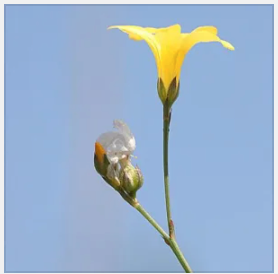
Nothoscordum bivalve – Crow Poison

LILI Nothoscordum bivalve - Crow-Poison

LILI Nothoscordum bivalve – Crow-Poison

The authorities have not yet reached a consensus whether this plant is toxic, either to humans or to crows, so they advise that you just don’t put this in your mouth. Or feed it to crows, I suppose.

Crow Poison can bloom early in the Spring, but as this shows, they can also bloom throughout the summer and well into fall. It is similar in size and shape to Allium Drummondii, Wild Garlic. Sight and Smell are the two senses that help to differentiate the two – Wild Garlic has a purple tint to its white flowers, and it smells like onion.


Here you can see the umbel of Crow Poison, with a couple of buds in the process still of opening. Elsewhere you can see an excellent photo by Joseph Marcus with the Lady Bird Johnson Wildflower Center in Austin, Tx (http://www.wildflower.org/gallery/result.php?id_image=13203 ). September 22, 2014 –  Note: the linked photo used to be here. It has been removed in order to avoid infringing on Mr. Marcus’ copyright as well as to abide by the NPIN terms of use.

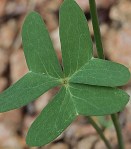
Oxalis drummondi – Drummond’s Woodsorrel

Here we are again with two phtos of Oxalis drummondi, Drummond’s Woodsorrel. This time there is a deliberate intent to get a shot of the woodsorrel’s distinctive leaves, as well as a shot of the blossom with its pinkish to purple color accented by striations of green leading down into the cup of the trumpet shaped flower. There is quite the little colony of these dainty little beauties along the side of the gravel path, almost to the point of aggressiveness…but not quite.

Gaillardia aestivalis var aestivalis – Prairie Gaillardia

Gaillardia aestivalis var aestivalis - Prairie Gaillardia

Gaillardia aestivalis var aestivalis – Prairie Gaillardia


Although this Gaillardia is indeed a native to Texas, and was photographed next to Gaillardia pulchella, the familiar Indian Blanket or Firewheel, this particular specimen is located at the Cape Canaveral National Seashore. It is found mainly in the coastal states, in dry, sandy soils. So I would guess in Texas it would be familiar along the Gulf Coast, while this Florida native was next to the Atlantic Ocean.