Exercise is good medicine

As several of my Power for Parkinson’s instructors are fond of repeating “Motion is the Lotion.”

As late as 2018, the society for Movement Disorders (or International Parkinson’s and Movement Disorder Society, to be more exact) had stated that there was insufficient evidence that exercise had any effect on the progression of the disease or its symptoms. (The exact reference can be found in an earlier post in which I included a presentation with references to studies linking the effects of music and dance as the best of the best forms of exercise (it goes without saying, however, that the best exercise is the one that you yourself find and enjoyable and reinforcing, and will therefore actually continue to do).)(Although I just said it, in contradiction to the previous sentence.)(Come to think of it, I should update that presentation with more current citations…)

Which brings us up to 2025, just seven years later, in which a review article concludes that:

These findings provide strong evidence that exercise, even light intensity, benefits general cognition, memory and executive function across all populations, reinforcing exercise as an essential, inclusive recommendation for optimising cognitive health.” (Singh B, Bennett H, Miatke A, et al, Effectiveness of exercise for improving cognition, memory and executive function: a systematic umbrella review and meta-meta-analysis, British Journal of Sports Medicine Published Online First: 06 March 2025. doi: 10.1136/bjsports-2024-108589

Results 133 systematic reviews (2,724 RCTs and 258 279 participants) were included. Exercise significantly improved general cognition (SMD=0.42), memory (SMD=0.26) and executive function (SMD=0.24). Memory and executive function improvements from exercise were greater for children and adolescents than for adults and older adults. Those with attention-deficit/hyperactivity disorder exhibited greater improvement in executive function than other populations. Effects were generally larger for low- and moderate-intensity interventions. Shorter interventions (1–3 months) and exergames (video games that require physical movement) had the largest effects on general cognition and memory. Findings remained statistically significant after excluding reviews rated as low and critically low quality.” (Emphasis added)

For the non-nerds out there, the review has also been been reported as Exercise of Any Kind Boosts Brain Power At Any Age in the Medical Express News by the University of South Australia.

In addition to several quotes from the lead author, Dr. Singh, the article mentioned Senior researcher Professor Carol Maher, who said exercise should be encouraged to boost cognitive health across all ages and fitness levels.

Cognitive decline and neurodegenerative disease are growing global health concerns, according to Professor Maher.

The review, which included over a quarter of a million subjects, presented compelling evidence that exercise should be integrated into health care and education settings to promote cognitive health.

Even small amounts of exercise can improve memory and brain function—especially for those at higher risk—means exercise should be included in clinical and public health guidelines.

You don’t maintain good cognitive health on a diet of hamburgers and diet soda, staying up late and sleeping until noon, one might conjecture. Riding around a golf course on a golf cart doesn’t exactly fit the description of the types of exercise reviewed in this study.

And, as fitting such an occasion, I’ll close out with a self-serving rendition of a “Parkinson’s Parody” of a song written by Christine McVie, originally. performed by Fleetwood Mac, and made even more famous by former President Bill Clinton’s campaign in the late 20th Century:

#Parkinson’s #PowerForParkinson’s #Reviews #Exercise #Cognitive #Memory #ExecutiveFunction #BenefitsOfExercise

###

The Healing Power of Nature on Human Health

Much has been written on the positive impact that exposure to nature has on general well-being, physical, and mental health. And yet, it seems that developers have not gotten the message. Why, I do not know. Maybe they are not aware of the research on the health benefits of nature. If not, here is some material to share.

A website post and two reviews, from most recent to next (within past five years):

Benefits of Nature Experience from Canada, posted in April 2024, lists the following benefits:

  • Attention: Our attention is a limited resource and it can become ‘fatigued’ throughout the day. Nature has been shown to restore attention and our ability to concentrate (Mason et al., 2022). Nature has also been found to reduce symptoms of Attention-Deficit/Hyperactivity Disorder (ADHD) (Faber Taylor & Kuo, 2009).
  • Mood: Nature improves mood and makes people feel happier (Neill et al., 2019). There is evidence that nature exposure can improve symptoms of depression (Berman et al, 2012).
  • Self-regulation: Nature helps us feel calmer and less irritable. This means that we are better able to control our impulses (Beute & de Kort, 2014; Weeland et al., 2019).
  • Stress: Nature reduces symptoms of anxiety, physical stress, and heart rate. It also helps us feel more relaxed (Shuda et al., 2020).
  • Social: Nature tends to increase generosity, cooperation, and our sense of social connection (Arbuthnott, 2023; Weinstein et al., 2009).

Impact of Nature on Human Health. An open access article, published in 2022:

this review has documented the increasing body of evidence in support of [nature-based-interventions] NBIs as effective tools to improve mental, physical, and cognitive health outcomes, and highlighted key factors that improve engagement with the natural world. [bracketed explanation of acronym inserted from elsewhere in the article]. Emphasis added.

And, finally, from 2021, another open access review, Association between Nature Exposure and Health, concluded that:

 We assessed the strength of evidence from experimental and observational studies and found evidence for associations between exposure to nature and improved cognitive function, brain activity, blood pressure, mental health, physical activity, and sleep. Evidence from experimental studies suggested protective effects of exposure to natural environments on mental health outcomes and cognitive function. Cross-sectional observational studies provide evidence of positive associations between exposure to nature, higher levels of physical activity and lower levels of cardiovascular disease. Longitudinal observational studies are starting to assess the long-term effects of exposure to nature on depression, anxiety, cognitive function, and chronic disease. Limitations and gaps in studies of nature exposure and health include inconsistent measures of exposure to nature, knowledge of the impacts of the type and quality of green space, and the health effects of the duration and frequency of exposure among different populations (e.g., adults, children, historically marginalized).

Reminds me of John Sebastian’s tune,  Daydream.  And also that I should take a walk outside about now…

2024-10-20-Monarch-IMG_9401

###

Where have all the (native) flowers gone?

Prosser, R.S., Brain, R.A. Where have all the flowers gone? A systematic evaluation of factors driving native terrestrial plant decline in North America. Environ Sci Pollut Res (2024). https://doi.org/10.1007/s11356-024-34349-9 

Prosser and Brain have done the research and  have come up with the following conclusions:

  • Habitat alteration and non-native species are the most important drivers of the decline in native terrestrial plant diversity in North America.
  • No listed species in the U.S. or Canada faced a singular threat. In the recovery plans for all listed species, several threats were identified as contributing to their risk of extirpation or extinction.
  • Pesticides, specifically herbicides, represent a micro-scale contributor to the decline of plant biodiversity in North America relative to other drivers.

(Note: the above three points are taken verbatim from text in the article, although they are not presented as bullets in the subject article. Emphasis using bold and italics has been added).

In their conclusion, they argue that pesticides and herbicides make an easy target for litigation, even though they contribute minimally to the extirpation or extinction of native plants .

On the other hand, Paraquat is an herbicide that not only has been banned in over 50 other nation-states, and has been linked as a probable cause of Parkinson’s Disease in the book Ending Parkinson’s Disease: A Prescription For Action  and in this February 2024 article on the EarthJustice website: This Weed Killer Is Linked to Parkinson’s. Why Isn’t It Banned Yet?

I would suggest that the authors of the article on causes contributing to reduction of native plant species are failing, in their words, to see the forest by focusing on the trees. I am a native plant advocate who also has Parkinson’s Disease. I don’t know whether I have been exposed to Paraquat in the past. Just because pesticides and herbicides are not a major factor in the reduction of native species doesn’t mean I should just ignore the bigger picture of the effect of herbicides like Paraquat on the species Homo sapiens, many of whom, including myself, have displaced other native occupants of this territory, like the Apaches, the Tonkawas, and other tribal groups who are members of the same Genus and species.

This post has covered most of my main interests: scientific research, Parkinson’s Disease, and native plants. All that’s missing is some music:

The Parkinson’s Anthem (We Ain’t Givin’ Up Hope)

#nativeplants  #research #parkinsonsdisease #advocacy

Music, music music (and exercise)

Dial the wayback machine to 2021, where this digital commons paper from Sacred Heart University on Influence and Effect of Music on Exercise  By Kendall Stewart appeared.

… Lack of adherence to exercise and physical activity, and related programs, is correlated with absence of motivation and enjoyment. Research has proven the presence of music, during physical activity, to be a strong motivator and linked to increased enjoyment, thus increasing exercise adherence. The purpose of this essay is to compile research in order to analyze and explain how the presence of music during physical activity increases mood and affective state of mind to bring about increased adherence and motivation as well as describe how individuals feel as though they are doing less work/exercising less when listening to music while being physically active. In addition, … examine the effect that different music genres, speeds, paces, and preferences have on exercise performance, enjoyment and adherence. (emphasis added).

Among the citations are:

de Dreu MJ, van der Wilk ASD, Poppe E, Kwakkel G, van Wegen EEH. Rehabilitation,
exercise therapy and music in patients with Parkinson’s disease: A meta-analysis of the
effects of music-based movement therapy on walking ability, balance and quality of life.
Parkinsonism & Related Disorders. 2012;18(Suppl 1):S114-S119. doi:10.1016/S1353-
8020(11)70036-0

which also refers to:

Goodwin VA, Richards SH, Taylor RS, Taylor AH, Campbell JL. The effectiveness of exercise interventions for people with Parkinson’s disease: a systematic review and meta-analysis. Mov Disord. 2008 Apr 15;23(5):631-40. doi: 10.1002/mds.21922. PMID: 18181210.

Evidence supported exercise as being beneficial with regards to physical functioning, health-related quality of life, strength, balance and gait speed for people with PD. There was insufficient evidence support or refute the value of exercise in reducing falls or depression.

On the topic of music and PD, we have:

Poliakoff, E., Bek, J., Phillips, M., Young, W. R., & Rose, D. C. (2023). Vividness and Use of Imagery Related to Music and Movement in People with Parkinson’s: A Mixed-methods Survey Study. Music & Science, 6. https://doi.org/10.1177/20592043231197919

excerpts from the abstract (as always, emphasis added):

… Music is used in interventions for people with Parkinson’s, either to pace movements, or as an integral element of activities such as dance. This study explored self-reported vividness of two forms of imagery – motor imagery evoked by music and auditory (including musical) imagery – in people with Parkinson’s, and whether and how they use these types of imagery in everyday life.

Participants (N = 199) completed:

(i) vividness ratings of visual and kinesthetic music-evoked motor imagery,

(ii) vividness ratings of auditory imagery, and

(iii) ratings and open questions about their everyday use of these types of imagery.

…  <20% reported actively using music to support motor imagery in daily activities. In contrast, participants reported a broad range of contexts and uses for musical imagery (imagined music), from supporting movement (e.g., walking or exercise) to emotion regulation, and concentration.

Correlational analyses associated vividness of music- evoked motor imagery with an urge to dance and musical training, while the use of musical imagery was associated with singing ability.

A minority of participants reported not experiencing either motor or musical imagery, suggesting that interventions based on imagery may not be suitable for all.

even participants with more severe motor symptoms reported experiencing and using both types of imagery, indicating promise for their strategic use at different stages of Parkinson’s. … musical and motor imagery have the potential to support rehabilitation strategies for Parkinson’s, either separately or in combination.

Not the “hardest” scientific evidence there is, but hey, Einstein (a guy who only has to be referred to by his surname, and we all know who were talking about) reported that he did his though experiments using visual imagery, and only later (and with much labor) worked out the math. (I believe the reference can be found in a book “The Act of Creation” by Arthur Koestler, if memory serves. As Einstein reportedly said, you can always look it up).

How to end this post on music and Parkinson’s Disease? Rather than submit one of my own YouTube videos, how about one from another person whose first name alone is sufficient to identify him:

Elvis

Do you wanna dance?

Costa V, Suassuna AOB, Brito TSS, da Rocha TF, Gianlorenco AC. Physical exercise for treating non-motor symptoms assessed by general Parkinson’s disease scales: systematic review and meta-analysis of clinical trials. BMJ Neurol Open. 2023 Oct 4;5(2):e000469. doi: 10.1136/bmjno-2023-000469. PMID: 37808516; PMCID: PMC10551973.

This study was a systematic review and meta-analysis.  Like many such desk reviews and meta-analyses, it winds up, in layperson’s terminology, comparing apples and oranges and pears and papayas and tangerines and dragon fruit and kiwis to each other. Treatments included “multimodal, aerobic, resistance, dance, conventional physical therapy and other types.” Five studies apparently were vulnerable to bias (in favor of the treatment being studied, one would suppose). They did conclude that, after sifting the studies down to eight, that aerobic exercise had a stronger effect than conventional exercise on non-motor symptoms. This is in conformance with other reviews that I have read (or read the abstracts of) in the past.

And then we have this study, which might have been kicked out due to possibility of bias, or maybe it wasn’t published early enough to be included.

Physical activity based on dance movements as complementary therapy for Parkinson’s disease: Effects on movement, executive functions, depressive symptoms, and quality of life
Duarte JdS, Alcantara WA, Brito JS, Barbosa LCS, Machado IPR, et al. (2023) Physical activity based on dance movements as complementary therapy for Parkinson’s disease: Effects on movement, executive functions, depressive symptoms, and quality of life. PLOS ONE 18(2): e0281204. https://doi.org/10.1371/journal.pone.0281204

Methods used were described as follows:

13 individuals with PD (Hoehn & Yahr I-III, MDS-UPDRS 67.62 ± 20.83), underwent physical activity based on dance movements (2x week for 6 months). Participants were assessed at baseline and after 6 months on movement (POMA, TUG and MDS-UPDRS Part III), executive function (FAB), depressive symptoms (MADRS), quality of life (PDQ-39), and severity of PD (MDS-UPDRS TOTAL).

The results were:

significant improvement in the movement (balance and gait) by the POMA test, p = 0.0207, executive function by the FAB test, p = 0.0074, abstract reasoning and inhibitory control by the FAB, Conceptualization test, p = 0.0062, and Inhibitory Control, p = 0.0064, depressive symptoms assessed by the MADRS test significantly reduced, p = 0.0214, and the quality of life by the PDQ-39 had a significant increase after the intervention, p = 0.0006, showed significant improvements between the pre-and post-intervention periods of physical activity based on dance movements.

The conclusions were obvious:

Physical activity based on dance movements contributed to significant improvements in movement (balance and gait), executive functions, especially in cognitive flexibility and inhibitory control, and the quality of life too. Sensorimotor integration, most cognitive processing and social skills may have contributed to the results.

Personally, I have to wonder whether inhibitory control and executive functions apply to my individual results, based on feedback from others, but it could be that I just need to keep on dancing more and worry less about what other folks think.

For nerds like myself, clicking on the following link will get you a list of similar articles published within the past five years (2019 – 2024)  available with free full text.

So, to reiterate the title of this post:

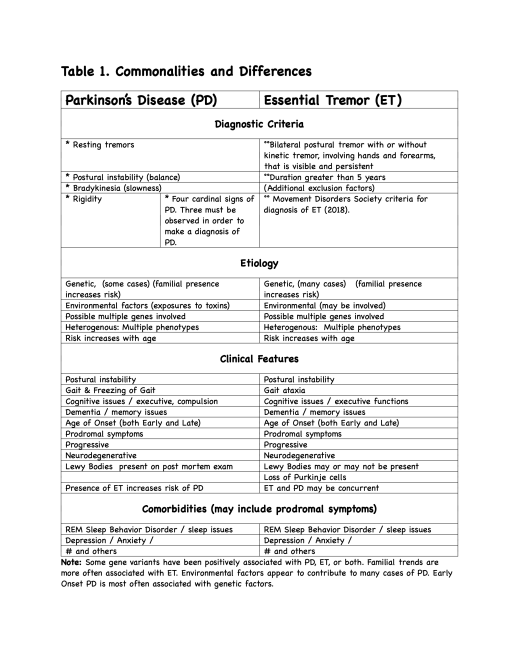
ET & PD – is there is or is there ain’t a connection?

As a person who has had essential tremors ever since his teenage years, and a person who was diagnosed with Parkinson’s disease at the average onset age of 62 years, it was with great interest that the author reviewed the abstracts and full text open access PubMedCenter articles available on the topic.

The author can recall others (medical professionals included) who did not observe tremors, although this subject could feel the tremors within, during teenage years. During undergraduate studies, he once was told that his initial impression on a fellow college student looking to sublet a room was that of a “speed freak” (methamphetamine abuser to those unfamiliar with the term). At age 28, his future wife remarked on his trembling hands as he reached out to touch her cheek in a moment of intimacy. And at age 60, following several recurring episodes of depression and increasing tremors, he was treated for essential tremors for almost two years, beginning in 2010. Then, after having opted for Deep Brain Stimulation (DBS), and undergoing further testing for several months, a third symptom, rigidity, one of the four cardinal symptoms of PD, was observed, allowing the Movement Disorder Specialist to finally make a diagnosis of PD. Mind you, the four cardinal symptoms required to make the call haven’t changed since 1817, when James Parkinson published his Essay On The Shaking Palsy. In case you don’t  already know, they are Tremors, Postural Instability, Bradykinesia, and Rigidity.

On the other hand, it was only in 2009 that the study “LINGO1 rs9652490 is associated with essential tremor and Parkinson disease” came out online and published in print a few months later in 2010.  In which year, the observant reader will notice, was when this author began receiving treatments for essential tremors, finally diagnosed in late 2011 as Parkinson’s.

After a few articles reported similar results, a few negative results were reported, in part by one group of desk jockeys who conducted a meta-review and concluded that there was NO association between ET and PD.  On looking just briefly at the abstracts, one can see that those that found a positive connection and those that found no connection were looking at different populations. The positive association came from a European background, and those with no association came from a Chinese population sample.  Mix them all together and you get mixed results, which doesn’t mean that a person with a half European background (like myself) with this specific variation doesn’t have an increased risk of developing ET (P = 0.014) and Parkinson’s(P = 0.0003), as reported in the article noted above.

So who should I believe? A study that involved a sample in which the participants were similar in ethnic/DNA background to mine? Or a meta-review which concludes that the null hypothesis is true? Or my own brain and body, which began exhibiting strong tremors back in late teens to early twenties? And which became so severe by age 60  that I couldn’t carry a cup of coffee from the kitchen to the living room without going into extreme oscillations?

Those were rhetorical questions, by the way.

References:

Jiménez-Jiménez FJ, García-Martín E, Lorenzo-Betancor O, Pastor P, Alonso-Navarro H, Agúndez JA. LINGO1 and risk for essential tremor: results of a meta-analysis of rs9652490 and rs11856808. J Neurol Sci. 2012 Jun 15;317(1-2):52-7. doi: 10.1016/j.jns.2012.02.030. Epub 2012 Mar 17. PMID: 22425540.

Agúndez JA, Lorenzo-Betancor O, Pastor P, García-Martín E, Luengo A, Alonso-Navarro H, Jiménez-Jiménez FJ. LINGO1 rs9652490 and rs11856808 are not associated with the risk of Parkinson’s disease: results of a meta-analysis. Parkinsonism Relat Disord. 2012 Jun;18(5):657-9. doi: 10.1016/j.parkreldis.2011.09.005. Epub 2011 Sep 28. PMID: 21955595.

Lorenzo-Betancor O, Samaranch L, García-Martín E, Cervantes S, Agúndez JA, Jiménez-Jiménez FJ, Alonso-Navarro H, Luengo A, Coria F, Lorenzo E, Irigoyen J, Pastor P; Iberian Parkinson’s Disease Genetics Study Group Researchers. LINGO1 gene analysis in Parkinson’s disease phenotypes. Mov Disord. 2011 Mar;26(4):722-7. doi: 10.1002/mds.23452. Epub 2011 Jan 4. PMID: 21506150.

Wu YW, Rong TY, Li HH, Xiao Q, Fei QZ, Tan EK, Ding JQ, Chen SD. Analysis of Lingo1 variant in sporadic and familial essential tremor among Asians. Acta Neurol Scand. 2011 Oct;124(4):264-8. doi: 10.1111/j.1600-0404.2010.01466.x. Epub 2010 Dec 15. PMID: 21158743.

Zuo X, Jiang H, Guo JF, Yu RH, Sun QY, Hu L, Wang L, Yao LY, Shen L, Pan Q, Yan XX, Xia K, Tang BS. Screening for two SNPs of LINGO1 gene in patients with essential tremor or sporadic Parkinson’s disease in Chinese population. Neurosci Lett. 2010 Sep 6;481(2):69-72. doi: 10.1016/j.neulet.2010.06.041. Epub 2010 Jun 19. PMID: 20600614.

Clark LN, Park N, Kisselev S, Rios E, Lee JH, Louis ED. Replication of the LINGO1 gene association with essential tremor in a North American population. Eur J Hum Genet. 2010 Jul;18(7):838-43. doi: 10.1038/ejhg.2010.27. Epub 2010 Apr 7. PMID: 20372186; PMCID: PMC2987362.

Nica AC, Montgomery SB, Dimas AS, Stranger BE, Beazley C, Barroso I, Dermitzakis ET. Candidate causal regulatory effects by integration of expression QTLs with complex trait genetic associations. PLoS Genet. 2010 Apr 1;6(4):e1000895. doi: 10.1371/journal.pgen.1000895. PMID: 20369022; PMCID: PMC2848550.

Vilariño-Güell C, Wider C, Ross OA, Jasinska-Myga B, Kachergus J, Cobb SA, Soto-Ortolaza AI, Behrouz B, Heckman MG, Diehl NN, Testa CM, Wszolek ZK, Uitti RJ, Jankovic J, Louis ED, Clark LN, Rajput A, Farrer MJ. LINGO1 and LINGO2 variants are associated with essential tremor and Parkinson disease. Neurogenetics. 2010 Oct;11(4):401-8. doi: 10.1007/s10048-010-0241-x. Epub 2010 Apr 6. PMID: 20369371; PMCID: PMC3930084.

Wu Y, Wang X, Xu W, Liu W, Fang F, Ding J, Song Y, Chen S. Genetic variation in LINGO-1 (rs9652490) and risk of Parkinson’s disease: twelve studies and a meta-analysis. Neurosci Lett. 2012 Jul 26;522(1):67-72. doi: 10.1016/j.neulet.2012.06.018. Epub 2012 Jun 15. PMID: 22710005.

Jasinska-Myga B, Wider C. Genetics of essential tremor. Parkinsonism Relat Disord. 2012 Jan;18 Suppl 1:S138-9. doi: 10.1016/S1353-8020(11)70043-8. PMID: 22166413.

Bourassa CV, Rivière JB, Dion PA, Bernard G, Diab S, Panisset M, Chouinard S, Dupré N, Fournier H, Raelson J, Belouchi M, Rouleau GA. LINGO1 variants in the French-Canadian population. PLoS One. 2011 Jan 11;6(1):e16254. doi: 10.1371/journal.pone.0016254. PMID: 21264305; PMCID: PMC3019170.

Guo Y, Jankovic J, Song Z, Yang H, Zheng W, Le W, Tang X, Deng X, Yang Y, Deng S, Luo Z, Deng H. LINGO1 rs9652490 variant in Parkinson disease patients. Neurosci Lett. 2011 Jan 7;487(2):174-6. doi: 10.1016/j.neulet.2010.10.016. Epub 2010 Oct 15. PMID: 20951767.

Thier S, Lorenz D, Nothnagel M, Stevanin G, Dürr A, Nebel A, Schreiber S, Kuhlenbäumer G, Deuschl G, Klebe S. LINGO1 polymorphisms are associated with essential tremor in Europeans. Mov Disord. 2010 Apr 30;25(6):717-23. doi: 10.1002/mds.22887. PMID: 20310002.

Vilariño-Güell C, Ross OA, Wider C, Jasinska-Myga B, Cobb SA, Soto-Ortolaza AI, Kachergus JM, Keeling BH, Dachsel JC, Melrose HL, Behrouz B, Wszolek ZK, Uitti RJ, Aasly JO, Rajput A, Farrer MJ. LINGO1 rs9652490 is associated with essential tremor and Parkinson disease. Parkinsonism Relat Disord. 2010 Feb;16(2):109-11. doi: 10.1016/j.parkreldis.2009.08.006. Epub 2009 Aug 31. PMID: 19720553; PMCID: PMC2844122.

Deng H, Gu S, Jankovic J. LINGO1 variants in essential tremor and Parkinson’s disease. Acta Neurol Scand. 2012 Jan;125(1):1-7. doi: 10.1111/j.1600-0404.2011.01516.x. Epub 2011 Apr 7. PMID: 21470193.

Zimprich A. Genetics of Parkinson’s disease and essential tremor. Curr Opin Neurol. 2011 Aug;24(4):318-23. doi: 10.1097/WCO.0b013e3283484b87. PMID: 21734494.

Music, movement, and PD

Jerry Coker, who was one of my instructors my first year in undergraduate college, and then again my last semester before graduation , had an hypothesis that for improvisation to be enjoyable, it had to be approximately 75% predictable and 25% unpredictable. Vary too far from those parameters, and you end up with something that is either too boring and predictable, or something that leaves the listener wondering what’s going on, trying to guess where the melody is.

I never advanced far enough to get his insights on swing, or the concept of where the beat is. Duke Ellington, whom I saw at a festival once, did have a short primer on swing. He began with the person who snaps his fingers or taps his feet on the downbeats (ONE-and-TWO-and….). Then he progressed to the folks who tapped their feet or snapped their fingers on the upbeat (1-AND-two-AND..). I forget where it went from there (maybe to Latin rhythm patterns), although I do remember him saying that when he greeted people, he always gave two kisses to the right, and two to the left, one for each cheek.

Love You Madly (ending)

Today’s readings all relate to music and movement –

From  Saluja A, Goyal V, Dhamija RK. Multi-Modal Rehabilitation Therapy in Parkinson’s Disease and Related Disorders. Ann Indian Acad Neurol. 2023 Jan;26(Suppl 1):S15-S25. doi: 10.4103/aian.aian_164_22. Epub 2022 Nov 21. PMID: 37092020; PMCID: PMC10114534. 

(emphasis added to the section quoted below):

Dance, Music, and Singing Therapy in Pd Rehabilitation

Dancing may improve speed of movement, balance, wellbeing, and QOL in patients with PD.[74,75] Multiple dancing interventions and their impact on symptomatology of PD patients have been assessed. In a systematic review of 38 articles that studied the role of various dancing interventions (tango, waltz/foxtrot, Sardinian folk dancing, Irish set dancing, Brazilian samba, Zumba, mixed dance forms, and home-based dance interventions), there was a moderate-to-large beneficial effect of dancing interventions in mild-to-moderate PD. Dancing sessions (once/week to daily for 30 minutes to 2 hours) significantly improved balance, total UPDRS, mobility, endurance, gait freezing, and depression among PD patients.[76]

Music and rhythmic auditory stimulation can improve gait parameters in PD.[77] BEATWALK is a smartphone-based application that initially assesses cadence in PD patients and then progressively increases musical tempo in order to reach the desired speed. A recent study found that BEATWALK significantly improved gait velocity (P < 0.01), cadence (P: 0.01), stride length (P: 0.04), and distance (P: 0.01) among 39 PD patients who could walk unaided and had no gait freezing.[78] The ParkinSong trial studied the effect of singing intervention (at weekly and monthly intervals) in PD and found significant improvements in vocal intensity (P = 0.018), maximum expiratory pressure (P = 0.032), and voice-related QOL (P = 0.043) among PD patients when compared to controls.[79] A recent systematic review and meta-analysis including 67 publications found that tango resulted in significantly improved UPDRS-III scores (Z = 2.87, P = 0.004) and TUG scores (Z = 11.25, P < 0.00001), whereas PD-specific dance resulted in improvement in PDQ-39 scores (Z = 3.77, P = 0.0002) when compared to usual care.[80]

Cox L, Youmans-Jones J. Dance Is a Healing Art. Curr Treat Options Allergy. 2023 Apr 10:1-12. doi: 10.1007/s40521-023-00332-x. Epub ahead of print. PMID: 37361639; PMCID: PMC10088655.

This article is considered an Opinion Statement rather than a “research study,”although they used the same armchair/desk jockey methods used by many reviews and meta-reviews. From the abstract (emphasis added):

The purpose of this review is to evaluate the health benefits of dance and dance therapy in various health domains. Dance interventions included movement therapy with certified therapists, common dances such as ballroom dancing, salsa, and cha-cha as well as ethnic dances, such as the Chinese Guozhuang Dance and the Native American jingle dance. The health domains included depression, cognitive function, neuromotor function, dementia, balance, neurological growth factors, and subjective well-being. The National Library of Medicine, Congress of Library, and the Internet were searched using the terms: dance, dance movement therapy, health, cognitive function, healing, neurological function, neuromotor function, and affective disorders from 1831 to January 2, 2023. Two-thousand five hundred and ninety-one articles were identified. Articles were selected if they provided information on the health benefits of dance in one or more of the above domains as compared to a “non-dance” control population. Studies included systematic reviews, randomized controlled studies, and long-term perspective studies. Most of the subjects in the studies were considered “elderly,” which was generally defined as 65 years or older. However, the benefits of DI on executive function were also demonstrated in primary school children. Overall, the studies demonstrated that DI provided benefits in several physical and psychological parameters as well as executive function as compared with regular exercise alone. Impressive findings were that dance was associated with increased brain volume and function and neurotrophic growth function. The populations studied included subjects who were “healthy” older adults and children who had dementia, cognitive dysfunction, Parkinson’s disease, or depression.

The benefits of dance for PwPs include movements and connections with others:

Jola C, Sundström M, McLeod J. Benefits of dance for Parkinson’s: The music, the moves, and the company. PLoS One. 2022 Nov 21;17(11):e0265921. doi: 10.1371/journal.pone.0265921. PMID: 36409733; PMCID: PMC9678293.

From the abstract:

Dance classes designed for people with Parkinson’s are very popular and associated not only with increasing individuals’ motor control abilities but also their mood; not least by providing a social network and the enjoyment of the music. However, quantitative evidence of the benefits is inconsistent and often lacks in power. For a better understanding of the contradictory findings between participants’ felt experiences and existing quantitative findings in response to dance classes, we employed a mixed method approach that focussed on the effects of music. Participant experience of the dance class was explored by means of semi-structured interviews and gait changes were measured in a within-subjects design through the Timed Up and Go (TUG) test before and after class, with and without music. We chose the TUG test for its ecological validity, as it is a simple test that resembles movements done in class. We hypothesised that the music and the dance class would have a facilitating effect on the TUG performance. In line with existing research, we found that before class, the gait of 26 participants was significantly improved when accompanied by a soundtrack. However, after class, music did not have a significantly facilitating effect, yet gait without music significantly improved after class compared to before.We suggest that whilst the music acts as an external stimulator for movement before the dance class, after the dance class, participants have an internalised music or rhythm that supports their motor control. Thus, externally played music is of less relevance. The importance of music was further emphasised in the qualitative data alongside social themes. A better understanding of how music and dance affects Parkinson’s symptoms and what aspects make individuals ‘feel better’ will help in the design of future interventions.

The entire article is Open Access at the link above. My own impression of the discussion of the contradictory results (from what was expected) reminded me of a quote my statistics professor was fond of repeating: It is meaningless to discuss what the data might have been if the data were something other than what they are. 

As a PwP, one explanation for the lack of significance difference in the TUG post-test could very well be fatigue. I, therefore, suggest that this could be looked into as a possible explanation for the lack of significant difference between external music v no external  music stimulus. Clearly, “Further research is needed.”

Morris ME, McConvey V, Wittwer JE, Slade SC, Blackberry I, Hackney ME, Haines S, Brown L, Collin E. Dancing for Parkinson’s Disease Online: Clinical Trial Process Evaluation. Healthcare (Basel). 2023 Feb 17;11(4):604. doi: 10.3390/healthcare11040604. PMID: 36833138; PMCID: PMC9957486.

The above citation reports on a clinical trial which was conducted with a fairly large and coordinated collaborative effort. Again, an excerpt from the abstract:

Results: Twelve people with PD, four dance instructors and two physiotherapists, participated in a 6-week online dance program. There was no attrition, nor were there any adverse events. Program fidelity was strong with few protocol variations. Classes were delivered as planned, with 100% attendance. Dancers valued skills mastery. Dance teachers found digital delivery to be engaging and practical. The safety of online testing was facilitated by careful screening and a home safety checklist. Conclusions: It is feasible to deliver online dancing to people with early PD.

As a PwP who has participated in Power for Parkinson’s online video dance Rhythm and Moves and other exercise videos, both live and asynchronously, the last line comes as no surprise.

The hour grows late, and I have medications to take before I sleep, oh so many medications to take before I sleep. To sleep, perchance to dream…

###

Low cholesterol levels – could be a biomarker for PD?

A couple of articles that look at cholesterol levels and PD.

Fu X, Wang Y, He X, Li H, Liu H, Zhang X. A systematic review and meta-analysis of serum cholesterol and triglyceride levels in patients with Parkinson’s disease. Lipids Health Dis. 2020 May 19;19(1):97. doi: 10.1186/s12944-020-01284-w. PMID: 32430016; PMCID: PMC7236933.

The results suggested that elevated serum levels of triglycerides (TG), low density cholesterol (LDL) and total cholesterol (TC) may be protective factors for the pathogenesis of PD.

And here’s another meta analysis that bottom lines the results in the title:

Hong X, Guo W, Li S. Lower Blood Lipid Level Is Associated with the Occurrence of Parkinson’s Disease: A Meta-Analysis and Systematic Review. Int J Clin Pract. 2022 Jun 9;2022:9773038. doi: 10.1155/2022/9773038. PMID: 35801143; PMCID: PMC9203242.

This meta review  looked at

  • total cholesterol (TC),
  • triglycerides (TG),
  • high-density lipoprotein cholesterol (HDL-C), and
  • low-density lipoprotein cholesterol (LDL-C).

Fifteen cohort studies with 9740 participants, including 2032 PD patients and 7708 controls were analyzed, and the analysis found that lipid levels in the PD patients was significantly lower than that of healthy controls. So dyslipidemia might have a predictive value.

As a Person With PD (PwP), this sort of information could have been useful, say, oh, between 50 or 60 years ago. Of course, it would have taken general practitioners with a broad knowledge of factors affecting the prodromal symptoms and signs of PD to pick up on it. (And that information wasn’t available at that time).

As it so happened, I had essential tremors, and could feel resting tremors oscillating away, even though they were not visible to the human eye. And other prodromal symptoms were present, too, and at an early age. Fortunately, I did not have the LRRK or PARK gene variations that cause early onset PD that can not be denied (Michael J. Fox’s case comes to mind). Unfortunately, my particular set of symptoms did not result in an actual diagnosis of PD until after I had been retired early due to one of my other prodromal symptoms (MDD) put me on disability leave for over 9 months, and I was unable to hold down a steady job for a couple of years.  Fortunately, the Social Security Administration provided me with retroactive disability benefits to the day following the date the insurance company gave up on trying to recoup their losses by representing my case to the OASDI. Fortunately, I have been able to find folks who have supported me through the years, intellectually and socially, as my continuing journey with PD has become a larger part of my life.

Perhaps the future of medicine lies in something like the application of IBM’s Big Blue computer (or other advanced Artificial Intelligence systems) to assimilating the huge (not just big) data residing in the NIH and other medical libraries, so that correlations among various signs could be identified and point to diagnostic criteria and effective treatment modalities, so that until there is a cure for Parkinson’s (and other diseases), we can do what we can to identify the probability of an eventual diagnosis (provided decent medical information and observations) and then to  defer or delay and to mitigate the symptoms.

And until then, I will do my best to forgive those who have caused me harm, whether through omission or commission, while asking forgiveness of those against whom I have “trespassed,” to use the word in the KJV.

(Didn’t mean to take an ethical/religious tangent at the end, but there it is. I’ve said too much, I haven’t said enough… I was sentenced to twenty years of boredom, for trying to change the system from within…[insert your favorite poplar song phrase here]).

###

Exercise & Sleep disorders and Parkinson’s – Oh my!

My first draft of this got lost in the computer (Thanks, all you coders who think you know how to create intuitive, ease to use interfaces). So here’s another attempt to get stuff from one location to another. We’ll see how it it goes…

A while back I posted a Powerpoint presentation on research on music, dance, and singing, which cited a review in the Movement Disorders Society (2018, I believe), in which the conclusion was that exercise did not affect Parkinson’s Disease (PD) symptoms. Since then, there have been many more studies on the effects of different modalities of exercise. In this first article, a meta review of publications, found that exercise is good for you if have PD.

Yang Y, Wang G, Zhang S, et al. Efficacy and evaluation of therapeutic exercises on adults with Parkinson’s disease: a systematic review and network meta-analysis. BMC Geriatrics. 2022 Oct;22(1):813. DOI: 10.1186/s12877-022-03510-9. PMID: 36271367; PMCID: PMC9587576.

The purpose of the review was to compare and rank the types of exercise that improve PD symptoms by quantifying information from randomised controlled trials.  Out of 10,474 citations, 250 studies were included involving 13,011 participants. The results (drumroll, please):

  • Power training (PT) had the best benefits for motor symptoms
  • Body weight support treadmill training showed the best improvement in balance, gait velocity  and walking distance
  • Robotic assisted gait training had the most benefits for freezing of gait
  • Dance showed the best benefits for depression
  • Only Yoga significantly reduced anxiety symptom compared with controls
  • Only resistance training significantly enhanced sleep quality and cognition
  • Physical Therapy showed the best results for muscle strength
  • Five types of therapy showed improvement in concerns about falling versus control groups.

If interested, the full free text is available at the linked citation above. Other reviews have shown different results. Best recommendation is to find a variety of exercises that you enjoy, and do them as often as you can. But don’t try so hard that you wind up hurting yourself.

The second meta review alluded to in the title has to do with sleep disorders.

Xu Z, Anderson KN, Pavese N. Longitudinal Studies of Sleep Disturbances in Parkinson’s Disease. Current Neurology and Neuroscience Reports. 2022 Oct;22(10):635-655. DOI: 10.1007/s11910-022-01223-5. PMID: 36018498; PMCID: PMC9617954.

Fifty-three longitudinal studies of sleep in PD were identified, which included:

  • Excessive daytime sleepiness,
  • Insomnia,
  • Obstructive sleep apnea,
  • Rapid eye movement sleep behavior disorder (RBD),
  • Restless legs syndrome, and
  • Shift work disorder were studied in addition to other studies that had focused on either multiple sleep disorders or broadly on sleep disorders as a whole.

RBD is now considered an established prodromal feature of PD, but other sleep disorders do not clearly increase risk of subsequent PD.

I’ll throw in one last citation. Not just because it plays on the title to one of Bob Dylan’s songs, but also because it is one of many nutritional supplements prescribed to aid in cleaning out neural cell debris in (where else?) Bob’s Brain:

Kalyanaraman B. NAC, NAC, Knockin’ on Heaven’s door: Interpreting the mechanism of action of N-acetylcysteine in tumor and immune cells. Redox Biology. 2022 Oct;57:102497. DOI: 10.1016/j.redox.2022.102497. PMID: 36242913; PMCID: PMC9563555. 

and that ends this day.

Don’t Stop Moving To The Music department

I’m not sure why the line numbers were included in the PDF, my guess is that it is/was pre-publication. At any rate, it just adds to the body of evidence that rhythm and movement helps get rid of the blues. 

Exploring the Use of Music to Promote Physical Activity Adherence: An Integrated Theoretical Approach. Kyoung Shin Park1*, David M. Williams, Jennifer L. Etnier  

Abstract …

Music can help people make more positive evaluations of acute exercise as an affective and
113 ergogenic stimulant. A recent meta-analysis of 139 studies revealed that listening to music during
114 acute bouts of exercise and sport activities increases positive affective valence (g = 0.48, CI [0.39,
115 0.56]), reduces ratings of perceived exertion (RPE; g = 0.22, CI [0.14, 0.30]), enhances physical
116 performance (g = 0.31, CI [0.25, 0.36]), and improves oxygen consumption (VO2max; g = 0.15, CI
117 [0.02, 0.27]) compared with activities without music (Terry et al., 2020). These findings support the
118 notion that music helps physical activity to be more joyous, less arduous, and more energetic and
119 efficient, arguably motivating the exerciser to join additional bouts. It is noteworthy that the
120 beneficial effects of music on affect and RPE were not moderated by physical activity intensity in the
121 meta-analysis (Terry et al., 2020), which indicates that music provides psychological benefits across
122 the full range of intensities.

Don’t Stop Moving To The Music