
Or, What I did last Summer
We remember, fondly or not, typical school essay topics:
- What I did last summer
- How my family celebrates the winter holidays
- What America means to me
- My favorite (TV, movie, book, song, musical group)
- Things my parents tell me not to tell other people
- The greatest American President
I once wrote an essay about a relative. I actually took the question seriously, instead of offering the usual platitudes. I pondered on a negative experience: the untimely death of a child. This loss could have been prevented with more timely reliance on medical providers. Of course, this happened well before penicillin became widely available for treatment of appendicitis or peritonitis. As a parent, I promptly responded when my child complained of abdominal pain. She was treated for appendicitis and survived.
This past year, my summer was also related to a missed diagnosis. Fortunately, no one died, although I had been treated for the wrong condition for over a dozen years. It has been said that physicians bury their mistakes. Not this time. Instead, the differential diagnosis and removal of medications triggered research into the differentiation between Essential Tremors and Parkinson’s Disease. Another side effect was rewording this blog’s subtitle, replacing PD with Movement Disorder.
I submitted an abstract to the World Parkinson’s Conference. It will be held in May of 2026. Unfortunately, the abstract didn’t make the cut. Perhaps the abstract failed to include enough information, perhaps it didn’t have a positive enough bias in its presentation. Whatever. The research found misdiagnosis of movement disorders is not uncommon. Therefore I’ve decided to share it through this medium. Some people will find value in it.
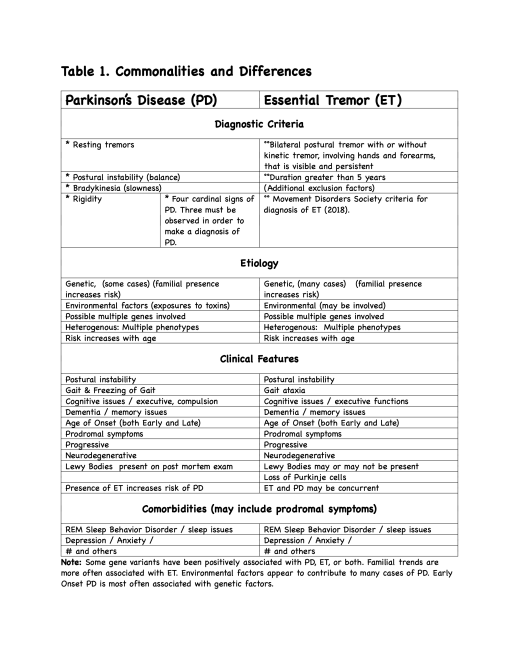
Below is a table from the article. In future posts, parts of the article will be shared, including the discussion, conclusions, and references by category.



 bob's brain: living well with a movement disorder and other comorbidities