Improv revisited

Today I’ll look back at a previous post: Pre-clinical trial starts February 26.

Or not.  Instead, I’ll do my best not to violate the NDA we signed about the trial, and look instead at oh, say, humor and Parkinson’s Disease (PD).

As one of my graduate professors mentioned to our class, humor is best when it is “in the moment,” spontaneous, and not planned, often helping to release the tension of what could be an awkward moment.

I’ll refer to the interview conducted by Power for Parkinson’s earlier this month with the PhD. candidate who was conducting the trial noted above. In it, he lays out the concepts and the parameters of the studies, and the three folks in the interview play some of the exercises.

Powerful People interview with Robert Cochrane

The home site for the program is yesandexercise.org.

I actually participated in the clinical trial noted in the previous post and felt that it helped me recognize some things about myself as a Person With Parkinson’s and my interactions with the rest of the world. Still have the same issue of people of thinking I’m serious when I’m jesting, and vice versa, though. And knowing just how far to go with it and when to shut my mouth (or press delete instead of send). It’s a work in progress… or an abandoned house/wisecrack house/fixer-upper. Take your pick.

and, just for today, we’ll end in a prayer:

Forgive, O Lord, my little jokes on Thee
And I’ll forgive Thy great big one on me.

      • Robert Frost

###

RBD and other things PD-related

Diagnosis of PD is often not made until a person is in their 60s. With all the attention that has been focused on the disease(s) in the last 20 years or so, I suspect that more people are getting diagnosed at an earlier age, although most cases of young onset PD are likely to be genetic in origin.

However, an “early” diagnosis may not be a timely diagnosis, as  the title of one opinion piece I read some time ago said (see link below).

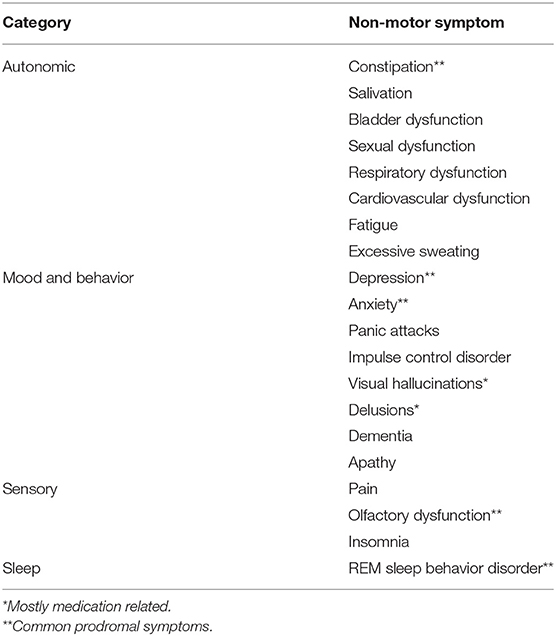
It is now becoming apparent that “Parkinson’s”includes several categories of symptoms, not just rigidity, tremors, and gait, as shown in the table below::

Source for the following table, accessed 11/28/2021:  URL=https://www.frontiersin.org/article/10.3389/fneur.2020.00686

The problem is that treatment and diagnosis are often delayed until PD has already reduced Quality of Life for many folks.

Good evidence for the quality-of-life benefits of existing symptomatic treatment supports the argument for earlier diagnosis at a time when symptoms are already present (emphasis added). This argument would be significantly bolstered by the development of disease-modifying treatments. Benefits of early diagnosis and treatment would affect not only the individual (and their families) but also the wider society and the research community. Ultimately, however, shared decision-making and the principles of autonomy, beneficence, and non-maleficence will need to be applied on an individual basis when considering a “timely” diagnosis.

Therefore, the earlier one can predict the probability or inevitability of PD the sooner one can use treatments – whether pharmacological, surgical, nutritional, or lifestyle in nature – that can either reduce, delay, or defer (and possibly reverse?) the symptoms of PD.

Of all the symptoms associated with PD: tremors, bradykinesia, depression & anxiety, posture, gait issues (difficulties walking), REM Sleep Behavior Disorder (RBD), anosmia (loss of ability to smell), cognitive issues, facial masking, and micrographia (small handwriting) – RBD is the one which is most highly predictive of a later PD diagnosis.

The predictive ‘specificity’ is so strong that if someone has RBD, the chance of being diagnosed with Parkinson’s or related conditions over the next 15 years or more is over 80%

If an 18-21 year old person walked into a physician’s office with RBD, essential tremors, and depression as main symptoms, what would happen? In 1970, probably nothing – one might get treated for depression, but essential tremors are also called “benign”tremors, and were ignored, even if the patient reported being able to feel the tremors while resting, though invisible to the external observer. As for RBD, it would probably also be ignored.

By “a physician,” we are talking about a General Practitioner, or “family doctor,” and not s specialist like a  Movement Disorders Specialist who would be trained to identify varied symptoms, including those that are prodromal. And, of course, the identification of prodromal symptoms has only been investigated within the last decade or so, and are identified as for “research only” purposes – not for clinical diagnosis. A recent survey article (not referenced below) indicated that a majority of general practitioners were either unaware of the Movement Disorders Society’s list of prodromal symptoms, or were not using them to make referrals to Movement Disorders Specialists.

But thanks to the dedication and generosity of folks like Michael J. Fox and others, PD has become a respectable disease for which the person who has it has no reason to be apologetic or ashamed, and can hold their head up (and they ought to, since one symptom is to walk with shoulders stooped down) and proudly proclaim that they have Parkinson’s, which is why they walk funny. And so it goes.

Articles that were quoted above or which contributed to this article are found in the links below.

But first:

I See The Signs of PD

Perspective: Current Pitfalls in the Search for Future Treatments and Prevention of Parkinson’s Disease

An early diagnosis is not the same as a timely diagnosis of Parkinson’s disease

Prodromal REM Sleep Behavior Disorder and PD

10 Early Signs of Parkinson’s Disease / Parkinson’s Foundation

REM Sleep Behavior and Motor Findings in Parkinson’s Disease: A Cross-sectional Analysis

Current Update on Clinically Relevant Sleep Issues in Parkinson’s Disease: A Narrative Review

The prodromes of Parkinson’s disease

Exercise-Induced Neuroprotection of the Nigrostriatal Dopamine System in Parkinson’s Disease

###

Depression, Parkinson’s Disease, Cannabis, suicidal ideation, and more…

There are two types of depression, we are sometimes told: Depression, and bipolar disorder. To my way of thinking, at least, ALL depressions are bipolar in nature. It’s just that those who don’t have the wild swings of high to low, but just from “normal” to low, aren’t considered to be be bipolar. (The report on Cannabis and suicide doesn’t mention PD, but it seemed close enough to the topic of depression that I included it.

But what do I know? I’m not a trained psychiatrist or psychologist.Here’s some articles from some folks who seem to have expertise in the area:

First: find out whether someone with PD is depressed.

Williams JR, Hirsch ES, Anderson K, Bush AL, Goldstein SR, Grill S, Lehmann S, Little JT, Margolis RL, Palanci J, Pontone G, Weiss H, Rabins P, Marsh L. A comparison of nine scales to detect depression in Parkinson disease: which scale to use? Neurology. 2012 Mar 27;78(13):998-1006. doi: 10.1212/WNL.0b013e31824d587f. Epub 2012 Mar 14. PMID: 22422897; PMCID: PMC3310315.

Conclusions: The Geriatric Depression scale (GDS-30) may be the most efficient depression screening scale to use in PD because of its brevity, favorable psychometric properties, and lack of copyright protection. However, all scales studied, except for the UPDRS Depression, are valid screening tools when PD-specific cutoff scores are used. (emphasis added).

And guess what? Comorbidities need to be considered, and depression rating scales don’t really tease out one of the more common ones. 

Calleo J, Williams JR, Amspoker AB, Swearingen L, Hirsch ES, Anderson K, Goldstein SR, Grill S, Lehmann S, Little JT, Margolis RL, Palanci J, Pontone GM, Weiss H, Rabins P, Marsh L. Application of depression rating scales in patients with Parkinson’s disease with and without co-Occurring anxiety. J Parkinsons Dis. 2013;3(4):603-8. doi: 10.3233/JPD-130264. PMID: 24275604.

Conclusions: Co-occurring anxiety disorders do not impact performance of depression rating scales in depressed PD patients. However, depression rating scales do not adequately identify anxiety disturbances alone or in patients with depression.

Why should we care? Because depression has an adverse effect on daily living for those with PD.

Pontone GM, Bakker CC, Chen S, Mari Z, Marsh L, Rabins PV, Williams JR, Bassett SS. The longitudinal impact of depression on disability in Parkinson disease. Int J Geriatr Psychiatry. 2016 May;31(5):458-65. doi: 10.1002/gps.4350. Epub 2015 Aug 18. PMID: 26284815; PMCID: PMC6445642.

Objective: Depression in Parkinson disease (PD) is a common problem that worsens quality of life and causes disability. However, little is known about the longitudinal impact of depression on disability in PD. This study examined the association between disability and DSM-IV-TR depression status across six years.

Results: A total of 43 participants were depressed at baseline compared to 94 without depression. Depressed participants were more likely to be female, were less educated, were less likely to take dopamine agonists, and more likely to have motor fluctuations. Controlling for these variables, symptomatic depression predicted greater disability compared to both never depressed (p = 0.0133) and remitted depression (p = 0.0009). Disability associated with symptomatic depression at baseline was greater over the entire six-year period compared to participants with remitted depressive episodes or who were never depressed.

Conclusions: Persisting depression is associated with a long-term adverse impact on daily functioning in PD. Adequate treatment or spontaneous remission of depression improves ADL function. (emphasis added).

Teamwork is needed. If the person with PD can’t be their own advocate, then someone needs to help coordinate and communicate.

Taylor J, Anderson WS, Brandt J, Mari Z, Pontone GM. Neuropsychiatric Complications of Parkinson Disease Treatments: Importance of Multidisciplinary Care. Am J Geriatr Psychiatry. 2016 Dec;24(12):1171-1180. doi: 10.1016/j.jagp.2016.08.017. Epub 2016 Sep 3. PMID: 27746069; PMCID: PMC5136297.

Abstract

Although Parkinson disease (PD) is defined clinically by its motor symptoms, it is increasingly recognized that much of the disability and worsened quality of life experienced by patients with PD is attributable to psychiatric symptoms. The authors describe a model of multidisciplinary care that enables these symptoms to be effectively managed. They describe neuropsychiatric complications of PD itself and pharmacologic and neurostimulation treatments for parkinsonian motor symptoms and discuss the management of these complications. Specifically, they describe the clinical associations between motor fluctuations and anxiety and depressive symptoms, the compulsive overuse of dopaminergic medications prescribed for motor symptoms (the dopamine dysregulation syndrome), and neuropsychiatric complications of these medications, including impulse control disorders, psychosis, and manic syndromes. Optimal management of these problems requires close collaboration across disciplines because of the potential for interactions among the pathophysiologic process of PD, motor symptoms, dopaminergic drugs, and psychiatric symptoms. The authors emphasize how their model of multidisciplinary care facilitates close collaboration among psychiatrists, other mental health professionals, neurologists, and functional neurosurgeons and how this facilitates effective care for patients who develop the specific neuropsychiatric complications discussed.

And, with a cautionary reminder that correlation does not equal causation, and that the new release about the referenced article comes from the Council on Drug Abuse: (which could possibly have a conflict of interest regarding the results of the data):

B Han, WM Compton, EB Einstein, ND Volkow. Associations of Suicidality Trends With Cannabis Use as a Function of Sex and Depression Status(link is external). JAMA Network Open. DOI: 10.1001/jamanetworkopen.2021.13025 (2021).

An analysis of survey data from more than 280,000 young adults ages 18-35 showed that cannabis (marijuana) use was associated with increased risks of thoughts of suicide (suicidal ideation), suicide plan, and suicide attempt. These associations remained regardless of whether someone was also experiencing depression, and the risks were greater for women than for men. The study published online today in JAMA Network Open and was conducted by researchers at the National Institute on Drug Abuse (NIDA), part of the National Institutes of Health.

“While we cannot establish that cannabis use caused the increased suicidality we observed in this study, these associations warrant further research, especially given the great burden of suicide on young adults,” said NIDA Director Nora Volkow, M.D., senior author of this study. “As we better understand the relationship between cannabis use, depression, and suicidality, clinicians will be able to provide better guidance and care to patients.”

On the other hand, it could be that young adults are depressed or suicidal because they live in a world in which constant war is being fought, in which war profiteering is not a crime, in which they see politics reduced not to a game of collaboration and mutual benefit, but a zero sum game in which the winner takes all. Perhaps they are depressed over the failure of the governments to address the mounting scientific evidence that climate “change” is resulting in climate chaos, and yet the governments of the world, funded by the fossil fuel industries, are “rearranging deck chairs on the Titanic” while the media band plays on. I could go on, but I won’t.

I used to be suicidal, but my life has changed. 

More to the point:

The National Suicide Prevention Lifeline is available today, providing suicide prevention and mental health crisis assistance at 1-800-273-8255 and through online chats. 988 is not a nationwide calling code right now. The Veterans Crisis Line is available today, providing Veteran specific suicide prevention and crisis assistance at 1 800 273 8255 (Press 1), by texting 838255, and through online chats at veteranscrisisline.net. On July 16, 2020, the FCC adopted rules to establish 988 as the new, nationwide, easy-to-remember 3-digit phone number for Americans in crisis to connect with suicide prevention and mental health crisis counselors.

And a final note: one of the main defenses against depression is activity is physical activity and human or non-human interaction. So get out here and run a mile, walk along a nature trail, play some music, call a friend, join a group or club, hug a tree, kiss a girl/boy, and get connected with the world we live in. 

You’ll feel better if you do.

###

What to do?

When it comes to diseases like cancer, the UK medical folks have decided that the “fighting” and “warrior” mentality are counter-productive. For one, this mindset causes people to delay seeking treatment. I don’t have the exact citation at hand, but it is referenced in this blog somewhere, and you’re welcome to search for it. (Thankfully, this is not a dissertation or scholarly article, or I couldn’t have written the previous sentence and gotten away with it).

But when it comes to exercise as a good way to slow, and sometimes reverse the physical or cognitive symptoms of Parkinson’s Disease (PD), there ain’t no doubt in some folks minds that dance is one of the finer things around to combine aerobic exercise, movements, and cognitive challenges to build new connections between neurons in the brain.

From the Digital Commons at Sarah Lawrence College comes this Master’s Thesis:

Rajan, Sneha, “Embodied Medicine: Integrating Dance/Movement Therapy into Physical Medicine & Rehabilitation” (2021). Dance/Movement Therapy Theses. 79. https://digitalcommons.slc.edu/dmt_etd/79

Long story short: “Overall, physiatry and dance/movement therapy have separately helped so many people but developing a synergy between these fields has the potential to transform rehabilitative medicine.”(emphasis added).

Specifically addressing Parkinson’s Disease issues, she writes:

For individuals with Parkinson’s disease, studies have shown that physical rehabilitation is an effective way to manage motor and non-motor symptoms (Mitra et al., 2020). However, maintaining motivation for treatment is difficult because of progressive difficulties with physical disability and co-existing emotional factors, so as a result not many adults engage with enough physical exercise (Mitra et al., 2020). By incorporating cognitive, emotional, and social components, the exercise environment could become more engaging and multidimensional (Mitra et al., 2020). One experimental study examined the effects of dance/movement therapy sessions on the cognition, quality of life, and motor symptoms of patients with Parkinson’s disease (Mitra et al., 2020). They used a variety of techniques such as targeted body exercises, memory games, movement improvisation, guided imagery, rhythm work, contact improvisation, mirroring, body coordination and movement reflexes (Mitra et al., 2020). Music was also used to incorporate rhythm and sensory motor cues (Mitra et al., 2020).

As a result, participants showed a significant increase in cognitive functioning and a decrease in Parkinson’s related health difficulties. Additionally, patients reported improvements in coordination, mood, and memory (Mitra et al., 2020). Another study analyzed the effectiveness of music-based movement therapy on gait related activities in Parkinson’s patients (Dreu et al., 2011). They examined both individual music-based gait training and partnered-dance interventions. The music provides rhythmic cues that help synchronize movements and also facilitates emotional responses in the participants (Dreu et al., 2011). Participants showed improvements in walking velocity and balance (Dreu et al., 2011). (Emphasis added.)

 If I were to judge this Master’s thesis, I would suggest more sources, and more recent ones than the one she used in material about Parkinson’s in the paragraphs before the ones I quoted above. But I’m not on the faculty of Sarah Lawrence College, so that’s their loss.

And the answer to the question posed in the title of this blog entry “What to do?” is simple: Don’t Stop Moving To The Music!


###

Dee Bee Ess (Deep Brain Stimulation (DBS))

First of all, something I have suspected seems to have some clinical evidence:

It seems that the earlier one has Deep Brain Stimulation (DBS) following a Parkinson’s Disease diagnosis, the better one fares:

Pre-dopa Deep Brain Stimulation: Is Early Deep Brain Stimulation Able to Modify the Natural Course of Parkinson’s Disease?

This observational study evidences that DBS treatment exerts beneficial effects on motor symptoms and quality of life in early stages of PD, if applied when first functional and QoL-impairments occur, even before L-Dopa treatment initiation. These novel data and paradigm shift proposal challenge current algorithms for PD treatment and grants further studies evaluating the disease course-modulating potential of very early DBS application in larger populations.

I was fortunate enough to have opted for DBS due to Essential Tremors, when eventually the testing revealed the cardinal traits of Parkinson’s. Had I not received DBS implants at that time, but waited until the disease had progressed to a later stage, I would not likely be in the shape I am today.

Another Item of Interest is the article titled “Personality dimensions of patients can change during the course of parkinson’s disease” to which I can also add an affirmation. DBS programming has enabled me (along with a long term psychiatric neurobehavioral specialist  relationship) to stop having episodes of Major Depressive Disorder (MDD) and have now been off antidepressants for over a year. Although this is not necessarily what the authors had in mind when they did their study, it does suggest that DBS had something to do with it. Particularly after one DBS programming session, I apparently went into a manic state, which caused my wife to report the change in mood and behavior to my Movement Disorders Specialist, so that the programming was “dialed back a few notches.”

And of course, a good deal of the credit goes to my wife, who looks after my diet so that I am eating nutritious and organic foods as much as possible, and the good folks at Power for Parkinson’s and the Georgetown Area Parkinson’s Support group, which provide exercise classes and social connections. I have noticed a more outgoing personality than previously, though it would be difficult to disentangle the various factors influencing any supposed changes in my alleged personality. 

As Michael Jackson said to Paul McCartney in “The Girl Is Mine,” I’m a lover, not a fighter.” 

or as David Bowie sang, “Ch-ch-ch-changes.”

okay, now I’m just being silly.

###

Slow down… or speed up, that is the question…

This article isn’t about Parkinson’s, but since bradykinesia is one of the signature symptoms of parkinsonism, and the title is about the challenge of being slow, it interested me.

Birgitta Burger & Clemens Wöllner (2021): The challenge of being slow: Effects of tempo, laterality, and experience on dance movement consistency, Journal of Motor Behavior, DOI: 10.1080/00222895.2021.1896469

Basically, the authors found that people who were musically trained were better able to perform the given tasks consistently on both sides of their bodies. In other words, they are bilateral in terms of brain dominance, while other folks showed lower scores in terms of consistently performing the actions at different tempi (speeds). Because they were dominant on one or the other side of their brains. 

As an amateur musician, mostly untrained (or it didn’t take) I have found that during rhythm & drumming classes that I have been in that things like a simple paradiddle are much more difficult at a slower tempo than at a faster tempo. On the other hand, some combinations are more difficult at a faster tempo than at the slower tempo. Just trying to build those cross brain connections, as the prefrontal cortex to the back of the brain and the motor control and reward system parts fade out. So I will play at the piano at a slow speed, ’cause if I pick up the tempo my fingers get even more clumsier than they are.

Maybe difficulty with moving both sides consistently is part of the reason People with Parkinson’s have difficulty with balance and with falls?  From my own experience, can’t confirm or deny the hypothesis, since I’m not that good as a musician, but seem to have some bilateral skills, and until recently, when immersion in the moment took over the judgement and reason, have not experienced problems with balance or falls. Would be an interesting research question, though…

###

Discrete choice experiment

Published in the Australian Journal of Physiotherapy as an open access article, we have an experiment in which several factors were used to determine participants’ preferences in a hypothetical exercise program.

People with Parkinson’s disease are more willing to do additional exercise if the exercise program has specific attributes

Conclusions were:

People with Parkinson’s disease were more willing to participate in exercise programs that cost less, involve less travel, provide physical or psychological benefits and are supervised by qualified professionals. To enable more people with Parkinson’s disease to exercise, health services should provide programs addressing these factors and account for sex differences. [emphasis added. Men were more likely to favor strength training, women were averse to aerobic exercise, and folks already exercising 300 minutes per week were less likely to favor adding more exercises.]

The group to which I subscribe on their YouTube channel, and support in various ways, is Power For Parkinson’s® (PFP). I also am a member of the Georgetown Area Parkinson’s Support group (GAPS) and the Capital Area Parkinson’s Society (CAPS) Both PFP and GAPS sponsor several exercise groups aimed directly at people with Parkinson’s Disease (PD) and their needs, so I am usually working out at least one hour daily. So I might fall into the last group of folks not willing to add more exercises.

On a different tangent, A couple of articles showed up that deal with the idea of Multiple Intelligences. Actually, one is a book excerpt with selected portions available on Google Books, and the other is the cover, Table of Contents, Bibliography, and Index of a different book. Granted, the Index does list Parkinson’s Disease on at least 2 pages. Why bother? Because, as those who have read the earlier blog post(s) on Moses Maimonides and Me, I don’t particularly subscribe to Maimonides’ categories of four ways in which humans strive to achieve perfection.

These books are:

Eastern European Perspectives on Emotional Intelligence

in which some of the available pages include charts of Howard Gardner’s Multiple Intelligences, and some of the results which seem to show a clustering of several factors (using factor analysis). Since that is outside of my area of expertise, I won’t comment on it. (This is all copyrighted material, provided only for personal education, etc.

The other is Mind Ecologies: Body, Brain and World which has the extensive bibliography and index. Probably well worth looking into the bibliography, if one has a mind to do so (but not today). The TOC reads:

1. Life, Experimentalism, and Valuation 16
2. Pragmatism and Embodied Cognitive Science 51
3. Social Cohesion, Experience, and Aesthetics 94
4. Pragmatism and Affective Cognition 124
5. Perception, Affect, World 156
6. Broadening Ecologies 184 

and the whole thing is copyright The Columbia University Press.

My pulmonologist prescribed a nap in the morning and afternoon, and since I missed the morning nap, will head off to do one this afternoon.

###

Where it’s at (at this moment )

As a person who was diagnosed in late 2011 with Parkinson’s disease after several years of treatment for Essential Tremors that had gotten uncontrollable, I had Deep Brain Stimulation (DBS) shortly thereafter (I had already decided to go for DBS to control the tremors, and in the additional testing, rigidity was observed, allowing the diagnosis).

Since then, thanks to a supportive care partner, a supportive community that provides exercise and dance classes, and now vocal exercises (singing) which I had initiated in 2015 along with a friend, now deceased, I am able to function fairly well. I consider my self ” the luckiest guy” to paraphrase Lou Gehrig.

So instead of my usual posting of an article or a few on a specific topic, I thought I would post this YouTube video documenting my current situation (albeit somewhat exaggerated for dramatic effect) as far as Parkinson’s Disease goes:

I Blame The Parkinson’s

The link between environmental chemicals and Parkinson’s

Jane Brody of the New York Times wrote a recent review of a new book, co-written by several experts in the field of neurology. These include Dr. Ray Dorsey, neurologist at the University of Rochester; Todd Sherer, neuroscientist with the Michael J. Fox Foundation for Parkinson’s Research; Dr. Michael S. Okun, neurologist at my other hometown at the University of Florida; and Dr. Bastiaan R. Bloem, neurologist at Radboud University Nijmegen Medical Center in the Netherlands.

The book titled “Ending Parkinson’s Disease” calls the occurrence of PD a “man-made pandemic” with references to to many studies that show the high correlation of PD to the exposure to toxic chemicals on farms and in the workplace, as well as animal studies in which PD symptoms were replicated.

Here’s one YouTube video about the book:

Brief overview of the book of Ending Parkinson’s Disease

And here’s a forty minute Zoom presentation by Dr. Michael Okun at the University of Florida on the book’s topics. (unfortunately, there are distracting sounds from participants/attendees who didn’t mute their microphones):

Ending Parkinson’s Disease with Dr. Michael Okun

My next action will be to order the book.

###

A review on dance and PD

Dance classes for Parkinson’s patients was one of the things that got me involved in Power for Parkinson’s© and the Georgetown Area Parkinson’s Support group to begin with. For me, it has helped to improve symptoms and quality of life tremendously.

In this desk review of many studies, the authors came to the following conclusions:

Overall, the reviewed evidence demonstrated that dance can improve motor impairments, specifically balance and motor symptom severity in individuals with mild to moderate PD, and that more research is needed to determine its effects on non-motor symptoms and QOL. RCTs that use a mixed-methods approach and include larger sample sizes will be beneficial in fully characterizing effects and in determining which program elements are most important in bringing about positive, clinically meaningful changes in people with PD.

 Carapellotti AM, Stevenson R, Doumas M (2020) The efficacy of dance for improving motor impairments, non-motor symptoms, and quality of life in Parkinson’s disease: A systematic review and meta-analysis. PLoS ONE 15(8): e0236820. https://doi.org/10.1371/journal.pone.0236820

I have come to the conclusion that every study or review has to include the phrase “more research is needed.” And it is true.

You can read the article in its entirety at the URL in the citation, or download it directly from this link:

The efficacy of dance for improving motor impairments, non-motor symptoms, and quality of life in Parkinson’s disease: A systematic review and meta-analysis