
A small gift after clearing away invasive plants

20200520_190727

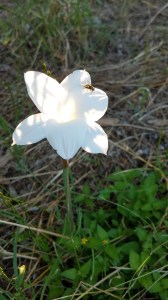
Cooperia pedunculata syn. Zephyranthes drummondii – Rain Lily

Thanks to some poor hygiene and poor knowledge regarding mowing ( or not mowing) next to a greenbelt, the berm behind my house and the neighboring greenbelt which has a cavern populated by endangered insects, has become overrun with Lolium perenne (annual ryegrass, winter ryegrass), Centaurea melitensis (Malta star thistle), and Bromus japonica (Japanese brome), to name the three worst offenders.

This February I wrote to both my HOA and my Municipal Utility District to report the failure of their mowers to follow the guidelines established in 2013 and 2018 by the Texas Department of Transportation on mowing of roadside vegetation, and vegetation adjacent to natural preserves.

Thankfully, the berm has not been mowed since early February, and I have been able to put in an hour or two, mostly on days following Spring rains, to fill about ten 42 gallon bags with the offending weeds. Although the natural covering of Gaillardia pulchella (Firewheel, Indian Blanket) and Ratibida columnifera (Prairie coneflower, Mexican hat) is greatly reduced at present, and I know that I will have to maintain vigilance and start pulling invasive weeds and grasses earlier next year, I did receive a small reward this past Wednesday.

As I was about to enter the berm to take a photograph of this Rain lily (Cooperia pedunculata, syn. Zephyranthes drummondii),  I noticed a small movement. It turned out to be an Eastern cottontail rabbit, munching on the plants in the berm. We both stood still for a few moments while I took some photos with my Android, it then hopped into the greenbelt and the cover of brush.

Then I went in, took a few shots of the Rain lily that would have been blocked from the sunlight by the ryegrass that I had removed, and caught the above photo of the light from the sunset shining through to backlight its stamens.

A small reward, perhaps, but a big warm feeling…
20200520_19073520200520_190755

For a fully detailed botanical description see: Studies on the Vascular Plants of Williamson County, Texas

###
Return of Return To The Natives

Well, folks, this site was left behind a few years ago, but from my overall WordPress traffic reports, it seems to be visited from time to time. Thus it seems that it might not be a bad idea to start updating it. Could be wrong of course, but here goes nothing: One of my favorite Texas native wildflowers, the Prairie Celestial.

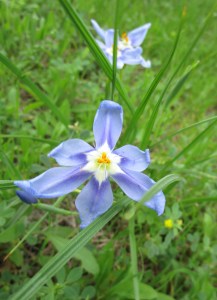
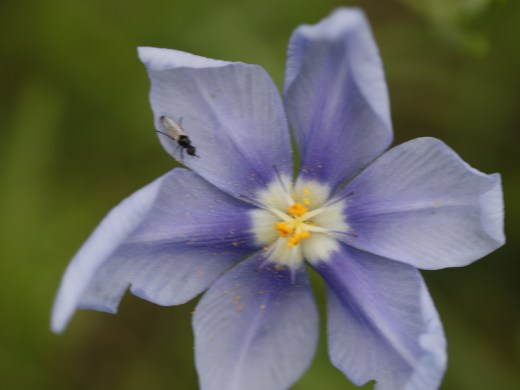
Nemastylis geminiflora - Prairie Celestial

Nemastylis geminiflora – Prairie Celestial

These members of the Iris family bloom for approximately two weeks, beginning with somewhere near the Spring equinox, and ending around April 1st. This year, there was an early “scouting” expedition around the 13th-15th of March, then a gap, followed by the expected blooming around the 19th of March through April 1st, which appeared to have been the last of it. Then, around the 5th through the 10th of April, I discovered some more blooms, stragglers, as it were.

Each flower blooms for just one day, and they often appear in pairs, hence the species name geminiflora. Each plant, which is a deep seated bulb (and hard to dig up, even for scientific sampling), may have several flowers. Another common name is Pleat Leaf Lily, derived from the “pleats” in the leaves, as shown below.

You might also note the bur clover or yellow clover, an invasive weed that forms a carpet and crowds out native plants, especially when mowing is frequent and close to the ground, and mowers move between locations without pressure washing plant materials off the blades of their mowers.

Nemastylis geminiflora - Pleat Leaf Lily

Nemastylis geminiflora – Pleat Leaf Lily

Ratibida columnifera- Mexican Hat

Ratibida columnifera- Mexican Hat

Ratibida columnifera- Mexican Hat

Also known as Prairie Coneflower,  this perennial also comes with yellow petals instead of the orange, brown, and yellow petals shown here.  In their native environment, they can form large colonies, sometimes interspersed with similarly colored Gaillardia pulchella Firewheel. Whether seen singly or en masse, it is singularly and strikingly sttractive. It is drought tolerant and can grow in a wide variety of soil types.

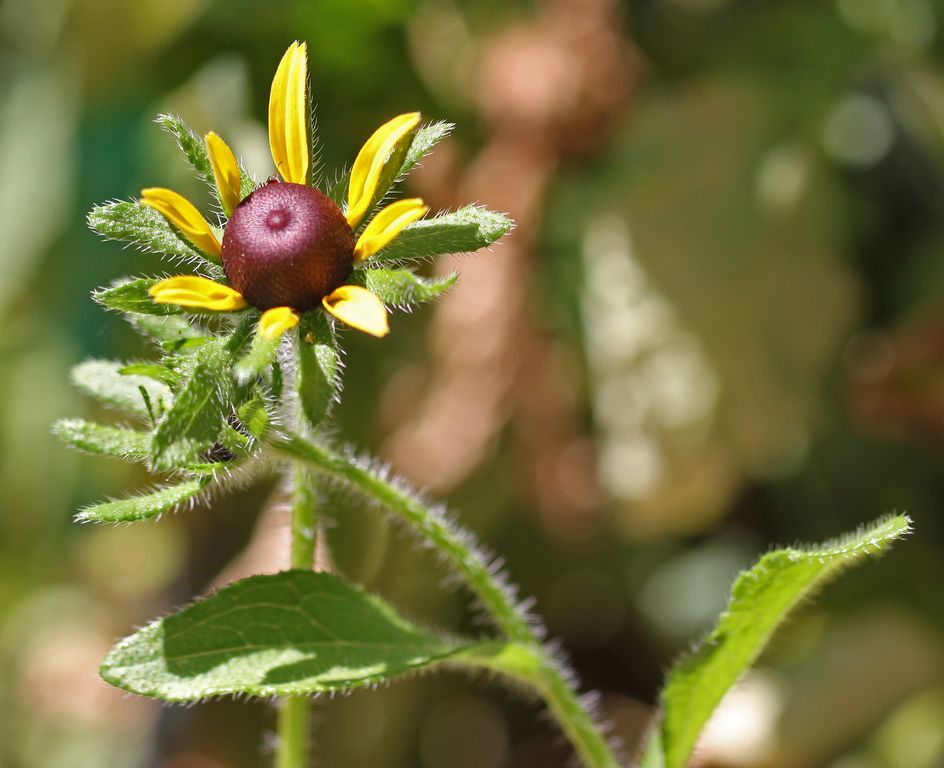
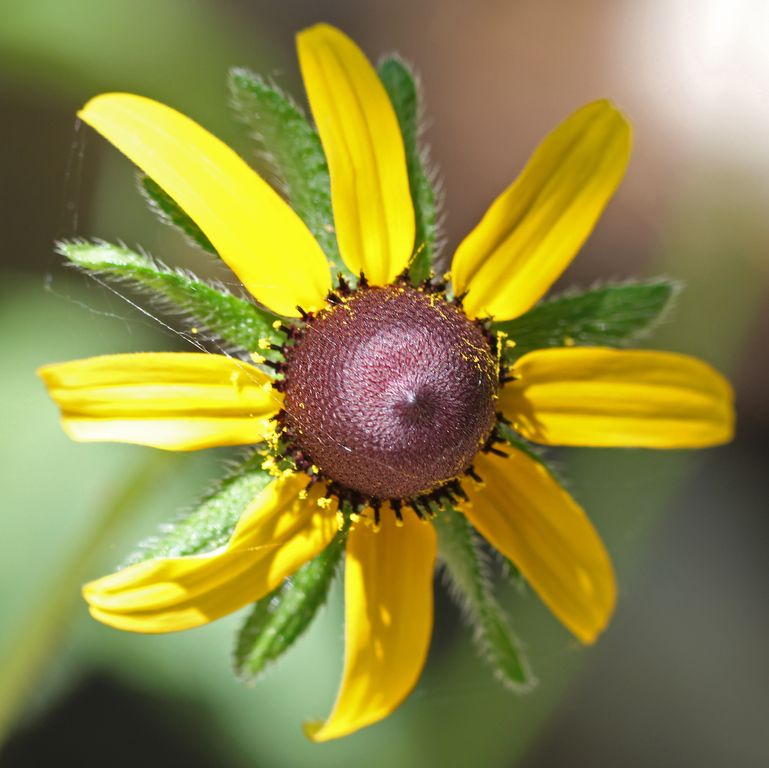
Rudbeckia hirta – Blackeyed Susan

Rudbeckia hirta - Blackeyed Susan

Rudbeckia hirta – Blackeyed Susan

Two of these wildflowers have shown up in my garden this year, most likely sown by birds. Not surprising, since it is one of the most widespread native plants in North America, native across Canada and the U.S. westward to New Mexico. It can grow in many light conditions, from sun to shade, but apparently doesn’t like calcareous or alkaline soils. It propagates itself easily by reseeding and can become aggressive if not faced with competition. It also has been widely used for medicinal as well as aesthetic purposes. What’s not to like about this cheery ornamental? For more information and links to more information than you can imagine, check out the entry at the NPIN plants database.

Rudbeckia hirta - Blackeyed Susan

Rudbeckia hirta – Blackeyed Susan

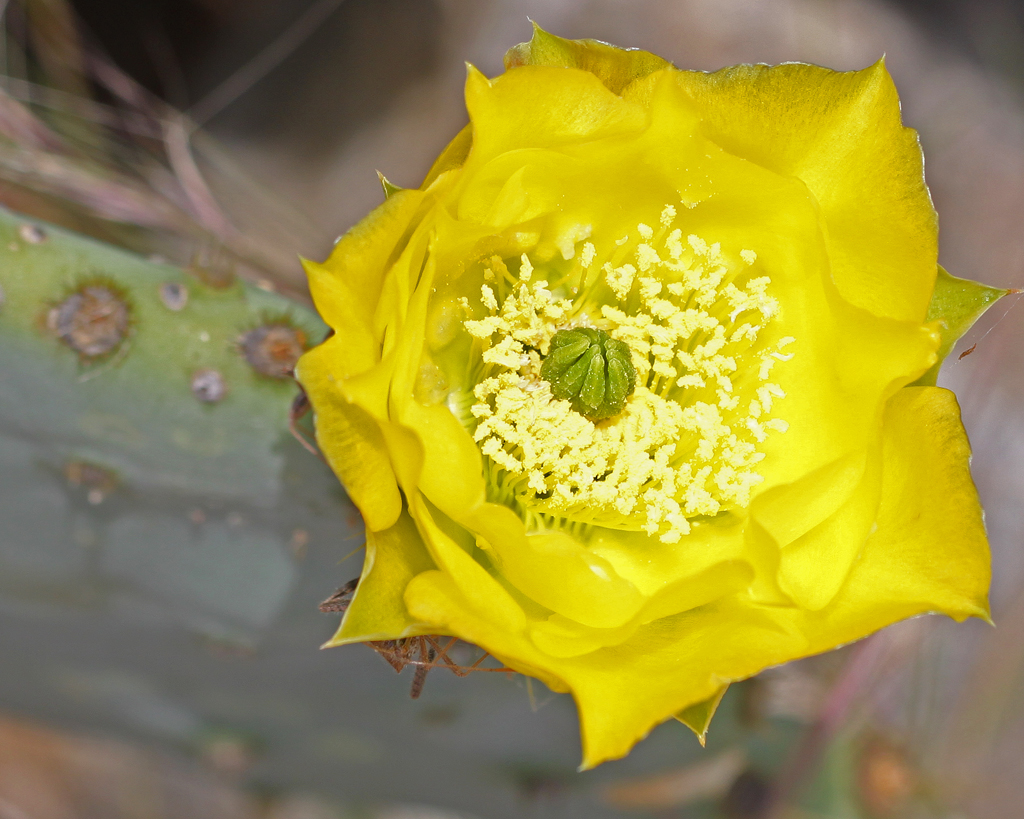
Opuntia species – Prickley Pear

Opuntia species - Prickley Pear

Opuntia species – Prickley Pear

Caught this bloom today at the Wildflower Center south of Austin. The Prickley Pear Cacti behind my house don’t seem to be in any hurry to bloom, or I’d have taken a picture of one of them instead. Prickley Pear is almost ubiquitous in these parts – they’re what’s left after folks let cattle and goats overgraze their land in order to get the agricultural use tax rate. The “tunas” (fruit) of this cactus is edible, as are the pads, once the spines are removed.  They call them nopalitas and you can search Google to find recipes, products and such.

Pavonia lasiopetala – Rock Rose

Pavonia lasiopetala - Rock Rose

Pavonia lasiopetala – Rock Rose

Also known as Rose Pavonia, Rose Mallow, and simply Pavonia, this small shrub is a member of the Mallow family. It blooms from April through November, and got started blooming a little earlier this year in March. Its pink flowers remind you of  Hibiscus, but unlike its cousin the Swamp Rose Mallow (found in swamps and ditches), this is found in rocky areas (thus the monicker “Rock Rose”) and slopes in woodlands and at the edge of thickets.

Also known by the scientific name of Pavonia wrightii, Rock Rose is a perennial shrub, with oblong alternating leaves, as seen here. It is drought tolerant and cold tolerant, and can handle full sun to partial shade conditions. It attracts butterflies, moths, and hummingbirds and is a good choice for a perennial garden, providing blooms throughout the summer.


Say It Ain’t So, Joe!

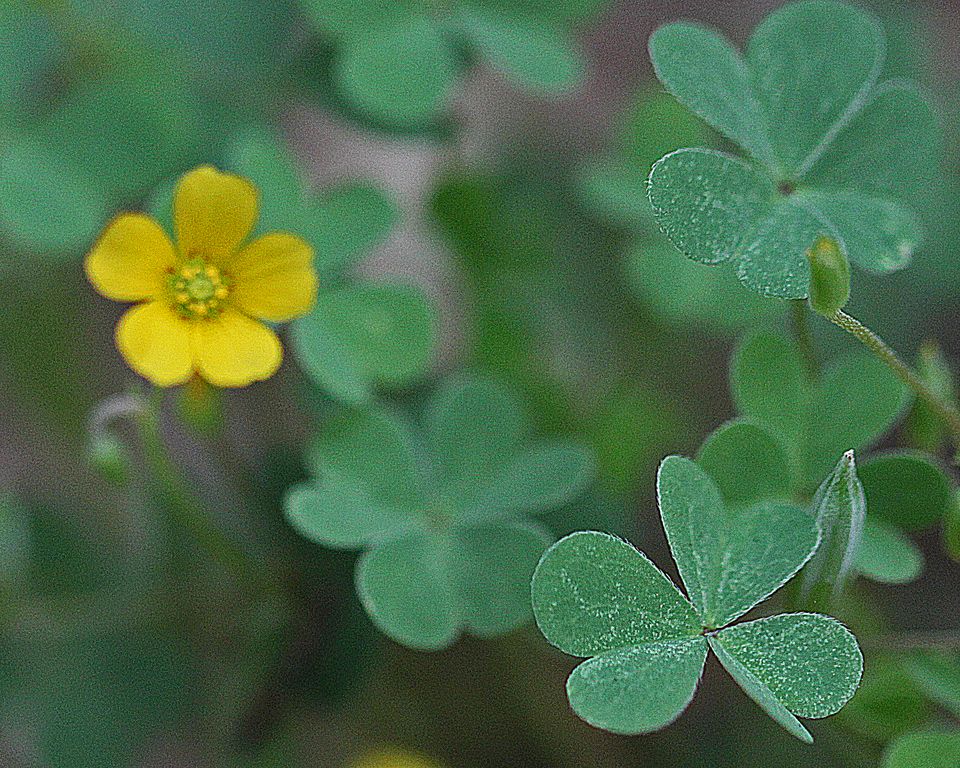
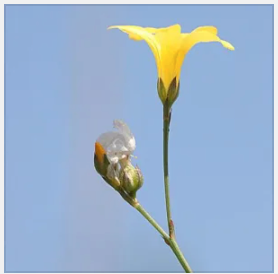
Oxalis dillenii - Slender Yellow Woodsorrel

Oxalis dillenii – Slender Yellow Woodsorrel


From Mr Smarty Plants:

TUESDAY – MARCH 19, 2013

From:Buda, TX
Region: Southwest
Topic:Problem PlantsTurf
Title: How to control Yellow Woodsorrel in Habiturf?
Answered by: Joe Marcus

QUESTION:

Last year we planted Habiturf in our front lawn and prepared the ground as directed with organic compost. This year we have an infestation of low growing yellow oxalis which we believe came in with the compost as we have not had this before. What do you recommend as a control? as weeding will not get all of it and the areas are large. We are considering using an herbicide knowing it will knock out our grass but then we will reseed.

ANSWER:

Yellow Wood Sorrel, Oxalis stricta, and Slender Yellow Wood Sorrel, Oxalis dillenii, both North American natives, are often unwanted visitors in lawns, especially newly-establish or unhealthy lawns.  As your lawn matures and develops a denser stand of grass, broadleaf weeds like Wood Sorrel will be less of an issue.  Promoting healthy grass growth will eventually pay off in reduced weed infestation.

There are broadleaf herbicides labeled for use on oxalis.  These chemicals are specific to dicot weeds and will not kill grasses and other monocots if used properly.  We take neither a pro nor con stance on garden chemicals, but only urge those choosing to use them to do so in a manner that is safest for them and the environment and to strictly adhere to label directions.

Other than hand weeding, we know of no effective organic control for Oxalis species.

In the words of Lennon & McCartney, how about “Let it be”?
This is a golden opportunity to change from turf to wildflowers.

Oxalis dillenii - Slender Yellow Woodsorrel

Oxalis dillenii – Slender Yellow Woodsorrel

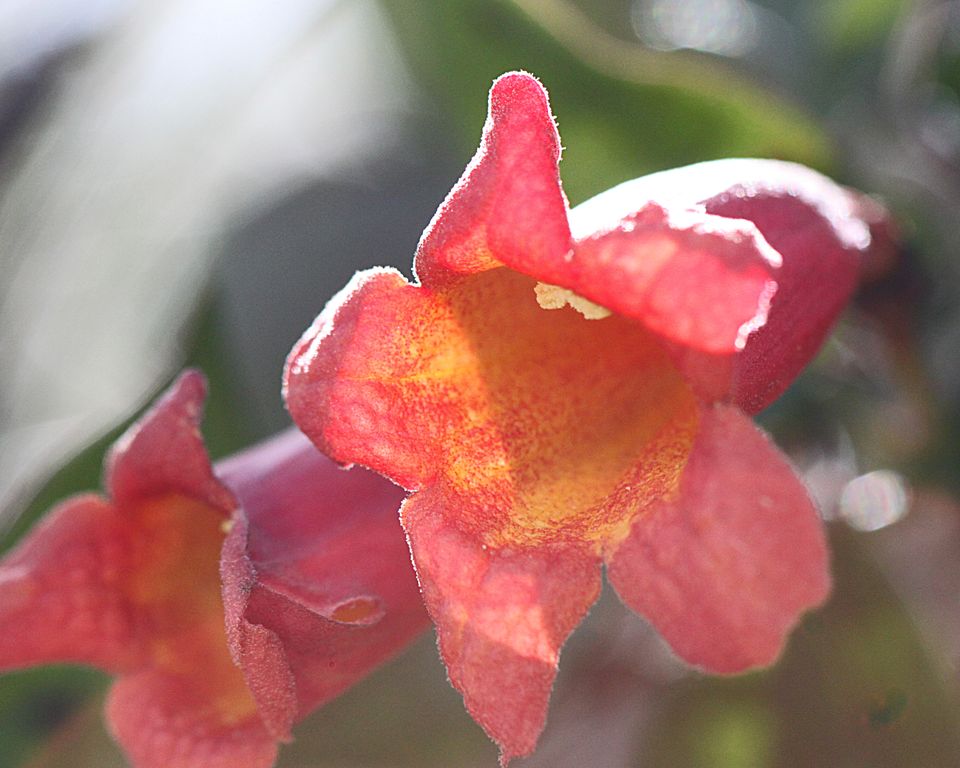
Bignonia capreolata – Crossvine

Bignonia capreolata - Crossvine

Bignonia capreolata – Crossvine

The Crossvine is blooming, draped across the Eastern Redbud, and it seems to be handling the drought with less stress than the Redbud.   The blooming period is from March through May. It attracts hummingbirds (if there happen to be any in the suburban desert) and butterflies that feed on the nectar. Which reminds me – I saw my first Monarch Butterfly (Danaus plexippus) of the season over the weekend (Saturday to be exact). Oddly enough, it was feeding on the Texas Mountain Laurel Sophora secundiflora, but apparently not long enough for me to grab the camera, Also spotted a couple of Red Admiral  (Vanessa atalanta) butterflies yesterday and did grab my camera, but the creature wouldn’t settle down long enough for me to get a shot. So here’s the Bignonia capreolata instead.