We know what’s good for the “all” but we can’t say yet that we know what’s good for the “one.”

More evidence from experiments on mice on how and why exercise is good for People with Parkinson’s (PwPs):

The popularized article: Link between exercise and dopamine

And from the abstract and significance statement of the original (non-open access) article:

Physical exercise improves motor performance in individuals with Parkinson’s disease and elevates mood in those with depression. Although underlying factors have not been identified, clues arise from previous studies showing a link between cognitive benefits of exercise and increases in brain-derived neurotrophic factor (BDNF). (emphasis added).

and:

Exercise has been shown to improve movement and cognition in humans and rodents. Here, we report that voluntary exercise over 30 days leads to an increase in evoked dopamine (DA) release throughout the striatum, and an increase in BDNF in the dorsal (motor) striatum. The increase in DA release appears to require BDNF, indicated by the absence of DA release enhancement with running in BDNF+/- mice. Activation of BDNF receptors using a pharmacological agonist was also shown to boost DA release. Together these data support a necessary and sufficient role for BDNF in exercise-enhanced DA release, and provide mechanistic insight into the reported benefits of exercise in individuals with dopamine-linked neuropsychiatric disorders, including Parkinson’s disease and depression. (emphasis added).

The citation:

Voluntary exercise boosts striatal dopamine release: evidence for the necessary and sufficient role of BDNF, Guendalina Bastioli, Jennifer C. Arnold, Maria Mancini, Adam C. Mar, Begoña Gamallo-Lana, Khalil Saadipour, Moses V. Chao, Margaret E. Rice,Journal of Neuroscience 16 May 2022, JN-RM-2273-21; DOI: 10.1523/JNEUROSCI.2273-21.2022

So that covers why exercise is good for all. But what about what is good for the one? 

Farrow SL, Cooper AA, O’Sullivan JM. Redefining the hypotheses driving Parkinson’s diseases research. NPJ Parkinsons Dis. 2022 Apr 19;8(1):45. doi: 10.1038/s41531-022-00307-w. PMID: 35440633; PMCID: PMC9018840.

… there is growing recognition that PD is not a single entity but instead reflects multiple diseases, in which different combinations of environmental, genetic and potential comorbid factors interact to direct individual disease trajectories… The clear consequence of there being distinct diseases that collectively form PD, is that there is no single biomarker or treatment for PD development or progression. We propose that diagnosis should shift away from the clinical definitions, towards biologically defined diseases that collectively form PD, to enable informative patient stratification. N-of-one type, clinical designs offer an unbiased, and agnostic approach to re-defining PD in terms of a group of many individual diseases. . (emphasis added).

The citation links to PubMed where you can download the full article, should you be so inclined. The next citation also links to an open access free article.

Riggare S, Hägglund M. Precision Medicine in Parkinson’s Disease – Exploring Patient-Initiated Self-Tracking. J Parkinsons Dis. 2018;8(3):441-446. doi: 10.3233/JPD-181314. PMID: 30124453; PMCID: PMC6130409.

In this article, Riggare reports on self tracking done in 2012 (as a Person with Parkinson’s), and the offer the possibility that self-tracking of symptoms and medications can help to inform the physician’s decisions over the course of treatment. In other words, one should be a self-advocate as a patient and work with your physician to achieve the best combination of treatments to address Parkinson’s and its comorbidities. (At least that’s my takeaway from the article. Others might differ).

Another look at PD aims to categorize it into various sub-types:

Mestre TA, Fereshtehnejad SM, Berg D, Bohnen NI, Dujardin K, Erro R, Espay AJ, Halliday G, van Hilten JJ, Hu MT, Jeon B, Klein C, Leentjens AFG, Marinus J, Mollenhauer B, Postuma R, Rajalingam R, Rodríguez-Violante M, Simuni T, Surmeier DJ, Weintraub D, McDermott MP, Lawton M, Marras C. Parkinson’s Disease Subtypes: Critical Appraisal and Recommendations. J Parkinsons Dis. 2021;11(2):395-404. doi: 10.3233/JPD-202472. PMID: 33682731; PMCID: PMC8150501.

This article is a “desk review”of other studies, using specific criteria to either include/exclude each study in the results. Their conclusion: 

Conclusion: Subtyping studies undertaken to date have significant methodologic shortcomings and most have questionable clinical applicability and unknown biological relevance. The clinical and biological signature of PD may be unique to the individual, rendering PD resistant to meaningful cluster solutions. New approaches that acknowledge the individual-level heterogeneity and that are more aligned with personalized medicine are needed. (emphasis added).

Among the articles cited in the bibliography is this one (another open access article):

Lawton M, Baig F, Toulson G, Morovat A, Evetts SG, Ben-Shlomo Y, Hu MT. Blood biomarkers with Parkinson’s disease clusters and prognosis: The oxford discovery cohort. Mov Disord. 2020 Feb;35(2):279-287. doi: 10.1002/mds.27888. Epub 2019 Nov 6. PMID: 31693246; PMCID: PMC7028059.

In this, the authors describe their methodology and results from the Oxford cohort (one of several cohorts of PwPs and controls that have been used for research. (I would take the time and effort to locate the original publication describing the different cohorts involved in the effort to find biomarkers, but I am currently experiencing a wave of Parkinson’s related apathy. Check my past posts, or do a search on PubMed – I do remember that Oxford and Boston were two of the cohorts of PwPs.  But I digress).

Results: Apolipoprotein A1 and C-reactive protein levels differed across our PD subtypes, with severe motor disease phenotype, poor psychological well-being, and poor sleep subtype having reduced apolipoprotein A1 and higher C-reactive protein levels. Reduced apolipoprotein A1, higher C-reactive protein, and reduced vitamin D were associated with worse baseline activities of daily living (MDS-UPDRS II).

Conclusion: Baseline clinical subtyping identified a pro-inflammatory biomarker profile significantly associated with a severe motor/nonmotor disease phenotype, lending biological validity to subtyping approaches. No blood biomarker predicted motor or nonmotor prognosis. © 2019 The Authors. Movement Disorders published by Wiley Periodicals, Inc. on behalf of International Parkinson and Movement Disorder Society. (emphasis added).

In other words: Close, but no cigar. But I, for one, certainly could have benefited from this knowledge had it been available 60 years ago. (don’t get me started – I’ve played that tape many times before).

Oh well, let’s end on a high note:

Basic human rights

I don’t have access to the content of this book, but I was struck by the abstract to this chapter:

The right to an education is an important human right and is regulated in considerable detail in Articles 13 and 14 of the International Covenant on Economic, Social and Cultural Rights as well as in Articles 28 and 29 of the UN Convention on the Rights of the Child. With the sole exception of the United States, all United Nations member States have accepted the right to education as a legally binding human right that needs to be implemented in their domestic systems. (emphasis added)

What’s wrong with education in the United States? The U.S.A. hasn’t accepted it as a legally binding human right. No wonder that (well, I won’t go there today).

Chapter: Music Education
Child Development and Human Rights
By Steven J. Holochwost, Elizabeth Stuk

The book citation is:
Fifer, J., Impey, A., Kirchschlaeger, P.G., Nowak, M., & Ulrich, G. (Eds.). (2022). The Routledge Companion to Music and Human Rights (1st ed.). Routledge https://doi.org/10.4324/9781003043478
eBook ISBN 9781003043478

Book Description
The Routledge Companion to Music and Human Rights is a collection of case studies spanning a wide range of concerns about music and human rights in response to intensifying challenges to the well-being of individuals, peoples, and the planet. It brings forward the expertise of academic researchers, lawyers, human rights practitioners, and performing musicians who offer critical reflection on how their work might identify, inform, or advance mutual interests in their respective fields. The book is comprised of 28 chapters, interspersed with 23 ‘voices’ – portraits that focus on individuals’ intimate experiences with music in the defence or advancement of human rights – and explores the following four themes: 1) Fundamentals on music and human rights; 2) Music in pursuit of human rights; 3) Music as a means of violating human rights; 4) Human rights and music: intrinsic resonances.

The book is scheduled for publishing on May 31, 2022. $250 for print, under $50.00 USD for ebook format.

I really gotta look into becoming a student or getting associated with an organization or library that would allow me to access research articles, journals, ans books. It’s the one thing I miss most about IBM: access to technical journals through the library. That, and the IBM Club band, aka the Blue Diamonds Jazz Orchestra (BDJO). 

While not exactly fitting in with music, but maybe under basic human rights (free speech, anyone?), here is an open access article reporting on the results of the Parkinson’s Voice initiative:

Conclusion first:

Sustained vowels may provide an objective, robust and streamlined approach towards informing PwP subtype assignment. The current study’s findings corroborate part of the PD research literature indicating the presence of four PD subtypes having been thoroughly validated on a large PwP cohort and externally validated on two additional PwP cohorts. There are important practical implications of defining PD subtypes using data that is easy to self-collect remotely such as speech signals and in particular sustained vowel /a/ phonations: they enable large-scale investigations and may bring us a step closer towards more personalized medicine approaches and targeted clinical management. The key limitation of the study is that we do not have additional clinical labels (e.g. UPDRS) or other self-reported outcome measures to map the resulting PD subtypes onto something that would be more tangible and comparable to related PD subtype studies. Future work could explore the extent subtypes form useful markers of symptom severity progression and conversely how PD progression might affect subtype membership for individual PwP. Similarly, further work could integrate additional modalities to speech to incorporate longitudinal passively collected modalities and self-reports which could be capturing PD-related symptoms, e.g. via using smartphones and wearables along the lines we have explored for mental disorders [64], [67]–[70]. Collecting additional modalities at scale using increasingly affordable technologies may provide new insights towards understanding PD subtypes which may translate into understanding individual PwP similarities, related PwP symptom trajectories, and ultimately lead to better symptom management strategies.

and from the abstract:

Purpose
People diagnosed with Parkinson’s (PwP) exhibit a diverse manifestation of heterogeneous symptoms which likely reflect different subtypes. However, there is no widely accepted consensus on the criteria for subtype membership assignment. We explored clustering PwP using a data-driven approach mining speech signals.

Results
We selected 21 dysphonia measures and found four main clusters which provide tentative insights into different dominating speech-associated characteristics (cophenetic coefficient=0.72, silhouette score=0.67). The cluster findings were consistent across the three PVI cohorts, strongly supporting the generalization of the presented methodology towards PwP subtype assignment, and were independently visually verified in 2D projections with t-SNE.

The citation (and the link to access) this open access article are:

Tsanas, T & Arora, S 2022, ‘Data-driven Subtyping of Parkinson’s using Acoustic Analysis of Sustained Vowels and Cluster Analysis: Findings in the Parkinson’s Voice Initiative Study’, SN Computer Science, vol. 3, 232. https://doi.org/10.1007/s42979-022-01123-y

and that’s all I have for today, folks!

###

More research on Dance

Not a lot to discuss: just a bunch of articles from the last couple of years.

Bearss KA, DeSouza JFX. Parkinson’s Disease Motor Symptom Progression Slowed with Multisensory Dance Learning over 3-Years: A Preliminary Longitudinal Investigation. Brain Sci. 2021 Jul 7;11(7):895. doi: 10.3390/brainsci11070895. PMID: 34356129; PMCID: PMC8303681.

Bek J, Groves M, Leventhal D, Poliakoff E. Dance at Home for People With Parkinson’s During COVID-19 and Beyond: Participation, Perceptions, and Prospects. Front Neurol. 2021 May 31;12:678124. doi: 10.3389/fneur.2021.678124. PMID: 34140925; PMCID: PMC8204717.

Fontanesi C, DeSouza JFX. Beauty That Moves: Dance for Parkinson’s Effects on Affect, Self-Efficacy, Gait Symmetry, and Dual Task Performance. Front Psychol. 2021 Feb 5;11:600440. doi: 10.3389/fpsyg.2020.600440. PMID: 33613357; PMCID: PMC7892443.

Emmanouilidis S, Hackney ME, Slade SC, Heng H, Jazayeri D, Morris ME. Dance Is an Accessible Physical Activity for People with Parkinson’s Disease. Parkinsons Dis. 2021 Oct 22;2021:7516504. doi: 10.1155/2021/7516504. PMID: 34721836; PMCID: PMC8556098.

Christensen-Strynø MB, Phillips L, Frølunde L. Revitalising sensualities of ageing with Parkinson’s through dance. J Aging Stud. 2021 Dec;59:100978. doi: 10.1016/j.jaging.2021.100978. Epub 2021 Oct 23. PMID: 34794724.

Krotinger A, Loui P. Rhythm and groove as cognitive mechanisms of dance intervention in Parkinson’s disease. PLoS One. 2021 May 6;16(5):e0249933. doi: 10.1371/journal.pone.0249933. PMID: 33956853; PMCID: PMC8101757.

Bar A, Czamanski-Cohen J, Federman JD. I Feel Like I Am Flying and Full of Life: Contemporary Dance for Parkinson’s Patients. Front Psychol. 2021 Jul 5;12:623721. doi: 10.3389/fpsyg.2021.623721. PMID: 34290638; PMCID: PMC8287013.

Gyrling T, Ljunggren M, Karlsson S. The impact of dance activities on the health of persons with Parkinson’s disease in Sweden. Int J Qual Stud Health Well-being. 2021 Dec;16(1):1992842. doi: 10.1080/17482631.2021.1992842. PMID: 34694957; PMCID: PMC8547839.

Bevilacqua R, Benadduci M, Bonfigli AR, Riccardi GR, Melone G, La Forgia A, Macchiarulo N, Rossetti L, Marzorati M, Rizzo G, Di Bitonto P, Potenza A, Fiorini L, Cortellessa Loizzo FG, La Viola C, Cavallo F, Leone A, Rescio G, Caroppo A, Manni A, Cesta A, Cortellessa G, Fracasso F, Orlandini A, Umbrico A, Rossi L, Maranesi E. Dancing With Parkinson’s Disease: The SI-ROBOTICS Study Protocol. Front Public Health. 2021 Dec 21;9:780098. doi: 10.3389/fpubh.2021.780098. PMID: 34993171; PMCID: PMC8724049.

Ismail SR, Lee SWH, Merom D, Megat Kamaruddin PSN, Chong MS, Ong T, Lai NM. Evidence of disease severity, cognitive and physical outcomes of dance interventions for persons with Parkinson’s Disease: a systematic review and meta-analysis. BMC Geriatr. 2021 Sep 22;21(1):503. doi: 10.1186/s12877-021-02446-w. PMID: 34551722; PMCID: PMC8456607. (This is a desk review of articles rather than original research. Personally, I am skeptical of the conclusions of such reviews [unless they support my biases, of course]).

Hsu P, Ready EA, Grahn JA. The effects of Parkinson’s disease, music training, and dance training on beat perception and production abilities. PLoS One. 2022 Mar 8;17(3):e0264587. doi: 10.1371/journal.pone.0264587. PMID: 35259161; PMCID: PMC8903281.

Walton L, Domellöf ME, Åström ÅN, Elowson Å, Neely AS. Digital Dance for People With Parkinson’s Disease During the COVID-19 Pandemic: A Feasibility Study. Front Neurol. 2022 Feb 3;12:743432. doi: 10.3389/fneur.2021.743432. PMID: 35185746; PMCID: PMC8850348.

Izbicki P, Stegemöller EL, Compton J, Thompson J. Dancing for Parkinson’s: A Gateway for Connectedness to Peers and Social Assurance. CBE Life Sci Educ. 2021 Jun;20(2):ar27. doi: 10.1187/cbe.20-05-0101. PMID: 33944618; PMCID: PMC8734394.

Sundström M, Jola C. “I’m Never Going to Be in Phantom of the Opera”: Relational and Emotional Wellbeing of Parkinson’s Carers and Their Partners in and Beyond Dancing. Front Psychol. 2021 Jul 29;12:636135. doi: 10.3389/fpsyg.2021.636135. PMID: 34393878; PMCID: PMC8358682.

Carapellotti AM, Rodger M, Doumas M. Evaluating the effects of dance on motor outcomes, non-motor outcomes, and quality of life in people living with Parkinson’s: a feasibility study. Pilot Feasibility Stud. 2022 Feb 9;8(1):36. doi: 10.1186/s40814-022-00982-9. PMID: 35139914; PMCID: PMC8827282.

Mele B, Ismail Z, Goodarzi Z, Pringsheim T, Lew G, Holroyd-Leduc J. Non-pharmacologic interventions to treat apathy in Parkinson’s disease: A realist review. Clin Park Relat Disord. 2021 May 25;4:100096. doi: 10.1016/j.prdoa.2021.100096. PMID: 34316673; PMCID: PMC8299975.

Kang SH, Kim J, Kim I, Moon YA, Park S, Koh SB. Dance Intervention Using the Feldenkrais Method Improves Motor, and Non-Motor Symptoms and Gait in Parkinson’s Disease: A 12-Month Study. J Mov Disord. 2022 Jan;15(1):53-57. doi: 10.14802/jmd.21086. Epub 2021 Nov 3. PMID: 34724780; PMCID: PMC8820889.

And there you have it. A bunch of research or reviews over the last year and a half involving dance and Parkinson’s Disease. I did a search and haven’t had enough time to read any of these yet, but That’s part of the reason for this blog: to serve as a repository of links to articles. All of these are open access articles so the full text should be available.

Meanwhile… 

Improv revisited

Today I’ll look back at a previous post: Pre-clinical trial starts February 26.

Or not.  Instead, I’ll do my best not to violate the NDA we signed about the trial, and look instead at oh, say, humor and Parkinson’s Disease (PD).

As one of my graduate professors mentioned to our class, humor is best when it is “in the moment,” spontaneous, and not planned, often helping to release the tension of what could be an awkward moment.

I’ll refer to the interview conducted by Power for Parkinson’s earlier this month with the PhD. candidate who was conducting the trial noted above. In it, he lays out the concepts and the parameters of the studies, and the three folks in the interview play some of the exercises.

Powerful People interview with Robert Cochrane

The home site for the program is yesandexercise.org.

I actually participated in the clinical trial noted in the previous post and felt that it helped me recognize some things about myself as a Person With Parkinson’s and my interactions with the rest of the world. Still have the same issue of people of thinking I’m serious when I’m jesting, and vice versa, though. And knowing just how far to go with it and when to shut my mouth (or press delete instead of send). It’s a work in progress… or an abandoned house/wisecrack house/fixer-upper. Take your pick.

and, just for today, we’ll end in a prayer:

Forgive, O Lord, my little jokes on Thee
And I’ll forgive Thy great big one on me.

      • Robert Frost

###

Keep on moving to (and making) music

The evidence that rhythm, movement, and making music continues to accumulate as a therapeutic approach to address the symptoms and Quality of Life issues related to Parkinson’s Disease (PD).

Today we look at an article just out in Frontiers of Human Neuroscience, titled

Rhythm and Music-Based Interventions in Motor Rehabilitation: Current Evidence and Future Perspectives  

Over the last quarter of a century, increasing research results point to rhythm and music as effective and useful tools for treatment and rehabilitation of people with neurological disorders. This article reviews the evidence for four different approaches, what the consensus is at the present time, and, of course, suggests future directions.

The authors look at four different approaches:

  1. Rhythmic Auditory Stimulation (RAS)
  2. Music-Supported Therapy (MST)
  3. Therapeutic Instrumental Music Performance therapy (TIMP) and
  4. Patterned Sensory Enhancement (PSE)

The consensus of recent meta-analyses and systematic reviews is that, for Parkinson’s Disease (PD), is that RAS is an effective tool for improving gait, stride, and speed – folks walk faster and with longer steps with RAS. Additionally, evidence is showing that it also reduces freezing of gait (FOG), improves balance and reduces the occurrence of falls.

Neither MST nor TIMP have been studied much beyond the rehabilitation of stroke patients. They involve practicing on a keyboard or drums, beginning with the patient’s comfort level and increasing in difficulty. Some studies have begun to be used to investigate effectiveness as treatments for PD.  Some have shown improvements in motor dexterity. More research is needed, but in the meantime, learning to play drums or keyboards can’t hurt, and may enrich one’s quality of life (QOL).

Growing evidence in neurological and brain imaging have shown increased activity in the auditory and motor areas of the brain, indicating that brain plasticity might be achieved through music and rhythmic interventions. The authors note that RAS has been well studied with stroke and PD populations, but not with other movement disorders and Alzheimer’s populations. In addition MST and TIMP have only begun to be investigated as a means of restoring fine motor coordination.

The authors also call for neuroimaging use in studies, to better understand the physiological basis of the rehabilitation process. They point out the gaps in research and hope to provide a framework for future research – not so much a roadmap, I would think, but a laying out of what we know and what we don’t know, and what kinds of studies are needed to answer the questions about what we don’t know..  They state that “musical rhythm is a powerful tool” for therapy, and our understanding and exploration of how it modulates brain networks is in the initial stages.

 In other words, “We’ve only just begun.”

Meanwhile: Don’t stop moving to the music.


Citation:
Braun Janzen T, Koshimori Y, Richard NM and Thaut MH (2022) Rhythm and Music-Based Interventions in Motor Rehabilitation: Current Evidence and Future Perspectives. Front. Hum. Neurosci. 15:789467. doi: 10.3389/fnhum.2021.78946


RBD and other things PD-related

Diagnosis of PD is often not made until a person is in their 60s. With all the attention that has been focused on the disease(s) in the last 20 years or so, I suspect that more people are getting diagnosed at an earlier age, although most cases of young onset PD are likely to be genetic in origin.

However, an “early” diagnosis may not be a timely diagnosis, as  the title of one opinion piece I read some time ago said (see link below).

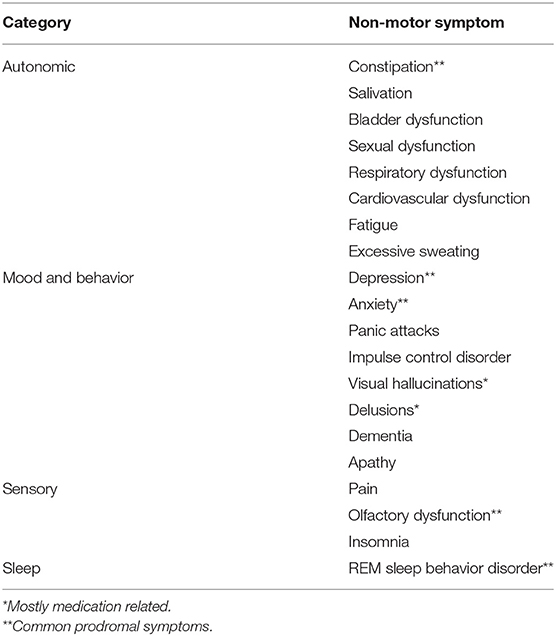
It is now becoming apparent that “Parkinson’s”includes several categories of symptoms, not just rigidity, tremors, and gait, as shown in the table below::

Source for the following table, accessed 11/28/2021:  URL=https://www.frontiersin.org/article/10.3389/fneur.2020.00686

The problem is that treatment and diagnosis are often delayed until PD has already reduced Quality of Life for many folks.

Good evidence for the quality-of-life benefits of existing symptomatic treatment supports the argument for earlier diagnosis at a time when symptoms are already present (emphasis added). This argument would be significantly bolstered by the development of disease-modifying treatments. Benefits of early diagnosis and treatment would affect not only the individual (and their families) but also the wider society and the research community. Ultimately, however, shared decision-making and the principles of autonomy, beneficence, and non-maleficence will need to be applied on an individual basis when considering a “timely” diagnosis.

Therefore, the earlier one can predict the probability or inevitability of PD the sooner one can use treatments – whether pharmacological, surgical, nutritional, or lifestyle in nature – that can either reduce, delay, or defer (and possibly reverse?) the symptoms of PD.

Of all the symptoms associated with PD: tremors, bradykinesia, depression & anxiety, posture, gait issues (difficulties walking), REM Sleep Behavior Disorder (RBD), anosmia (loss of ability to smell), cognitive issues, facial masking, and micrographia (small handwriting) – RBD is the one which is most highly predictive of a later PD diagnosis.

The predictive ‘specificity’ is so strong that if someone has RBD, the chance of being diagnosed with Parkinson’s or related conditions over the next 15 years or more is over 80%

If an 18-21 year old person walked into a physician’s office with RBD, essential tremors, and depression as main symptoms, what would happen? In 1970, probably nothing – one might get treated for depression, but essential tremors are also called “benign”tremors, and were ignored, even if the patient reported being able to feel the tremors while resting, though invisible to the external observer. As for RBD, it would probably also be ignored.

By “a physician,” we are talking about a General Practitioner, or “family doctor,” and not s specialist like a  Movement Disorders Specialist who would be trained to identify varied symptoms, including those that are prodromal. And, of course, the identification of prodromal symptoms has only been investigated within the last decade or so, and are identified as for “research only” purposes – not for clinical diagnosis. A recent survey article (not referenced below) indicated that a majority of general practitioners were either unaware of the Movement Disorders Society’s list of prodromal symptoms, or were not using them to make referrals to Movement Disorders Specialists.

But thanks to the dedication and generosity of folks like Michael J. Fox and others, PD has become a respectable disease for which the person who has it has no reason to be apologetic or ashamed, and can hold their head up (and they ought to, since one symptom is to walk with shoulders stooped down) and proudly proclaim that they have Parkinson’s, which is why they walk funny. And so it goes.

Articles that were quoted above or which contributed to this article are found in the links below.

But first:

I See The Signs of PD

Perspective: Current Pitfalls in the Search for Future Treatments and Prevention of Parkinson’s Disease

An early diagnosis is not the same as a timely diagnosis of Parkinson’s disease

Prodromal REM Sleep Behavior Disorder and PD

10 Early Signs of Parkinson’s Disease / Parkinson’s Foundation

REM Sleep Behavior and Motor Findings in Parkinson’s Disease: A Cross-sectional Analysis

Current Update on Clinically Relevant Sleep Issues in Parkinson’s Disease: A Narrative Review

The prodromes of Parkinson’s disease

Exercise-Induced Neuroprotection of the Nigrostriatal Dopamine System in Parkinson’s Disease

###

Late Stage Parkinson’s (LSP): Undertreated?

This paper (or rather a chapter in a thesis) landed in my newsfeed recently. In it, the authors describe a study done to see whether people with Parkinson’s in the later stages are getting adequate treatment and whether they could benefit from more specific treatment. (A link to the PDf file is at the end of this post).

A person in Late Stage Parkinson’s has more than one of the following:

  • Motor symptoms not controlled despite medication.
  • Levadopa-related dyskinesias or dystonia,
  • PD dementia (defined according to MDS Task Force definition (Dubois et al. 2007), and
    not treated with cholinesterase inhibitors,
  • Depression not adequately treated,
  • Neuropsychiatric symptoms, such as agitation/ aggression; anxiety and irritability,
  • Orthostatic hypotension, pain, constipation, urinary symptoms, insomnia or daytime sleepiness (autonomic systems degeneration),
  • Falls on a regular basis,
  • Other symptoms related to risk of choking, speech issues, or producing too much saliva,
  • Inadequate Home environment.

Basically, the study provided a list of recommended activities and treatment on a sheet of paper (the control group) and actually providing the treatments and activities recommended, (the treatment group).

Not surprisingly, the treatment group did better at the end of the study than the controls. The conclusions were that people in late-stage Parkinson’s are often undertreated and could benefit from implementation of movement disorder specialists’ recommendations. (One would hope that the control group would also be provided with the treatments after the study ended. Perhaps, leading to another report)?

I’ve paraphrased the table used to describe late stage Parkinsonism in order not to infringe on their copyright. The title of the entire thesis is “Impairment and Disability in Late Stage Parkinsonism” and the overall author is Danny Hommel. I couldn’t find an email to ask for permission in writing to reproduce anything verbatim.

Other chapters include:

  • The late-stage of parkinsonism’s – motor and non-motor complications
  • The prevalence and determinants of neuropsychiatric symptoms in late-stage parkinsonism
  • Prevalence and prescribed treatments of orthostatic hypotension in institutionalized peoples with Parkinson’s disease (the chapter discussed in this post)
  • Optimizing treatment in undertreated late-stage parkinsonism: a pragmatic randomized trial
  • General discussion/English summary

Published as: ALAJ Hommel, MJ Meinders, NJ Weerkamp, C Richinger,
C Schmotz, S Lorenzl, R Dodel, M Coelho, JJ Ferreira, F Tison, T Boraud,
WG Meissner, K Rosqvist, J Timpka, P Odin, M Wittenberg, BR Bloem,
RT Koopmans, A Schrag and the CLaSP consortium.
Optimizing treatment in undertreated late-stage parkinsonism: a pragmatic
randomized trial.
J Parkinsons Dis. 2020;10(3):1171-1184.

Depression, Parkinson’s Disease, Cannabis, suicidal ideation, and more…

There are two types of depression, we are sometimes told: Depression, and bipolar disorder. To my way of thinking, at least, ALL depressions are bipolar in nature. It’s just that those who don’t have the wild swings of high to low, but just from “normal” to low, aren’t considered to be be bipolar. (The report on Cannabis and suicide doesn’t mention PD, but it seemed close enough to the topic of depression that I included it.

But what do I know? I’m not a trained psychiatrist or psychologist.Here’s some articles from some folks who seem to have expertise in the area:

First: find out whether someone with PD is depressed.

Williams JR, Hirsch ES, Anderson K, Bush AL, Goldstein SR, Grill S, Lehmann S, Little JT, Margolis RL, Palanci J, Pontone G, Weiss H, Rabins P, Marsh L. A comparison of nine scales to detect depression in Parkinson disease: which scale to use? Neurology. 2012 Mar 27;78(13):998-1006. doi: 10.1212/WNL.0b013e31824d587f. Epub 2012 Mar 14. PMID: 22422897; PMCID: PMC3310315.

Conclusions: The Geriatric Depression scale (GDS-30) may be the most efficient depression screening scale to use in PD because of its brevity, favorable psychometric properties, and lack of copyright protection. However, all scales studied, except for the UPDRS Depression, are valid screening tools when PD-specific cutoff scores are used. (emphasis added).

And guess what? Comorbidities need to be considered, and depression rating scales don’t really tease out one of the more common ones. 

Calleo J, Williams JR, Amspoker AB, Swearingen L, Hirsch ES, Anderson K, Goldstein SR, Grill S, Lehmann S, Little JT, Margolis RL, Palanci J, Pontone GM, Weiss H, Rabins P, Marsh L. Application of depression rating scales in patients with Parkinson’s disease with and without co-Occurring anxiety. J Parkinsons Dis. 2013;3(4):603-8. doi: 10.3233/JPD-130264. PMID: 24275604.

Conclusions: Co-occurring anxiety disorders do not impact performance of depression rating scales in depressed PD patients. However, depression rating scales do not adequately identify anxiety disturbances alone or in patients with depression.

Why should we care? Because depression has an adverse effect on daily living for those with PD.

Pontone GM, Bakker CC, Chen S, Mari Z, Marsh L, Rabins PV, Williams JR, Bassett SS. The longitudinal impact of depression on disability in Parkinson disease. Int J Geriatr Psychiatry. 2016 May;31(5):458-65. doi: 10.1002/gps.4350. Epub 2015 Aug 18. PMID: 26284815; PMCID: PMC6445642.

Objective: Depression in Parkinson disease (PD) is a common problem that worsens quality of life and causes disability. However, little is known about the longitudinal impact of depression on disability in PD. This study examined the association between disability and DSM-IV-TR depression status across six years.

Results: A total of 43 participants were depressed at baseline compared to 94 without depression. Depressed participants were more likely to be female, were less educated, were less likely to take dopamine agonists, and more likely to have motor fluctuations. Controlling for these variables, symptomatic depression predicted greater disability compared to both never depressed (p = 0.0133) and remitted depression (p = 0.0009). Disability associated with symptomatic depression at baseline was greater over the entire six-year period compared to participants with remitted depressive episodes or who were never depressed.

Conclusions: Persisting depression is associated with a long-term adverse impact on daily functioning in PD. Adequate treatment or spontaneous remission of depression improves ADL function. (emphasis added).

Teamwork is needed. If the person with PD can’t be their own advocate, then someone needs to help coordinate and communicate.

Taylor J, Anderson WS, Brandt J, Mari Z, Pontone GM. Neuropsychiatric Complications of Parkinson Disease Treatments: Importance of Multidisciplinary Care. Am J Geriatr Psychiatry. 2016 Dec;24(12):1171-1180. doi: 10.1016/j.jagp.2016.08.017. Epub 2016 Sep 3. PMID: 27746069; PMCID: PMC5136297.

Abstract

Although Parkinson disease (PD) is defined clinically by its motor symptoms, it is increasingly recognized that much of the disability and worsened quality of life experienced by patients with PD is attributable to psychiatric symptoms. The authors describe a model of multidisciplinary care that enables these symptoms to be effectively managed. They describe neuropsychiatric complications of PD itself and pharmacologic and neurostimulation treatments for parkinsonian motor symptoms and discuss the management of these complications. Specifically, they describe the clinical associations between motor fluctuations and anxiety and depressive symptoms, the compulsive overuse of dopaminergic medications prescribed for motor symptoms (the dopamine dysregulation syndrome), and neuropsychiatric complications of these medications, including impulse control disorders, psychosis, and manic syndromes. Optimal management of these problems requires close collaboration across disciplines because of the potential for interactions among the pathophysiologic process of PD, motor symptoms, dopaminergic drugs, and psychiatric symptoms. The authors emphasize how their model of multidisciplinary care facilitates close collaboration among psychiatrists, other mental health professionals, neurologists, and functional neurosurgeons and how this facilitates effective care for patients who develop the specific neuropsychiatric complications discussed.

And, with a cautionary reminder that correlation does not equal causation, and that the new release about the referenced article comes from the Council on Drug Abuse: (which could possibly have a conflict of interest regarding the results of the data):

B Han, WM Compton, EB Einstein, ND Volkow. Associations of Suicidality Trends With Cannabis Use as a Function of Sex and Depression Status(link is external). JAMA Network Open. DOI: 10.1001/jamanetworkopen.2021.13025 (2021).

An analysis of survey data from more than 280,000 young adults ages 18-35 showed that cannabis (marijuana) use was associated with increased risks of thoughts of suicide (suicidal ideation), suicide plan, and suicide attempt. These associations remained regardless of whether someone was also experiencing depression, and the risks were greater for women than for men. The study published online today in JAMA Network Open and was conducted by researchers at the National Institute on Drug Abuse (NIDA), part of the National Institutes of Health.

“While we cannot establish that cannabis use caused the increased suicidality we observed in this study, these associations warrant further research, especially given the great burden of suicide on young adults,” said NIDA Director Nora Volkow, M.D., senior author of this study. “As we better understand the relationship between cannabis use, depression, and suicidality, clinicians will be able to provide better guidance and care to patients.”

On the other hand, it could be that young adults are depressed or suicidal because they live in a world in which constant war is being fought, in which war profiteering is not a crime, in which they see politics reduced not to a game of collaboration and mutual benefit, but a zero sum game in which the winner takes all. Perhaps they are depressed over the failure of the governments to address the mounting scientific evidence that climate “change” is resulting in climate chaos, and yet the governments of the world, funded by the fossil fuel industries, are “rearranging deck chairs on the Titanic” while the media band plays on. I could go on, but I won’t.

I used to be suicidal, but my life has changed. 

More to the point:

The National Suicide Prevention Lifeline is available today, providing suicide prevention and mental health crisis assistance at 1-800-273-8255 and through online chats. 988 is not a nationwide calling code right now. The Veterans Crisis Line is available today, providing Veteran specific suicide prevention and crisis assistance at 1 800 273 8255 (Press 1), by texting 838255, and through online chats at veteranscrisisline.net. On July 16, 2020, the FCC adopted rules to establish 988 as the new, nationwide, easy-to-remember 3-digit phone number for Americans in crisis to connect with suicide prevention and mental health crisis counselors.

And a final note: one of the main defenses against depression is activity is physical activity and human or non-human interaction. So get out here and run a mile, walk along a nature trail, play some music, call a friend, join a group or club, hug a tree, kiss a girl/boy, and get connected with the world we live in. 

You’ll feel better if you do.

###

What to do?

When it comes to diseases like cancer, the UK medical folks have decided that the “fighting” and “warrior” mentality are counter-productive. For one, this mindset causes people to delay seeking treatment. I don’t have the exact citation at hand, but it is referenced in this blog somewhere, and you’re welcome to search for it. (Thankfully, this is not a dissertation or scholarly article, or I couldn’t have written the previous sentence and gotten away with it).

But when it comes to exercise as a good way to slow, and sometimes reverse the physical or cognitive symptoms of Parkinson’s Disease (PD), there ain’t no doubt in some folks minds that dance is one of the finer things around to combine aerobic exercise, movements, and cognitive challenges to build new connections between neurons in the brain.

From the Digital Commons at Sarah Lawrence College comes this Master’s Thesis:

Rajan, Sneha, “Embodied Medicine: Integrating Dance/Movement Therapy into Physical Medicine & Rehabilitation” (2021). Dance/Movement Therapy Theses. 79. https://digitalcommons.slc.edu/dmt_etd/79

Long story short: “Overall, physiatry and dance/movement therapy have separately helped so many people but developing a synergy between these fields has the potential to transform rehabilitative medicine.”(emphasis added).

Specifically addressing Parkinson’s Disease issues, she writes:

For individuals with Parkinson’s disease, studies have shown that physical rehabilitation is an effective way to manage motor and non-motor symptoms (Mitra et al., 2020). However, maintaining motivation for treatment is difficult because of progressive difficulties with physical disability and co-existing emotional factors, so as a result not many adults engage with enough physical exercise (Mitra et al., 2020). By incorporating cognitive, emotional, and social components, the exercise environment could become more engaging and multidimensional (Mitra et al., 2020). One experimental study examined the effects of dance/movement therapy sessions on the cognition, quality of life, and motor symptoms of patients with Parkinson’s disease (Mitra et al., 2020). They used a variety of techniques such as targeted body exercises, memory games, movement improvisation, guided imagery, rhythm work, contact improvisation, mirroring, body coordination and movement reflexes (Mitra et al., 2020). Music was also used to incorporate rhythm and sensory motor cues (Mitra et al., 2020).

As a result, participants showed a significant increase in cognitive functioning and a decrease in Parkinson’s related health difficulties. Additionally, patients reported improvements in coordination, mood, and memory (Mitra et al., 2020). Another study analyzed the effectiveness of music-based movement therapy on gait related activities in Parkinson’s patients (Dreu et al., 2011). They examined both individual music-based gait training and partnered-dance interventions. The music provides rhythmic cues that help synchronize movements and also facilitates emotional responses in the participants (Dreu et al., 2011). Participants showed improvements in walking velocity and balance (Dreu et al., 2011). (Emphasis added.)

 If I were to judge this Master’s thesis, I would suggest more sources, and more recent ones than the one she used in material about Parkinson’s in the paragraphs before the ones I quoted above. But I’m not on the faculty of Sarah Lawrence College, so that’s their loss.

And the answer to the question posed in the title of this blog entry “What to do?” is simple: Don’t Stop Moving To The Music!


###

The link between environmental chemicals and Parkinson’s

Jane Brody of the New York Times wrote a recent review of a new book, co-written by several experts in the field of neurology. These include Dr. Ray Dorsey, neurologist at the University of Rochester; Todd Sherer, neuroscientist with the Michael J. Fox Foundation for Parkinson’s Research; Dr. Michael S. Okun, neurologist at my other hometown at the University of Florida; and Dr. Bastiaan R. Bloem, neurologist at Radboud University Nijmegen Medical Center in the Netherlands.

The book titled “Ending Parkinson’s Disease” calls the occurrence of PD a “man-made pandemic” with references to to many studies that show the high correlation of PD to the exposure to toxic chemicals on farms and in the workplace, as well as animal studies in which PD symptoms were replicated.

Here’s one YouTube video about the book:

Brief overview of the book of Ending Parkinson’s Disease

And here’s a forty minute Zoom presentation by Dr. Michael Okun at the University of Florida on the book’s topics. (unfortunately, there are distracting sounds from participants/attendees who didn’t mute their microphones):

Ending Parkinson’s Disease with Dr. Michael Okun

My next action will be to order the book.

###