On hiatus again…

unintended selfie

Seems that I went and got elected to my HOA board, which will require me to cut back or off on certain activities until my 3 year term is up, or I have to resign for any of a number of possible reasons that one might imagine. (Health is the most likely culprit). I might post on an even more irregular basis – maybe some of the stuff I do for my HOA, if it proves to be of value.

Therefore, I am once again abandoning this blog, although if you’ve seen one year’s worth of photos here, you’ve probably seen most of what there is to see within 1/2 mile of my home, or in my yard.

I will be posting directly to the Williamson County chapter of the Native Plant Society of Texas (NPSOT-Wilco) Facebook page from time to time.

Hopefully, I can help to improve my community by ensuring that the virtues and benefits of native plants are more than the appeal of  cheap prices and easy availability of common exotics.

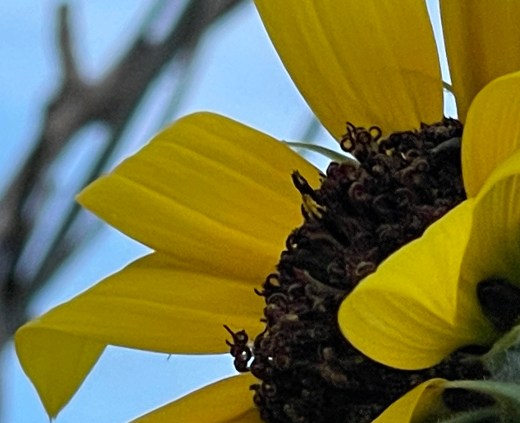
So, as parting photos, I present one taken recently by my smartphone when I wasn’t trying to take a photo (above), and another of a volunteer in my backyard (below).

Maximilian Sunflower

Maximilian Sunflower

###

Back in my own backyard…

Early June 2022 and the heat is in the “triple digits”as the meteorologists like to say in TV-land. or 39 ° Celsius, as we were told we would have converted to 50 or more years ago. Either system, hot to humans is hot.

But to native plants that evolved in Central Texas for more years than Crepe Myrtle has been here, even these signs of Global Warming haven’t phased them. (Granted, I do some supplemental watering, especially of small trees for the first few years, but other plants like Passiflora incarnata grow like “weeds”).

I’ll  let the plants speak for themselves:

Those are just the photos I took on June 8, 2022, mostly in my yard. The Rain Lilies were just past the back fence (the ones in my yard had bloomed and gone to seed after the previous week’s mild spattering of rain drops).

###

On the road again…

This past Saturday (May 29, 2022), I went out of the house for a change, on a field trip with the Williamson County Chapter of the Native Plant Society of Texas (NPSOT-Wilco), at the Southwest Williamson County Regional Park (SWCRP). The field trip consisted of walking along the Jim Rodgers Nature Trail, 1.75 miles long, I’m told.

I managed to arrive late, but soon caught up with the group. (Usually I arrive a week early, having managed to forget the actual date and time).

Then I managed to continually fall behind and catch up, working up a sweat. Because this was an evening field trip on a fairly even path (it does need mulching to give it a little more comfort underfoot), the pace of the hike was a little closer to a real hike than the usual NPSOT or Texas Master Naturalists’ walk in the woods – where it often takes an hour to go half a mile down the trail – if that much. And yet, I was able to get some interesting shots of some of the native plants and wildflowers.

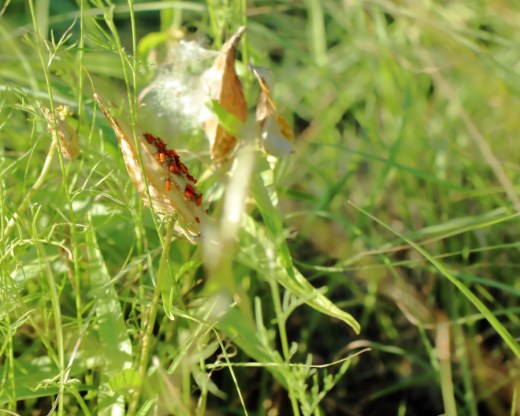
Asclepias asperula (Antelope Horns) milkweed seed pods ripened.

Asclepias asperula (Antelope Horns) milkweed, seed pods ripened.

Quercas marilandis (Blackjack Oak) has distinctive "duckfoot"shaped leaves.

Quercus marilandica (Blackjack Oak) has distinctive “duckfoot”shaped leaves.

2022-05-29-006703

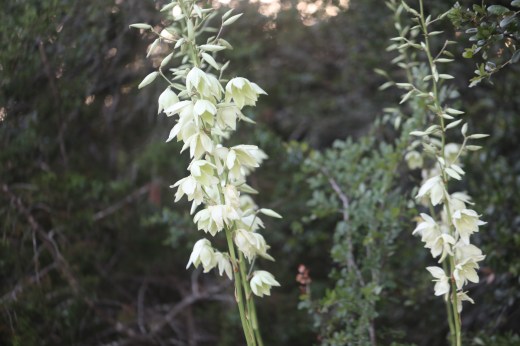
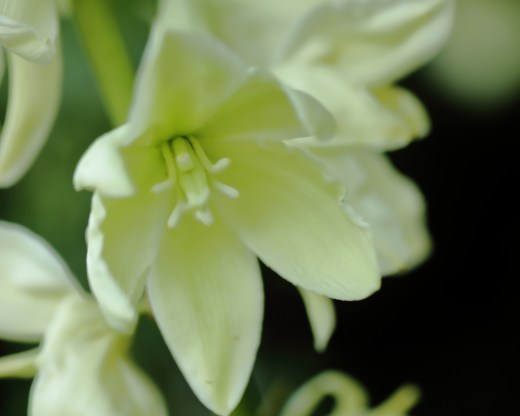
Yucca rupicola (Twist-Leaf Yucca) was in bloom

2022-05-29-006697-Yucca-rupicola

Yucca rupicola flower detail

2022-05-29-006695-Prosopis glandulosa

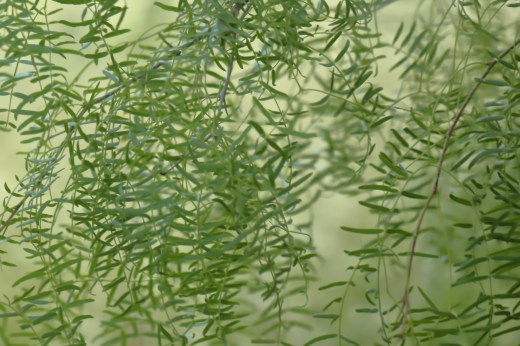
Prosopis glandulosa (Honey Mesquite)

2022-05-29-006714

Toxicodendron radicans (Poison Ivy)

2022-05-29-006704

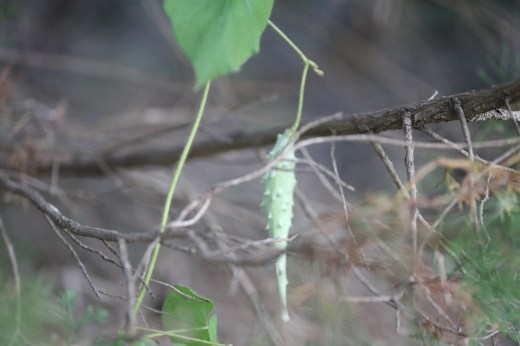
Pearl Milkweed vine seed pod

###

Lack of April Showers… doesn’t faze native wildflowers

Rock Rose (Pavonia lasiopetala)

Well, the month of April is nearly over.

Here in Central Texas, the Golden Groundsel (Packera obvata) have already gone to seed, and the state flower, the Texas Bluebonnet (Lupinus texensis) is still in bloom, but many have started to go to seed.

My Milkweeds are coming up and thriving, but no blooms yet. Four Nerve Daisies (Tetraneuris scaposa)continue to push out blossoms. False Foxglove (Penstemon cobea) and Brazos Penstemon (Penstemon tenuis )are blooming..

The Mealy Blue Sage  (Salvia farinacea) are bouncing up and are in bloom in the backyard. The inconspicuous Purple Milkweed (Matalea biflora ) has bloomed, and the Purple Passion Flower (Passiflora incarnata) vines nearby, have bloomed.

Lyre-Leaf Sage (Salvia lyrata )and Missouri Violets are in bloom lining the front yard stone walkway.

And the Scarlet LeatherFlower (Clematis texensis ), which is endemic to the Edwards Plateau, has also put out several flowers. The Coral Yucca (Hesperaloe parviflora) flowers are starting to open. And a few white wine cups (Callirhoe involucrata var. lineariloba) that I had rescued from a construction culvert on Old Chisholm Trail in Round Rock are in bloom, with their white petals and faint purple lines. They are endemic to just a few counties in Texas, and the Williamson County chapter of the Native Plant Society of Texas has adopted the name “Williamson County Winecup” for this species.

Finally, let’s hear it for the  red, white and blue blooms.

Rose Pavonia (Pavonia lasiopetala) (more hot pink than red) Autumn Sage (Salvia greggii)(both red and white, and Blue-eyed Grass (Sisyrinchium pruinosum) are all in evidence.

I don’t need any more evidence to arrive at my verdict.

Native plants are the answer.

January 2022: different state, same natives, other different plants

Raccoon

In January 2022, made my first trip out of state of TX to sometime sunny North Central Florida. since the pandemic. Checked the CDC Covid alert, and found that all of the counties we would be going to were rated at the highest level as a hot spot. So it was like going from the frying pan into the fire. Fortunately we had our HazMat gear on hand, and managed to go to and fro without (apparently) contracting any viral infections, according to the Covid-19 15 minute results tests.

After landing in Florida, saw some species familiar in central Texas. Also saw a few that were not familiar.

2022-01-15-003574

Mistletoe, a parasite in Texas, also thrives in Florida.
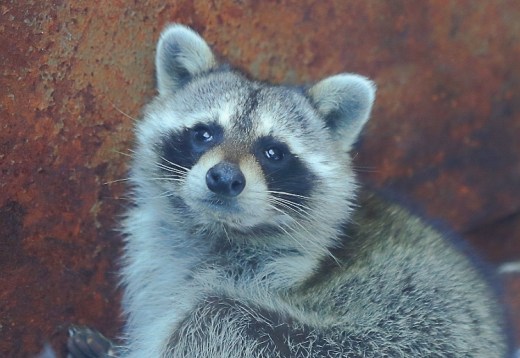
2022-01-17-003660-raccoon

This little critter was pointed out to me by a gentleman in a parking lot. Apparently It had been looking for tasty morsels in the large garbage bins, and was unable to get out on its own. Hopefully, someone gave him or her a ramp  to get out of the bin before the next garbage pickup.

2022-01-17-003640

I believe that this was a Yaupon Holly, or a cultivated variation thereof, as it was in the same parking lot as the raccoon. Could have been Ilex decidua, and just not dropped its leaves yet, due to a shorter Fall and Winter in Florida (if there is one). As a cultivated/planted plant, I didn’t bother to check it in iNaturalist.org.
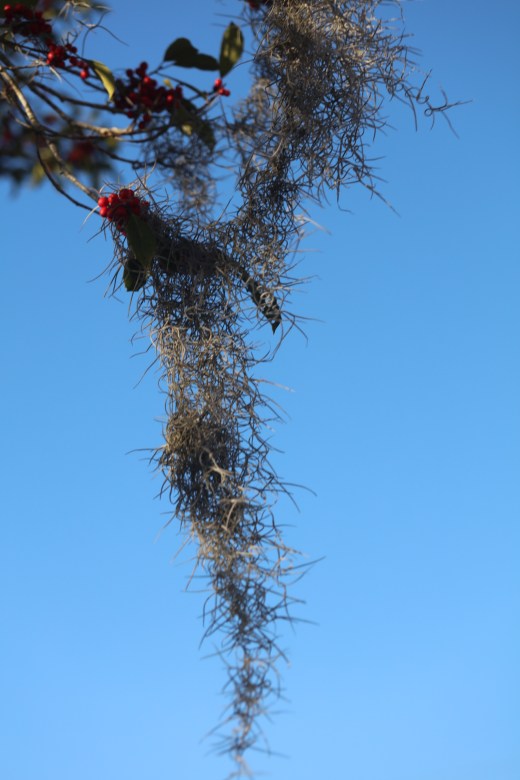
2022-01-17-003643

Spanish Moss

I suppose there is Spanish Moss in abundance in South and Gulf Coast Texas, but what we see here is mostly Ball Moss. So this was a distinctive and omnipresent reminder that we weren’t in the Greater Austin Metro Area anymore. (Of course, there were lots of Southern Oaks present, from which the Spanish Moss was hanging. We have them here, though other oak species are more common in Central TX.

A new one to me was this interesting little reddish plant. common name Tassel Plant. After encountering this one in the motel parking lot, I began to notice them all over Gainesville. An exotic or introduced plant.

Found in many places in the Gainesville area. An exotic or introduced plant

Tassel Plant

Finally, a fern which I had not yet known the name of A fern with the aptly descriptive common name of “Fishbone Fern.” This was shot in the jungle-like surroundings of Bivens Arm Nature Park on the South side of Gainesville, just north of Paynes Prairie. This photo  (below) was chosen because it demonstrates the leaf pattern that gives the fern its name.
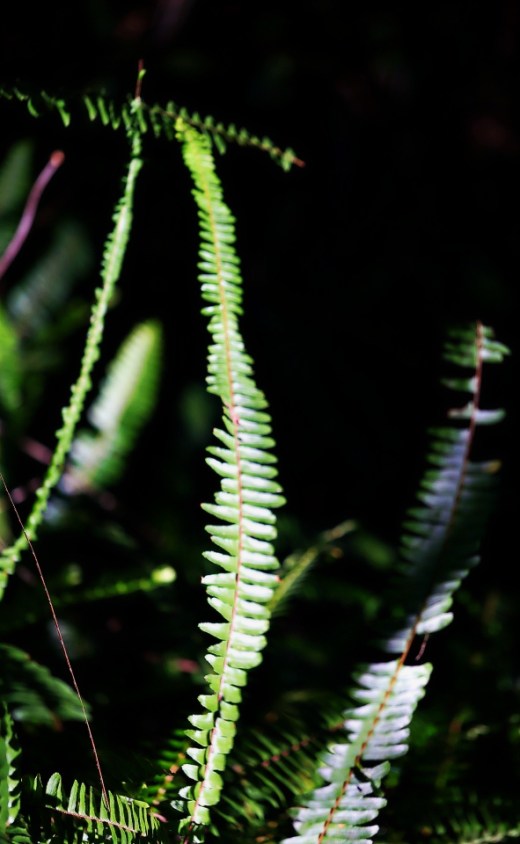
2022-01-18-003708-fishbonefern

Though it was nice to go “home”again, it was also nice to get back “home” again.

###

#nativeplants #Texas #Florida #GainesvilleFlorida
What’s in bloom in December?

Just a look at the most recent shots:

Taken on December 1, 2021. Since March 27, I have seen and photographed at least one Monarch Butterfly in each of the following months in 2021. And that just doesn’t seem right…

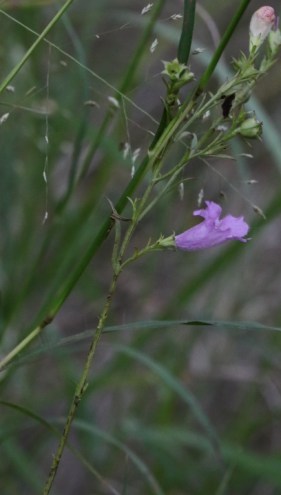
Agalinis species found on my way to cast my ballot . . .

Agalinis strictifolia

November 2nd, 2021, was a primary election day where I live. I decided to carry my camera in order to get some better photos of the first species shown below. Good enough for positive identification, if nothing else. On the other side of the draw, along the actual hike and dog walk bathroom trail, found a different set of Agalinis species. Plus other stuff, which I might post later. The Agalinis species are also known by the common name of “False Foxgloves” due to their resemblance to the “True” Foxgloves, one might suppose.

Agalinis in bloom and gone to seed on Election day:

Agalinis heterophylla

Agalinis heterophylla

and, not so far away,  Agalinis strictifolia:

Agalinis strictifolia

Agalinis sstrictifolia

I had a difficult time making the correct identification,  but thanks to the good-hearted folks on iNaturalist.org. I was able to get through my confusion and agree to the IDs they made from my numerous photos. Next year, I won’t wait until November to look for these. And hopefully, will be able to identify which Agalinis is which, using the field guides and other materials available.

###

Old man’s beard

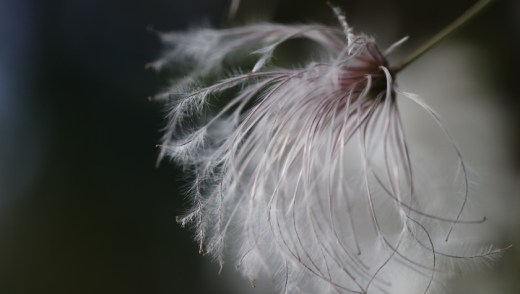
Last September, the bulldozers came and razed a 19 acre plot of land that was for sale. Along with it went any number of wildflowers, including a healthy stand of Old Man’s Beard, aka Texas Virgin’s Bower, and other native and a few invasive plants.

recently I came upon a female C. drummondii wending its way through some planted holly (most likely a non-native variety), catching the November sun in feathery achenes. 

Loss of roadside vegetation

My previous post mentioned a September set of observations – unfortunately, the observations were not posted to this blog but on Facebook. Sad to say, the situation has gotten worse – Although the native (mostly) plants  were left alone while in bloom in September, the blooms had disappeared a few. months later, and this first week of March 2021, I observed that the plants, for the most part, appeared to have been removed.  Thanks to the ongoing pandemic and my age, I try not to go out too often. but will have to go out and see if any Winecups are in evidence (there was at least one rosette in the video). Maybe take a few home to ensure the preservation of the species. The folks running City Hall don’t seem to care about preserving native plants… as far as I can tell. Oh well. Watch it and weep.

The irony of the last few slides are that they show the invasive Crepe Myrtle and Heavenly Bamboo or Nandina, used as landscaping in the property just south of. the one now being bulldozed for a parking lot and who knows what kind of business. I suspect that a similar lack of consideration for native plants, birds, and other wildlife will guide the development of this property.

#RoundRock #OldChisholmTrail #NativePlants #HabitatDestruction