Me and My PD – 14 Sept 2024

It’s been said that if you’ve met one person with Parkinson’s Disease (PD), then you’ve met one person with PD.

Today I saw a news segment about a guy who plays trombone, and how he had experienced a deterioration in his ability to play in the previous year. He was diagnosed with Essential Tremors (ET), also known as familial tremors or benign tremors. The point of the story was that he had opted for Deep Brain Stimulation (DBS), during which the patient is awake (at least part of the time), and that he played trombone during the operation.

I hope his physician got the diagnosis correct. As noted earlier in this blog, et-pd-is-there-is-or-is-there-aint-a-connection, a research paper was published that established a link between ET and PD: “LINGO1 rs9652490 is associated with essential tremor and Parkinson disease.” Having had essential tremors since my teenage years, I checked my DNA analysis and discovered that I did have that specific variation on the LINGO1 gene. As I’ve often remarked about PD research, this would have been good information to know 50 years ago.

I did remark a couple of times to my Movement Disorders Specialist’s team that I regretted not having asked to play the saxophone or guitar during my own DBS operation. To their credit, they attempted to fine tune my settings, but either due to lack of practice or progression of PD symptoms, I was not able to recover the picking and strumming skills I had back in 1997. And so it goes.

These days, I try to play on my keyboard as often as I can, but any attempt to follow an instructional program, or parse out simple pieces written for instruction (e.g., Bach’s selections from the notebook for Anna Magdalena, Bela Bartok’s pieces for children), soon devolve into loose jams on simple chord progressions, or attempts to recall, remember, and play some of my own simple songs with a minimum of egregious errors.

But I have promises to keep and chores to do before I sleep, so I will just end this with a selection from 1997, when I could play a little bit (self-taught). Unlike many of my songs, this one was not influenced by Bob Dylan.

You’re A Mystery To Me

#Essentialtremors #Parkinsonsdisease #music #DBS #idiopathic

###

Where have all the (native) flowers gone?

Prosser, R.S., Brain, R.A. Where have all the flowers gone? A systematic evaluation of factors driving native terrestrial plant decline in North America. Environ Sci Pollut Res (2024). https://doi.org/10.1007/s11356-024-34349-9 

Prosser and Brain have done the research and  have come up with the following conclusions:

  • Habitat alteration and non-native species are the most important drivers of the decline in native terrestrial plant diversity in North America.
  • No listed species in the U.S. or Canada faced a singular threat. In the recovery plans for all listed species, several threats were identified as contributing to their risk of extirpation or extinction.
  • Pesticides, specifically herbicides, represent a micro-scale contributor to the decline of plant biodiversity in North America relative to other drivers.

(Note: the above three points are taken verbatim from text in the article, although they are not presented as bullets in the subject article. Emphasis using bold and italics has been added).

In their conclusion, they argue that pesticides and herbicides make an easy target for litigation, even though they contribute minimally to the extirpation or extinction of native plants .

On the other hand, Paraquat is an herbicide that not only has been banned in over 50 other nation-states, and has been linked as a probable cause of Parkinson’s Disease in the book Ending Parkinson’s Disease: A Prescription For Action  and in this February 2024 article on the EarthJustice website: This Weed Killer Is Linked to Parkinson’s. Why Isn’t It Banned Yet?

I would suggest that the authors of the article on causes contributing to reduction of native plant species are failing, in their words, to see the forest by focusing on the trees. I am a native plant advocate who also has Parkinson’s Disease. I don’t know whether I have been exposed to Paraquat in the past. Just because pesticides and herbicides are not a major factor in the reduction of native species doesn’t mean I should just ignore the bigger picture of the effect of herbicides like Paraquat on the species Homo sapiens, many of whom, including myself, have displaced other native occupants of this territory, like the Apaches, the Tonkawas, and other tribal groups who are members of the same Genus and species.

This post has covered most of my main interests: scientific research, Parkinson’s Disease, and native plants. All that’s missing is some music:

The Parkinson’s Anthem (We Ain’t Givin’ Up Hope)

#nativeplants  #research #parkinsonsdisease #advocacy

We got the beat

This open access article piqued my interest. I have long been aware of studies that showed that infants are basically altruistic. This is the first one I came across that shows that infant “Spontaneous Motor Tempo”  (SMT)  is something that can be measured. Here’s the link:

Infant Spontaneous Motor Tempo

From the abstract:

We present the first data documenting the SMT of infants from 5 to 37 months of age using a simple drumming task. As in late childhood and adulthood, we predicted that infant SMT would slow across the first years of life. However, we find that older infants drum more quickly than younger infants. Furthermore, studies of adults suggest larger bodies prefer slower rhythms. 

(emphasis added to quote)  … which explains why this is the first time I’ve heard about infant SMT. A couple of their research highlights:

  • SMT can be measured at 5 months old using a simple drumming task
  • Infant drumming gets faster and more regular as they get older

Kinda makes you want to read  the whole article…

or sing along to the title to this post:

We Got The Beat

An early Spring, this year

This February has seen no scenes like the one above (Feb. 15, 2021) where we saw over 6 inches of snow and sub freezing temperatures for about two weeks. Thousands of people lost power, and I don’t want to look up how many died from the pre-20th Century conditions to which they were not conditioned or prepared to deal with.

However, thanks to Global Warming, this Winter has been warm, for the most part. So we’ve seen some early blooms, one of which always persists, is the Ten-Petal Anemone. This bloom is white, but the species can vary from white through pinkish to violet. (An artist might differ with my choice of descriptive colors).

And here’s an unopened Anemone berlandieri from the violet end of the spectrum.

What are these doing in the Bob’s Brain: Living well with PD and other co-morbidities blog?

  • Bob’s brain mistakenly failed to switch to the Back to the natives: Native plants are the answer before beginning the draft, or
  • Bob’s brain has other interests in his life other than an incurable, progressive,  degenerative neurological disease,
  • or both of the above… whatever answer you choose, you won’t go wrong.

Oh well, might as well end with a song:

https://youtu.be/sxoTWy0bTXo?si=NmKkd0bLzysH8ZSO

###

Just a song and dance man

[updated April 8, 2025]

Some folks may recognize the title as an allusion to an old interview with Bob Dylan in which a reporter asked about him being considered a protest singer and/or the voice of a generation. If not, do a search on YouTube for the interview – probably in San Francisco, 1965, maybe – If my memory serves me well.

A hallmark of human movement is volitional control – the freedom to move easily, automatically, and safely within the changing demands of daily living. Clinical signs characteristic of Parkinson’s disease (PD) include rigidity and tremor, hypokinesia, stooped posture, vocal alterations, facial masking, and progressive loss of peri- and extrapersonal use of space . These movement aberrations are one of many factors that increase the risk of falling and point to the need for improving fall prevention strategies . These disease-related limitations experienced by people with Parkinson’s disease (PPD) increasingly rob them of movement freedom. Quality of life declines as conscious attention and effort in everyday living replace spontaneity of communication and safety in navigation.

Reading those words in the introduction to this article  flowed off of the page like they  were written in my soul. Many times I have avoided falling by using dance steps learned in my Rhythm and Moves class from Power for Parkinson’s® (PfP) (taught by Nancy Bain) located in nearby Austin, Texas. And certainly the improvisational dance techniques used in the class have improved my quality of life, allowing me to be more spontaneous. Following a fall in April of 2023, I have been on a 6 month journey of rehabilitation, and certainly my quality of life has deteriorated somewhat due to the conscious attention and effort in performing activities of daily living. But  dance, music, and improvisation continue to be the core of my spirit as I strive to improve against this incurable (yet!), progressive, degenerative, neurological disease. Even though I don’t get around much anymore…

This study reported on one of the co-authors’ method in teaching dance to mild-to-moderate stage People with Parkinson’s over a 3-year period (2013–2015). She is a tenured university dance professor also trained in the Mark Morris Dance for PD® program. 

Another (modified) quote from the article is this table, which I find reflects many of the implicit and explicit principles used in dance classes.  Verbal Auditory Cueing (VAC) is the acronym used in the table. Color coding has been added to separate the different methods more clearly:

Principles

and Methods 

Non-judgment

Class advertised as movement class


Greeting at entrance by teacher


Class offered free of charge


Inclusion of carepartners as students


VAC that there are no mistakes, only new movement options

Non-competitiveness

All movement is seen as an honest effort


VAC focused on action, not quality of movement


VAC “Yes, and …” replaces “Not that” or “Rather try this”

Curiosity and

playfulness

Awareness of movement possibilities

VAC “Stay curious in what you are doing” or “Keep going”

VAC “Nothing is precious”

Pacing of VAC does not allow self-editing

Risk taking

Selection of class environment


Student self-selection of participation level


VAC to validate self-selected level of participation


Adaptation of exercises to sitting or at the barre as needed


Structured, directive (non-improvised) activity transitions

VAC to attend to constraints of an activity rather than invoke fear

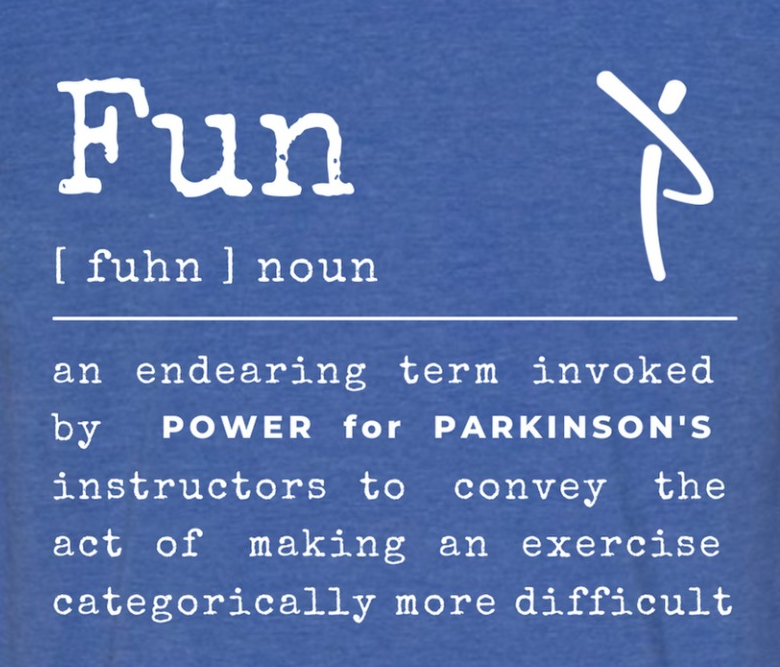
Another point used in the method was to increase challenge by gradually increasing the variety and complexity of movement tasks. In this way, the participants maintained safety while increasing their sense of confidence.  In PfP classes, this is called “Fun.” They even have a t-shirt with the definition of Fun printed on the back.

FUN Tshirt — Power for Parkinson's - www.powerforparkinsons.org

This particular study was published back in 2016,  and most of the authors were associated with Wake Forest University in Winston-Salem North Carolina.

Here’s the citation and a link to the open access article, which goes into more detail about the principles and the practice of the improvisational dance classes.

Batson G, Hugenschmidt CE, Soriano CT. Verbal Auditory Cueing of Improvisational Dance: A Proposed Method for Training Agency in Parkinson’s Disease. Front Neurol. 2016 Feb 17;7:15. doi: 10.3389/fneur.2016.00015. PMID: 26925029; PMCID: PMC4756105.

More information about Power for Parkinson’s®, their classes, and YouTube channel can be found at:

https://powerforparkinsons.org

Another 501(c)(3) charitable organization which happens to be focused on improvisation as a means to offer People with Parkinson’s (and their caregivers) to a safe environment using many of the principles listed above is Yes, and… Exercise (if that sounds familiar, take a look at the methods related to non-competitiveness in the table above) at https://yesandexercise.org.

And since the title says it, here’s a song about dance that I loved as a kid (still do, and probably still will, if I ever grow up)(note 2025-04-08: the original link is no longer available, so I just created a link to a song  that I also loved during my wasted youth, besides, I don’t remember what the original link was about.)

The Contours “Do You Love Me (Now That I can dance?)”

###

Music, movement, and PD

Jerry Coker, who was one of my instructors my first year in undergraduate college, and then again my last semester before graduation , had an hypothesis that for improvisation to be enjoyable, it had to be approximately 75% predictable and 25% unpredictable. Vary too far from those parameters, and you end up with something that is either too boring and predictable, or something that leaves the listener wondering what’s going on, trying to guess where the melody is.

I never advanced far enough to get his insights on swing, or the concept of where the beat is. Duke Ellington, whom I saw at a festival once, did have a short primer on swing. He began with the person who snaps his fingers or taps his feet on the downbeats (ONE-and-TWO-and….). Then he progressed to the folks who tapped their feet or snapped their fingers on the upbeat (1-AND-two-AND..). I forget where it went from there (maybe to Latin rhythm patterns), although I do remember him saying that when he greeted people, he always gave two kisses to the right, and two to the left, one for each cheek.

Love You Madly (ending)

Today’s readings all relate to music and movement –

From  Saluja A, Goyal V, Dhamija RK. Multi-Modal Rehabilitation Therapy in Parkinson’s Disease and Related Disorders. Ann Indian Acad Neurol. 2023 Jan;26(Suppl 1):S15-S25. doi: 10.4103/aian.aian_164_22. Epub 2022 Nov 21. PMID: 37092020; PMCID: PMC10114534. 

(emphasis added to the section quoted below):

Dance, Music, and Singing Therapy in Pd Rehabilitation

Dancing may improve speed of movement, balance, wellbeing, and QOL in patients with PD.[74,75] Multiple dancing interventions and their impact on symptomatology of PD patients have been assessed. In a systematic review of 38 articles that studied the role of various dancing interventions (tango, waltz/foxtrot, Sardinian folk dancing, Irish set dancing, Brazilian samba, Zumba, mixed dance forms, and home-based dance interventions), there was a moderate-to-large beneficial effect of dancing interventions in mild-to-moderate PD. Dancing sessions (once/week to daily for 30 minutes to 2 hours) significantly improved balance, total UPDRS, mobility, endurance, gait freezing, and depression among PD patients.[76]

Music and rhythmic auditory stimulation can improve gait parameters in PD.[77] BEATWALK is a smartphone-based application that initially assesses cadence in PD patients and then progressively increases musical tempo in order to reach the desired speed. A recent study found that BEATWALK significantly improved gait velocity (P < 0.01), cadence (P: 0.01), stride length (P: 0.04), and distance (P: 0.01) among 39 PD patients who could walk unaided and had no gait freezing.[78] The ParkinSong trial studied the effect of singing intervention (at weekly and monthly intervals) in PD and found significant improvements in vocal intensity (P = 0.018), maximum expiratory pressure (P = 0.032), and voice-related QOL (P = 0.043) among PD patients when compared to controls.[79] A recent systematic review and meta-analysis including 67 publications found that tango resulted in significantly improved UPDRS-III scores (Z = 2.87, P = 0.004) and TUG scores (Z = 11.25, P < 0.00001), whereas PD-specific dance resulted in improvement in PDQ-39 scores (Z = 3.77, P = 0.0002) when compared to usual care.[80]

Cox L, Youmans-Jones J. Dance Is a Healing Art. Curr Treat Options Allergy. 2023 Apr 10:1-12. doi: 10.1007/s40521-023-00332-x. Epub ahead of print. PMID: 37361639; PMCID: PMC10088655.

This article is considered an Opinion Statement rather than a “research study,”although they used the same armchair/desk jockey methods used by many reviews and meta-reviews. From the abstract (emphasis added):

The purpose of this review is to evaluate the health benefits of dance and dance therapy in various health domains. Dance interventions included movement therapy with certified therapists, common dances such as ballroom dancing, salsa, and cha-cha as well as ethnic dances, such as the Chinese Guozhuang Dance and the Native American jingle dance. The health domains included depression, cognitive function, neuromotor function, dementia, balance, neurological growth factors, and subjective well-being. The National Library of Medicine, Congress of Library, and the Internet were searched using the terms: dance, dance movement therapy, health, cognitive function, healing, neurological function, neuromotor function, and affective disorders from 1831 to January 2, 2023. Two-thousand five hundred and ninety-one articles were identified. Articles were selected if they provided information on the health benefits of dance in one or more of the above domains as compared to a “non-dance” control population. Studies included systematic reviews, randomized controlled studies, and long-term perspective studies. Most of the subjects in the studies were considered “elderly,” which was generally defined as 65 years or older. However, the benefits of DI on executive function were also demonstrated in primary school children. Overall, the studies demonstrated that DI provided benefits in several physical and psychological parameters as well as executive function as compared with regular exercise alone. Impressive findings were that dance was associated with increased brain volume and function and neurotrophic growth function. The populations studied included subjects who were “healthy” older adults and children who had dementia, cognitive dysfunction, Parkinson’s disease, or depression.

The benefits of dance for PwPs include movements and connections with others:

Jola C, Sundström M, McLeod J. Benefits of dance for Parkinson’s: The music, the moves, and the company. PLoS One. 2022 Nov 21;17(11):e0265921. doi: 10.1371/journal.pone.0265921. PMID: 36409733; PMCID: PMC9678293.

From the abstract:

Dance classes designed for people with Parkinson’s are very popular and associated not only with increasing individuals’ motor control abilities but also their mood; not least by providing a social network and the enjoyment of the music. However, quantitative evidence of the benefits is inconsistent and often lacks in power. For a better understanding of the contradictory findings between participants’ felt experiences and existing quantitative findings in response to dance classes, we employed a mixed method approach that focussed on the effects of music. Participant experience of the dance class was explored by means of semi-structured interviews and gait changes were measured in a within-subjects design through the Timed Up and Go (TUG) test before and after class, with and without music. We chose the TUG test for its ecological validity, as it is a simple test that resembles movements done in class. We hypothesised that the music and the dance class would have a facilitating effect on the TUG performance. In line with existing research, we found that before class, the gait of 26 participants was significantly improved when accompanied by a soundtrack. However, after class, music did not have a significantly facilitating effect, yet gait without music significantly improved after class compared to before.We suggest that whilst the music acts as an external stimulator for movement before the dance class, after the dance class, participants have an internalised music or rhythm that supports their motor control. Thus, externally played music is of less relevance. The importance of music was further emphasised in the qualitative data alongside social themes. A better understanding of how music and dance affects Parkinson’s symptoms and what aspects make individuals ‘feel better’ will help in the design of future interventions.

The entire article is Open Access at the link above. My own impression of the discussion of the contradictory results (from what was expected) reminded me of a quote my statistics professor was fond of repeating: It is meaningless to discuss what the data might have been if the data were something other than what they are. 

As a PwP, one explanation for the lack of significance difference in the TUG post-test could very well be fatigue. I, therefore, suggest that this could be looked into as a possible explanation for the lack of significant difference between external music v no external  music stimulus. Clearly, “Further research is needed.”

Morris ME, McConvey V, Wittwer JE, Slade SC, Blackberry I, Hackney ME, Haines S, Brown L, Collin E. Dancing for Parkinson’s Disease Online: Clinical Trial Process Evaluation. Healthcare (Basel). 2023 Feb 17;11(4):604. doi: 10.3390/healthcare11040604. PMID: 36833138; PMCID: PMC9957486.

The above citation reports on a clinical trial which was conducted with a fairly large and coordinated collaborative effort. Again, an excerpt from the abstract:

Results: Twelve people with PD, four dance instructors and two physiotherapists, participated in a 6-week online dance program. There was no attrition, nor were there any adverse events. Program fidelity was strong with few protocol variations. Classes were delivered as planned, with 100% attendance. Dancers valued skills mastery. Dance teachers found digital delivery to be engaging and practical. The safety of online testing was facilitated by careful screening and a home safety checklist. Conclusions: It is feasible to deliver online dancing to people with early PD.

As a PwP who has participated in Power for Parkinson’s online video dance Rhythm and Moves and other exercise videos, both live and asynchronously, the last line comes as no surprise.

The hour grows late, and I have medications to take before I sleep, oh so many medications to take before I sleep. To sleep, perchance to dream…

###
World Parkinson’s Day

Don’t know if it’s a cause for celebration or awareness, but here it is. World Parkinson’s Day , April 11, 2023. (If I managed to get my days right – seems I’m correct).

Anyway, to commemorate this day, I shall present some of my songs and “Parkinson’s Parodies©” that I’ve composed and or written lyrics to since having been diagnosed with Parkinson’s Disease in late 2011:

Submitted to the World Parkinson’s Coalition (WPC) this year as an entry in their song contest an original tune;

No Estoy Borracho

Also submitted to the WPC, a “Parkinson’s Parody©” based on Fleetwood Mac’s song “Don’t Stop”:

Don’t Stop Moving To The Music

Previously submitted to the WPC, but not this year,

Parkinson’s Anthem (We Ain’t Givin’ Up Hope”

… And that’s enough for today… I have an appointment with my Movement Disorders Specialist and so I gotta go now.

###

Don’t Stop Moving To The Music department

I’m not sure why the line numbers were included in the PDF, my guess is that it is/was pre-publication. At any rate, it just adds to the body of evidence that rhythm and movement helps get rid of the blues. 

Exploring the Use of Music to Promote Physical Activity Adherence: An Integrated Theoretical Approach. Kyoung Shin Park1*, David M. Williams, Jennifer L. Etnier  

Abstract …

Music can help people make more positive evaluations of acute exercise as an affective and
113 ergogenic stimulant. A recent meta-analysis of 139 studies revealed that listening to music during
114 acute bouts of exercise and sport activities increases positive affective valence (g = 0.48, CI [0.39,
115 0.56]), reduces ratings of perceived exertion (RPE; g = 0.22, CI [0.14, 0.30]), enhances physical
116 performance (g = 0.31, CI [0.25, 0.36]), and improves oxygen consumption (VO2max; g = 0.15, CI
117 [0.02, 0.27]) compared with activities without music (Terry et al., 2020). These findings support the
118 notion that music helps physical activity to be more joyous, less arduous, and more energetic and
119 efficient, arguably motivating the exerciser to join additional bouts. It is noteworthy that the
120 beneficial effects of music on affect and RPE were not moderated by physical activity intensity in the
121 meta-analysis (Terry et al., 2020), which indicates that music provides psychological benefits across
122 the full range of intensities.

Don’t Stop Moving To The Music

Prodromal symptoms, Parkinson’s Disease (PD), and that old song and dance…

Here’s a few studies that came up in my news feed from  PubMed Central (PMC) or elsewhere for articles recently published on the topics in which I’m interested – namely, prodromal symptoms related to PD, the relationship of REM sleep disorder and depression to PD, and, of course, the use of singing and dance therapies as complementary approaches to dealing with the symptoms of PD.

Prevalence and duration of non-motor symptoms in prodromal Parkinson’s disease

The prevalence and duration of non-motor symptoms (NMS) in prodromal Parkinson’s disease (PD) has not been extensively studied. The aim of this study was to determine the prevalence and duration of prodromal NMS (pNMS) in a cohort of patients with recently diagnosed PD.

…subtracted the duration of the presence of each individual NMS reported from the duration of the earliest motor symptom. NMS whose duration preceded the duration of motor symptoms were considered a pNMS. Individual pNMS were then grouped into relevant pNMS clusters based on the NMSQuest domains. Motor subtypes were defined as tremor dominant, postural instability gait difficulty (PIGD) and indeterminate type according to the Movement Disorder Society Unified Parkinson’s Disease Rating Scale revision.

Results: Prodromal NMS were experienced by 90.3% of patients with PD. … males reporting more sexual dysfunction, forgetfulness and dream re-enactment, whereas females reported more unexplained weight change and anxiety. There was a significant association between any prodromal gastrointestinal symptoms and urinary symptoms  and the PIGD phenotype.[n.b.: phenotype includes inherent traits or characteristics that are observable]. [Emphases added].

Citation:  Durcan R, Wiblin L, Lawson RA, Khoo TK, Yarnall AJ, Duncan GW, Brooks DJ, Pavese N, Burn DJ; ICICLE-PD Study Group. Prevalence and duration of non-motor symptoms in prodromal Parkinson’s disease. Eur J Neurol. 2019 Jul;26(7):979-985. doi: 10.1111/ene.13919. Epub 2019 Mar 1. PMID: 30706593; PMCID: PMC6563450.

Associations of Sleep Disorders With Depressive Symptoms in Early and Prodromal Parkinson’s Disease

Purpose: To explore the effect of sleep disorders, including the probable rapid eye movement (REM) sleep behavior disorder (pRBD) and the daytime sleepiness, on depressive symptoms in patients with early and prodromal PD.

5-year follow-up study showed that sleep disorders, including pRBD and daytime sleepiness, were associated with the increased depressive-related score in individuals with early and prodromal PD.

Conclusion:Sleep disorders, including pRBD and daytime sleepiness, are associated with depression at baseline and longitudinally, …  partially mediated by the autonomic dysfunction in early and prodromal PD, …  implication that sleep management is of great value for disease surveillance.

Citation: Ma J, Dou K, Liu R, Liao Y, Yuan Z, Xie A. Associations of Sleep Disorders With Depressive Symptoms in Early and Prodromal Parkinson’s Disease. Front Aging Neurosci. 2022 Jun 10;14:898149. doi: 10.3389/fnagi.2022.898149. PMID: 35754965; PMCID: PMC9226450.

Group therapeutic singing improves clinical motor scores in persons with Parkinson’s disease

Abstract
Background Previous reports suggest that group therapeutic singing (GTS) may have a positive effect on motor symptoms in persons with Parkinson’s disease (PD).

Objective To determine the effect of a single session of GTS on clinical motor symptoms.

Methods Clinical motor symptom assessment was completed immediately before and after 1 hour of GTS in 18 participants.

Results A significant decrease in average scores for gait and posture and tremor, but not speech and facial expression or bradykinesia was revealed.

Conclusion These results support the notion that GTS is a beneficial adjuvant therapy for persons with PD that warrants further research.

Citation: Stegemoller E, Forsyth E, Patel B, et al. Group therapeutic singing improves clinical motor scores in persons with Parkinson’s disease BMJ Neurology Open 2022;4:e000286. doi: 10.1136/bmjno-2022-000286

Sing!

What research has found its way into the email inbox recently?

Although singing is a nearly universal human behavior, many adults consider themselves poor singers and avoid singing based on self-assessment of pitch matching accuracy during singing (here referred to as singing accuracy), in contrast to the uninhibited singing exhibited by children. In this article, I report results that shed light on how singing accuracy changes across the lifespan, using data from a large online sample, including participants ranging from 6 to 99 years old. Results suggest that singing accuracy improves dramatically from childhood to young adulthood, unperturbed by voice changes during adolescence, and remain at a similarly high level for the remainder of life, exhibiting no strong tendency toward age-related decline. Vocal or instrumental musical training has significant positive effects on singing accuracy, particularly in childhood, though there was no evidence for gender differences. Finally, pitch discrimination varied with age similarly to singing accuracy, in support of views that singing accuracy reflects sensorimotor learning. Taken together, these results are consistent with the view that singing accuracy is a learned motor skill that benefits from engagement and can remain a fruitful endeavor into old age. (emphasis added).

citation: Singing accuracy across the lifespan
Peter Q. Pfordresher preprint  article accessed 6-19-22 at https://nyaspubs.onlinelibrary.wiley.com/doi/10.1111/nyas.14815

Basically, this says that if you learned how sing accurately when you were young, you can probably sing well into your later years. And, since singing is a learned motor skill, one might assume that it can be learned even as one gets older.

Relevance to folks with Parkinson’s Disease (PD)?

Vocal strength exercises, such as those provided by Power for Parkinson’s as free YouTube video classes, can help with specific Parkinson’s related symptoms:

Many people with PD speak quietly and in one tone; they don’t convey much emotion. Sometimes speech sounds breathy or hoarse. People with Parkinson’s might slur words, mumble or trail off at the end of a sentence. Most people talk slowly, but some speak rapidly, even stuttering or stammering.

Parkinson’s motor symptoms, such as decreased facial expression, slowness and stooped posture, may add to speech problems. These can send incorrect non-verbal cues or impact the ability to show emotion. Source: https://www.michaeljfox.org/news/speech-swallowing-problems accessed June 20, 2022  (emphasis added).

Since our vocal cords are muscles, and singing is a learned motor skill, we can strengthen those muscles and push against the progressive, degenerative symptoms of PD through exercises that:

  • remind us to breathe deeply to sustain vocal volume,
  • improve our posture in order to enable deep breathing,
  • exercise the muscles of the face and mouth
  • to enable crisp diction instead of slurring and mumbling, and that
  • support emotional expression through inflection and singing.

And “Everybody Knows” that if exercise is fun, one is more likely to continue doing it.

Full disclosure: The author has attended Power for Parkinson’s ® vocal exercise classes since their inception in 2016, and co-founded a participant organized singing group (with the late Jeff Berke) in 2015.  Therefore, he might be (definitely is) biased in favor of this modality of treatment for vocal and speech related symptoms of PD.

###