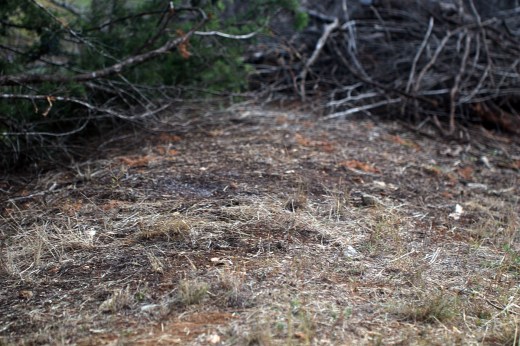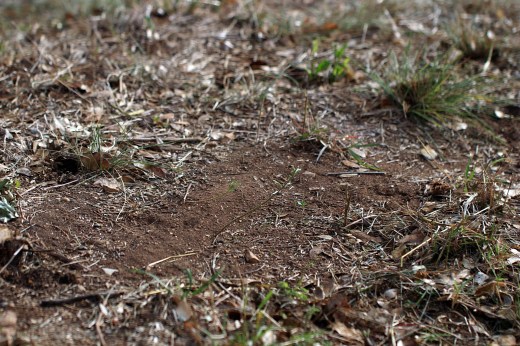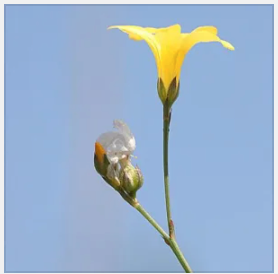
Oh no! They (almost) did it again!?!

May 7, 2021: I was just about to go out into the greenbelt for some photo taking when I heard the sound of a mower on the berm. I quickly came back running and shouting for him to stop.

Pointing out all of the native Texas wildflowers still in bloom, I explained that one should NEVER mow down a stand of wildflowers in bloom (as was done last year while I talked on the phone with their home office). I mentioned that I was trying to eliminate the invasive weeds so that the native wildflowers would have a chance to return, including the Bluebonnets, some of which had not set seed yet. (And to which he replied something along the lines of yeah, I thought I saw some back there, indicating the area that he had just mowed, and which now showed no evidence of Bluebonnets).

For an idea of what happened in 2020, refer to these two posts: May 25, 2020 May 28, 2020

Last year I managed to pull most of the Perennial ryegrass (Lolium perenne) that had covered the berm. This time around, Maltese star-thistle (Centaurea melitensis) was the infestation of the year, and as of May 11, 2021, I have removed about 10 bags of this from the berm behind my house. Of course, it has already infested the greenbelt.

To their credit, the mowers backed off, apparently called someone for instructions on what to do, and then proceeded not to mow any more of the berm behind my fence, although he did have to drive through the area, choosing a path that would minimize the damage to the wildflowers. And crushed a good deal of the thistles to the ground, along with some wildflowers.

Thankfully, in spite of the C. melitensis, the wildflower population was much more numerous than last year. The recessive gene all-yellow Gaillardia pulchella (Indian blankets) for which I have coined the common name “Sunwheels” in contrast to the all-red pigmented “Firewheels” have also bloomed again, this time almost entirely on the berm. In previous years I have seen them in a few nearby locations, but for the last three years I have observed them directly behind my house, on the berm or in the greenbelt. (Of course, when you only have to step out the back yard to see them, you are not motivated to search very far for them).

But enough blah blah blah. Here are some pictures worth a thousand words, especially when compared with the posts from 2020.
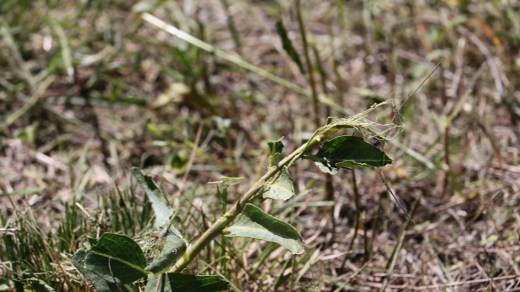
2021-05-05-7870

Asclepias asperula (Antelope Horns) after the mowing.

2021-05-05-7885

Gaillardia pulchella (“Sunwheel”) surrounded by Centaurea melitensis (Maltese star thistle)
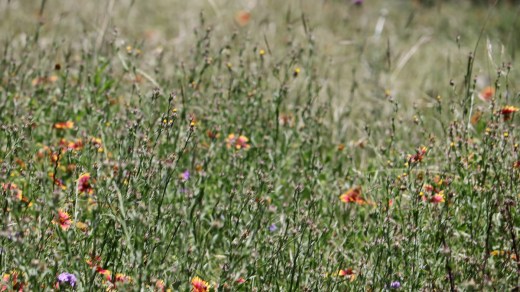
2021-05-05-7803

Berm behind my house – native plants plus invasive weeds
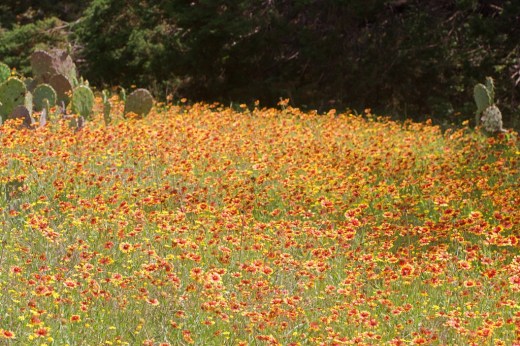
2021-05-14-8172-greenbelt2-1024pxl

The green belt – Gaillardia pulchella in bloom

2021-05-14-8146

The mower mows, leaving nothing behind. Looking South from behind my house, greenbelt to the left, berm behind my fence in the foreground.

May all your weeds be wildflowers.

#BCMUD

###
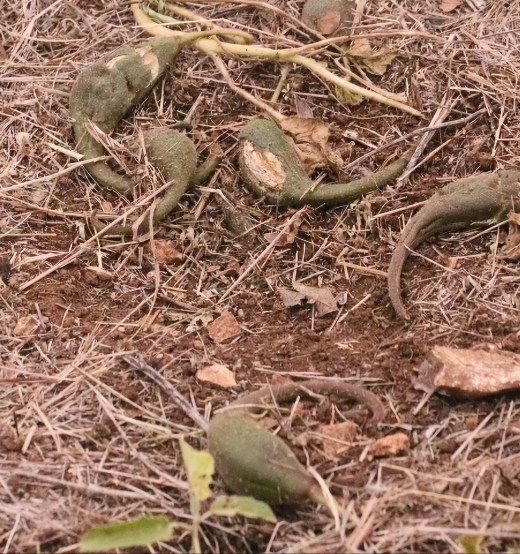
And we have some losers…

Proboscidea louisianica - Ram's Horn, Devil's Claw

Not so long ago, (November 10th 2020) I went out to the backyard and looked over the fence to find that the mowers had once again been through the berm ( the area between the houses and the greenbelt/protected zone that prevents (one hopes) undesirable materials (such as pesticides) from draining into the cavern which houses an endangered species.

Here’s what I observed:

2020-11-10-3715

2020-11-10-3711

“Scalping” of the berm in several places. The berm is slightly sloped, so as one drives over the top from either side, it is hard to avoid scalping unless the blades of the mower are set to the seven inches which the Texas Department of Transportation specifies in its 2018 Roadside Vegetation Management Manual for rural areas and five inches in urban areas (Chapter 2, page 17). The reasoning is this: low cutting is undesirable because it:

  • stresses the vegetation, especially in dry, hot conditions, resulting in loss of desirable vegetative cover,
  • deprives wildlife of cover,
  • and the lack of leaves above the ground reduces the ability of the plants to develop roots below the ground, resulting in susceptibility to things like
    • erosion,
    • loss of native plant cover, and
    • vulnerability to invasive plant species which can crowd out native species because they have no natural enemies or symbiotic fauna species ( which might depend on them for survival).

Earlier posts on this blog have documented

  • Mowing on wet ground after a rain (Chapter 2, page 16)
  • Mowing down stands of wildflowers still in bloom, (Chapter 1, page 8), and
  • invasive species that were most likely introduced by failure to follow safe hygiene (Special Provision 730-003, which requires pressure washing before and after equipment enters and leaves an area).

The November mowing was no exception, although it was done on dry soil, before a predicted rainfall the following week. But no plants below the height of three inches was spared. Although this Proboscidea louisianica was no longer in bloom, it had not completely set seed, as evident in these still green fruits. The mower had no sympathy for this Devil’s Claw.

Proboscidea louisianica - Ram's Horn, Devil's Claw

Proboscidea louisianica – Ram’s Horn, Devil’s Claw

One of my favorite Korean drama series, “Romance Is A Bonus Book” has a scene in which the CEO of the book publishing company says “You don’t need a botanist to mow the lawn.”

I’m beginning to think that you DO need a botanist, if not to mow the lawn, to tell the mowers When to mow, Where to mow, What to mow, How to mow, and Why to mow or not mow, so that the person Who does the mowing understands what he or she is doing, and can take pride in a job well done. The supervisors of the people who have mowed the berm between my house and the greenbelt, as well as other locations, based on the evidence I see, do not know, or have not trained their employees well.

Every time I see a roadside scalped, or steep sloped ditch mowed when it should have been planted with appropriate native plants, I wonder how long humans have before they realize that they are not the only species on this planet, and start to act as intelligently as they seem to think they are, “the most intelligent creatures on Earth.”