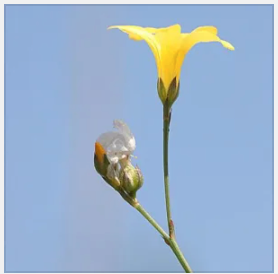
Loss of roadside vegetation

My previous post mentioned a September set of observations – unfortunately, the observations were not posted to this blog but on Facebook. Sad to say, the situation has gotten worse – Although the native (mostly) plants  were left alone while in bloom in September, the blooms had disappeared a few. months later, and this first week of March 2021, I observed that the plants, for the most part, appeared to have been removed.  Thanks to the ongoing pandemic and my age, I try not to go out too often. but will have to go out and see if any Winecups are in evidence (there was at least one rosette in the video). Maybe take a few home to ensure the preservation of the species. The folks running City Hall don’t seem to care about preserving native plants… as far as I can tell. Oh well. Watch it and weep.

The irony of the last few slides are that they show the invasive Crepe Myrtle and Heavenly Bamboo or Nandina, used as landscaping in the property just south of. the one now being bulldozed for a parking lot and who knows what kind of business. I suspect that a similar lack of consideration for native plants, birds, and other wildlife will guide the development of this property.

#RoundRock #OldChisholmTrail #NativePlants #HabitatDestruction
Native plants are the answer…

Maybe it’s just me, but it seems to me that there are far too many crepe myrtles (Lagerstroemia sp.) in use for the good of the planet, especially for the good of wildlife in the United States.

The same could be said of other exotic plants, such as Privet or Ligustrum (Ligustrum sp.), Heavenly Bamboo (Nandina domestica),   Chinaberry (Melia azedarach), and others. Even plants native to one area might become invasive if introduced and allowed to spread in another ecoregion.

Best advice, of course, is to plant plants that are native to your ecoregion. And with Climate Change (or Climate Chaos, which seems to be a more accurate description), even plants native to one’s ecoregion might be getting squeezed out or moving further north, or moving higher up, or retreating into ecological niches (if they haven’t been paved over or bulldozed into oblivion).

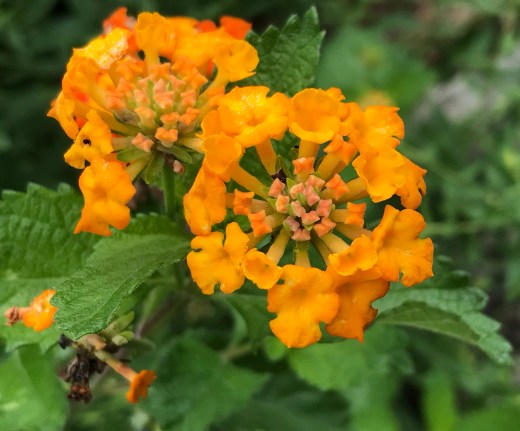
img_0413

Texas Lantana (Lantana urticoides)

Take, for instance, Texas Lantana (Lantana urticoides) which can often be found, even in the “big box” stores. However, its cousin Lantana camara which is similar but has different colored flowers and somewhat different leaf texture (I am told) can also be found in those same stores which don’t offer plants grown only in the local region. So it shouldn’t have surprised me when I found several of the L. camara in the greenbelt this past fall, growing right beside what I took to be L. urticoides. And while trying to get photos of a stand of native Solidago sp., (aka Goldenrod), I chanced upon a young Chinaberry (Melia azedarach) sapling. Nearby there are several invasive Chinese pistache (Pistacia chinensis). And that’s just directly behind my house and/or my neighbors’ houses.

This, in a greenbelt that is protected because there is a cavern underneath it within which live one or two endangered species.

The conclusion is the title to this post.

PLANT GRASSES, FLOWERS, SHRUBS AND TREES THAT ARE NATIVE TO THE AREA IN WHICH YOU LIVE. NOTHING ELSE.

If you want a Crepe Myrtle in your yard, then move to Southeast Asia, or wherever it is that they’re from. And take the big-box store nurseries with you. Please. Thank you.

p.s. drove past the construction site where I had taken photos on September 23, 2020, and it appears that most of the native plants have been the subject of “brush clearing.” Don’t know for sure. Didn’t stop and inspect. Would think the Winecups might be in bloom, either now or soon.

###.