
ET & PD – is there is or is there ain’t a connection?

As a person who has had essential tremors ever since his teenage years, and a person who was diagnosed with Parkinson’s disease at the average onset age of 62 years, it was with great interest that the author reviewed the abstracts and full text open access PubMedCenter articles available on the topic.

The author can recall others (medical professionals included) who did not observe tremors, although this subject could feel the tremors within, during teenage years. During undergraduate studies, he once was told that his initial impression on a fellow college student looking to sublet a room was that of a “speed freak” (methamphetamine abuser to those unfamiliar with the term). At age 28, his future wife remarked on his trembling hands as he reached out to touch her cheek in a moment of intimacy. And at age 60, following several recurring episodes of depression and increasing tremors, he was treated for essential tremors for almost two years, beginning in 2010. Then, after having opted for Deep Brain Stimulation (DBS), and undergoing further testing for several months, a third symptom, rigidity, one of the four cardinal symptoms of PD, was observed, allowing the Movement Disorder Specialist to finally make a diagnosis of PD. Mind you, the four cardinal symptoms required to make the call haven’t changed since 1817, when James Parkinson published his Essay On The Shaking Palsy. In case you don’t  already know, they are Tremors, Postural Instability, Bradykinesia, and Rigidity.

On the other hand, it was only in 2009 that the study “LINGO1 rs9652490 is associated with essential tremor and Parkinson disease” came out online and published in print a few months later in 2010.  In which year, the observant reader will notice, was when this author began receiving treatments for essential tremors, finally diagnosed in late 2011 as Parkinson’s.

After a few articles reported similar results, a few negative results were reported, in part by one group of desk jockeys who conducted a meta-review and concluded that there was NO association between ET and PD.  On looking just briefly at the abstracts, one can see that those that found a positive connection and those that found no connection were looking at different populations. The positive association came from a European background, and those with no association came from a Chinese population sample.  Mix them all together and you get mixed results, which doesn’t mean that a person with a half European background (like myself) with this specific variation doesn’t have an increased risk of developing ET (P = 0.014) and Parkinson’s(P = 0.0003), as reported in the article noted above.

So who should I believe? A study that involved a sample in which the participants were similar in ethnic/DNA background to mine? Or a meta-review which concludes that the null hypothesis is true? Or my own brain and body, which began exhibiting strong tremors back in late teens to early twenties? And which became so severe by age 60  that I couldn’t carry a cup of coffee from the kitchen to the living room without going into extreme oscillations?

Those were rhetorical questions, by the way.

References:

Jiménez-Jiménez FJ, García-Martín E, Lorenzo-Betancor O, Pastor P, Alonso-Navarro H, Agúndez JA. LINGO1 and risk for essential tremor: results of a meta-analysis of rs9652490 and rs11856808. J Neurol Sci. 2012 Jun 15;317(1-2):52-7. doi: 10.1016/j.jns.2012.02.030. Epub 2012 Mar 17. PMID: 22425540.

Agúndez JA, Lorenzo-Betancor O, Pastor P, García-Martín E, Luengo A, Alonso-Navarro H, Jiménez-Jiménez FJ. LINGO1 rs9652490 and rs11856808 are not associated with the risk of Parkinson’s disease: results of a meta-analysis. Parkinsonism Relat Disord. 2012 Jun;18(5):657-9. doi: 10.1016/j.parkreldis.2011.09.005. Epub 2011 Sep 28. PMID: 21955595.

Lorenzo-Betancor O, Samaranch L, García-Martín E, Cervantes S, Agúndez JA, Jiménez-Jiménez FJ, Alonso-Navarro H, Luengo A, Coria F, Lorenzo E, Irigoyen J, Pastor P; Iberian Parkinson’s Disease Genetics Study Group Researchers. LINGO1 gene analysis in Parkinson’s disease phenotypes. Mov Disord. 2011 Mar;26(4):722-7. doi: 10.1002/mds.23452. Epub 2011 Jan 4. PMID: 21506150.

Wu YW, Rong TY, Li HH, Xiao Q, Fei QZ, Tan EK, Ding JQ, Chen SD. Analysis of Lingo1 variant in sporadic and familial essential tremor among Asians. Acta Neurol Scand. 2011 Oct;124(4):264-8. doi: 10.1111/j.1600-0404.2010.01466.x. Epub 2010 Dec 15. PMID: 21158743.

Zuo X, Jiang H, Guo JF, Yu RH, Sun QY, Hu L, Wang L, Yao LY, Shen L, Pan Q, Yan XX, Xia K, Tang BS. Screening for two SNPs of LINGO1 gene in patients with essential tremor or sporadic Parkinson’s disease in Chinese population. Neurosci Lett. 2010 Sep 6;481(2):69-72. doi: 10.1016/j.neulet.2010.06.041. Epub 2010 Jun 19. PMID: 20600614.

Clark LN, Park N, Kisselev S, Rios E, Lee JH, Louis ED. Replication of the LINGO1 gene association with essential tremor in a North American population. Eur J Hum Genet. 2010 Jul;18(7):838-43. doi: 10.1038/ejhg.2010.27. Epub 2010 Apr 7. PMID: 20372186; PMCID: PMC2987362.

Nica AC, Montgomery SB, Dimas AS, Stranger BE, Beazley C, Barroso I, Dermitzakis ET. Candidate causal regulatory effects by integration of expression QTLs with complex trait genetic associations. PLoS Genet. 2010 Apr 1;6(4):e1000895. doi: 10.1371/journal.pgen.1000895. PMID: 20369022; PMCID: PMC2848550.

Vilariño-Güell C, Wider C, Ross OA, Jasinska-Myga B, Kachergus J, Cobb SA, Soto-Ortolaza AI, Behrouz B, Heckman MG, Diehl NN, Testa CM, Wszolek ZK, Uitti RJ, Jankovic J, Louis ED, Clark LN, Rajput A, Farrer MJ. LINGO1 and LINGO2 variants are associated with essential tremor and Parkinson disease. Neurogenetics. 2010 Oct;11(4):401-8. doi: 10.1007/s10048-010-0241-x. Epub 2010 Apr 6. PMID: 20369371; PMCID: PMC3930084.

Wu Y, Wang X, Xu W, Liu W, Fang F, Ding J, Song Y, Chen S. Genetic variation in LINGO-1 (rs9652490) and risk of Parkinson’s disease: twelve studies and a meta-analysis. Neurosci Lett. 2012 Jul 26;522(1):67-72. doi: 10.1016/j.neulet.2012.06.018. Epub 2012 Jun 15. PMID: 22710005.

Jasinska-Myga B, Wider C. Genetics of essential tremor. Parkinsonism Relat Disord. 2012 Jan;18 Suppl 1:S138-9. doi: 10.1016/S1353-8020(11)70043-8. PMID: 22166413.

Bourassa CV, Rivière JB, Dion PA, Bernard G, Diab S, Panisset M, Chouinard S, Dupré N, Fournier H, Raelson J, Belouchi M, Rouleau GA. LINGO1 variants in the French-Canadian population. PLoS One. 2011 Jan 11;6(1):e16254. doi: 10.1371/journal.pone.0016254. PMID: 21264305; PMCID: PMC3019170.

Guo Y, Jankovic J, Song Z, Yang H, Zheng W, Le W, Tang X, Deng X, Yang Y, Deng S, Luo Z, Deng H. LINGO1 rs9652490 variant in Parkinson disease patients. Neurosci Lett. 2011 Jan 7;487(2):174-6. doi: 10.1016/j.neulet.2010.10.016. Epub 2010 Oct 15. PMID: 20951767.

Thier S, Lorenz D, Nothnagel M, Stevanin G, Dürr A, Nebel A, Schreiber S, Kuhlenbäumer G, Deuschl G, Klebe S. LINGO1 polymorphisms are associated with essential tremor in Europeans. Mov Disord. 2010 Apr 30;25(6):717-23. doi: 10.1002/mds.22887. PMID: 20310002.

Vilariño-Güell C, Ross OA, Wider C, Jasinska-Myga B, Cobb SA, Soto-Ortolaza AI, Kachergus JM, Keeling BH, Dachsel JC, Melrose HL, Behrouz B, Wszolek ZK, Uitti RJ, Aasly JO, Rajput A, Farrer MJ. LINGO1 rs9652490 is associated with essential tremor and Parkinson disease. Parkinsonism Relat Disord. 2010 Feb;16(2):109-11. doi: 10.1016/j.parkreldis.2009.08.006. Epub 2009 Aug 31. PMID: 19720553; PMCID: PMC2844122.

Deng H, Gu S, Jankovic J. LINGO1 variants in essential tremor and Parkinson’s disease. Acta Neurol Scand. 2012 Jan;125(1):1-7. doi: 10.1111/j.1600-0404.2011.01516.x. Epub 2011 Apr 7. PMID: 21470193.

Zimprich A. Genetics of Parkinson’s disease and essential tremor. Curr Opin Neurol. 2011 Aug;24(4):318-23. doi: 10.1097/WCO.0b013e3283484b87. PMID: 21734494.
Like Puzzles? You’ll love Parkinson’s

It’s been said that if you’ve met one person with Parkinson’s Disease (PD), then you’ve met one person with PD. This week I met another person with PD, who said the same thing.  The implication is that PD is different for everyone who has it (or any other form of parkinsonism, as the terminology goes). As stated by one of the contributing authors:

The truth is that every person living with PD has a unique expression of the dysfunction and precise balance of factors contributing to this idiosyncratic disease journey.

Today, we look at and try to communicate in  “normal”  language the following open access article. To read the original, just click on the link at the bottom of this post.

Different pieces of the same puzzle: a multifaceted perspective on the complex biological basis of Parkinson’s disease.

As noted in the abstract:

Notably, … growing recognition that the definition of PD as a single disease should be reconsidered, perhaps each with its own unique pathobiology and treatment regimen.

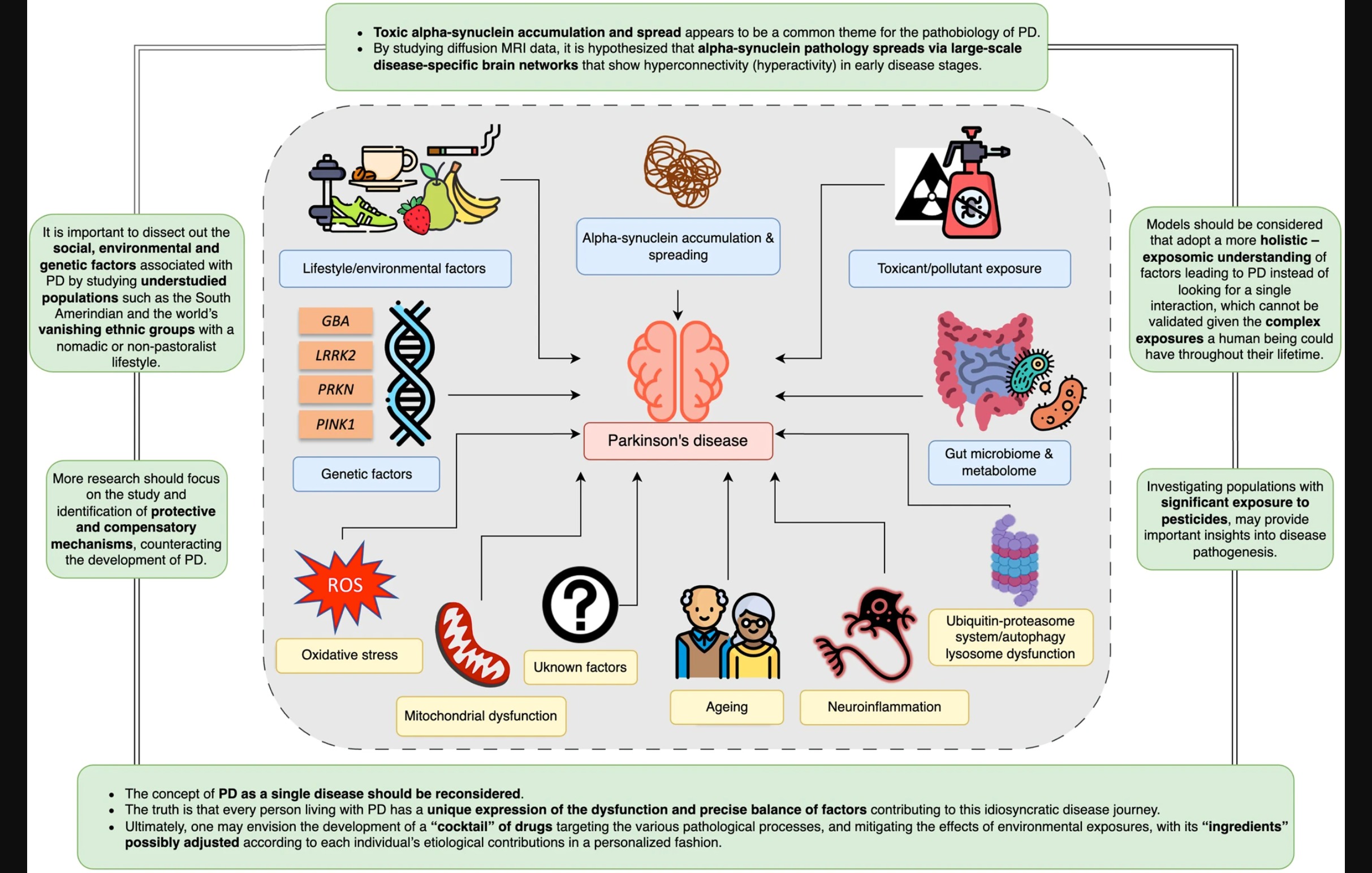
PD as complex- 41531_2023_535_Fig1_HTML.png (2075×1374) - media.springernature.com

Figure 1: Illustration from the article

Gene Genie

Pathological variations in a couple of different genes or enzymes ( PRKN, PINK1) are the strongest predictors of the disease. On the other hand, variations in other specific genes or enzymes (such as GBA and LRRK2) greatly increase an individual’s risk, and current research studies are looking into trying to tease out environmental factors, lifestyle behaviors or changes that might modify the course or severity of PD.

Down at the cellular level of our bodies, two other pathologies impact the progression of this neurodegenerative disease. One is the aggregation of alpha-synuclein proteins, the other is mitochondrial dysfunction, where the alpha-synuclein proteins fail to get cleared out and eventually result in apoptosis, or cell death. Part of this may be due to the aging process, but the occurrence of early onset PD should make us wary of the simplistic notion that PD symptoms are “just a sign of getting older.” The aggregation of alpha-synuclein proteins may be due to various reasons, such as over-production, while the end result is the same: mitochondrial dysfunction, leading to increased neurodegeneration.

LRRK2-ing around

Since its discovery in the early 2000s, the LRRK2 gene and leucine rich repeat kinase 2 enzyme have been repeatedly associated with the risk for PD.

Despite the fact that there have been no formal epidemiologic studies, and figures cited in the literature are mostly from clinical reports, LRRK2 dysfunctional mutations appear to confer the highest risk of PD. LRRK2 coding substitutions tend to be population specific: Basques,  North African Berbers, Ashkenazi Jews, and South Eastern Asia. Why these mutations (or variations) seem to provide an evolutionary advantage, allowing them to be passed on to future generations, is unknown.

Since PD is a multifactorial disease, the article proposes that animal models of the disease should also include factors such as genetic variations, environmental toxins, neurons, and the immune system, in order to find out where the biological intersections are.

Toxin exposure

Genetic risk factors, along with other factors, including toxins (including pesticides), are believed to have a cumulative impact on the brain, resulting in alpha-synuclein protein accumulation, low-grade inflammation, and the eventual apoptosis of dopaminergic neurons. These hypotheses are based on research data from high income countries. Two Sub Saharan African tribes, which have a nomadic or partly nomadic lifestyle, have virtually no exposure to pesticides, and no reported cases of parkinsonism. The author of this section suggests that “absence of” studies might be as important as “presence of” studies, in the search for causes of PD.

The genetic predisposition for PD may account for only 1/3 of the risk for PD.

…there is strong evidence to implicate pesticides as a significant environmental factor associated with the disease, especially paraquat, rotenone, and organochlorines

Although scientific research has shown its risks, paraquat is still widely used (and has not banned in the USA, although book bans seem to be popular. I have yet to hear of a book that caused PD).  Loose regulation of pesticides in Latin America seems highly correlated with the occurrence of PD compared to other countries,where paraquat is either restricted or banned. Studies comparing PD in populations where paraquat is restricted or banned vs. those in which its use is more loosely regulated, including longitudinal studies from conception to  end of life, are suggested. Finding biomarkers of chronic or long term exposure to such pesticides which might help predict risk of PD could be one goal of such studies. 

Toxic Hoarders: Accumulation of alpha-synuclein

Misfolded alpha-synuclein is the primary constituent of Lewy bodies, as was discovered over two decades ago. Further, variants in the alpha-synuclein gene (SNCA) were found to cause familial PD, linking genetics to PD for the first time. Since then, research has shown that it can also cause neurodegeneration and leads to apoptosis of mitochondria, and then on to the death of dopaminergic cells.

It is thought that abnormal alpha-synuclein s generated in the intestinal tract, where it causes inflammation and then can spread to the brain through the vagus nerve or other pathways.

Recent research has found the CHCHD2 gene as a cause for hereditary PD. This gene is localized to mitochondria, and animal model studies have show an increase in alpha synuclein in the brain. Whether alpha-synuclein damages mitochondria or mitochondrial dysfunction results in accumulation of misfolded alpha-synuclein is yet to be figured out.

Whether PD is body-first or brain-first in terms of pathogenesis is no longer a tenable position. Over the last 15 years, it has been recognized that “PD” should refer to “Parkinson’s Diseases,” which include a variety of factors, including genetic,  pesticides exposures, pollutants, exercise, diet, viral infection, head trauma, and inflammatory diseases, all of which interact to affect the progression of the symptoms.

Complexity, multiplicity and interactivity

Until recently, much of PD research has assumed that PD is a single disease; more recently, it has been accepted by many as a systemic disease with multiple effects on various systems instead of a localized neurological disorder. 

One of the authors of this article proposes a “threshold model” in which the different triggers work independently or simultaneously to build up stress on the various systems until reaching a a damage threshold, after which the initial stage(s) of the disease are developed.

We understand now that the disease initiation process is not following a single model. So, in one case, a pathogenic gene variant could interact with different environmental factors causing the disease (gene-environment interaction). In another case, different genetic variants could interact to cause the disease (gene–gene interaction), or different pollutants can interact to lead to the disease (environment-environment interaction). This can be even extended to involve more factors e.g., social stressors, metabolic diseases, etc. This model could allow us to adopt a more holistic – exposure over lifetime understanding of factors leading to PD instead of looking for a single interaction, which cannot be validated given the complex exposures a human being could have throughout their lifetime.

On the other hand, given that there is evidence that implicates both genetic and environmental factors in the occurrence and progression of PD, there are commonalities:

  1. PD is progressive and degenerative.
  2. PD includes the change of “normal” processes past a tipping point, to spiral downward into cellular degeneration. This includes factors such as inflammation, abnormal protein aggregation, and metabolic imbalance. Where it begins and the individual’s initial cause may well differ from person to person. 
  3. The disease(s) are triggered many years before symptoms of Parkinsonism become obvious.

Another contributor to this article emphasized protective and preventive factors such as

anti-inflammatory agents, antioxidants, calcium channel agonists, inhibitors of alpha-synuclein aggregation, neurotrophic factors and protective lifestyle factors, such as coffee drinking.

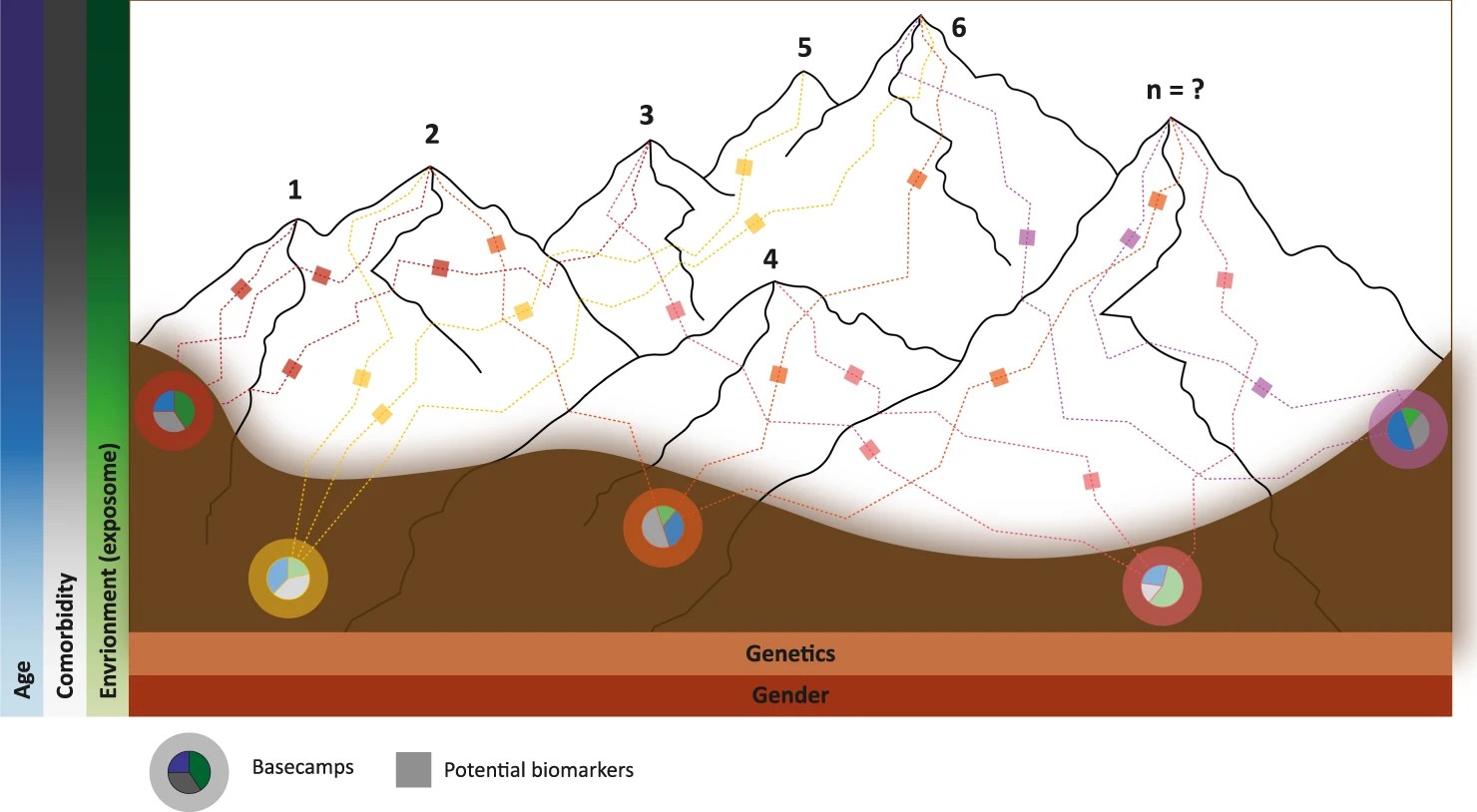
Reference is made to a Mountain Range model for PD, in which the genetic risk is considered as different “basecamps” at the valley at the foot of the mountain range, and the various risk factors or protective factors interact with the genetic risk to impact onset age, rapidity of progression, etc. Pie Charts at the basecamps indicate these risks and protective factors, and boxes along the paths or trails represent potential biomarkers. The height of the mountains within the range represent how rapidly the disease progresses.

41531_2022_307_fig1_html

Figure 2. The Mountain Range model. (This figure is from Farrow, S.L., Cooper, A.A. & O’Sullivan, J.M. Redefining the hypotheses driving Parkinson’s diseases research. npj Parkinsons Dis. 8, 45 (2022). https://doi.org/10.1038/s41531-022-00307-w, which is an open access  article ).

The microbiome-gut-brain-axis

It has been suggested that the disease originates in the gut biome, while theopposite theory that it originates in the brain and spreads to the gut microbiome also has support. It appears that it is possible that both explanations may be true, depending on the individual. As noted at the beginning, each case of Parkinson’s is different, to a certain extent Recent studies have indicated that once the process has begun, it may spread bi-directionally.

Loss of bacteria producing neuroprotective molecules such as short-chain fatty acids (a lack of which are linked to constipation, gut barrier dysfunction and inflammation, early symptoms related to PD). Corroborating these  human observations, animal models suggest that gut microbiome can contribute to PD onset. Definitive proof that they are causative will require large-scale longitudinal  studies with multiple samples to determine the role of gut microbial changes in PD. Studies that factor in caffeine intake, cigarette smoking, pesticides and other toxins that affect PD risk impact the gut microbiome are also needed.

In the future, a better understanding of modifiable factors and events operating along the microbiome-gut-brain axis may open up new ways to prevent or change the course of PD.

combo: socio-bio-enviro factors

In 2017, the economic burden of PD only in the USA was $51.9 billion USD. (And that was before COVID and subsequent inflation). 

Chile over the last 10 years, epidemiological and demographic data has been used to generate a publicly accessible resource: a nationwide de-identified individual-level electronic health record database. In addition, medical research can access clinical statistics from the Ministry of Health through the Department of Health Statistics and Information (DHSI) and to environmental factor exposure data (i.e., registry of contaminants by geographic districts) through the Ministry of Environment and others. A population of more than 37,000 PD cases over the last 20 years have been identified, mainly in overpopulated or industrialized regions. This shows how environmental factors (pesticides, pollution) influence the pathology of PD. Regional disease prevalence, progression, comorbidities, mortality, social factors, and economic burden can be inferred from the data involved in PD progression. Together, the social, biological, and environmental factors may help to explain why every person with PD has, for the most part, a unique experience and journey.

In conclusion:

Over 200 years after James Parkinson wrote his essay on The Shaking Palsy, we still do not have an answer to the question: What causes Parkinson’s Disease(s)? We can assume with confidence that the cause(s) of the disorder are multifactorial. Because individuals differ in genetics, environment and lifestyle, PD is different for and in each person with PD.


###

Note: The source materials for this blog post were published as Open Access under a Creative Commons license, which can be found at the links above and below. This writer has modified and paraphrased much of the wording from the  original article, hopefully to make it more accessible to folks with PD but neither an M.D. or PhD. after their name. Any misinterpretation of the original article is solely due to my own shortcomings (I blame it on the Parkinson’s©).  I omitted the concluding statement that suggested that since all the contributing authors were either M.D.s or Phd.s, or both, that there might be some biases in their viewpoints. I did notice that lifestyle was listed as a possible factor, but that exercise and dance were not specifically called out.

For anyone who wants to read the entire article, here’s the citation and link.

https://Müller-Nedebock, A.C., Dekker, M.C.J., Farrer, M.J. et al. Different pieces of the same puzzle: a multifaceted perspective on the complex biological basis of Parkinson’s disease. npj Parkinsons Dis. 9, 110 (2023)

###

Moses Maimonides, James Parkinson, and me

Subscribe to continue reading

Subscribe to get access to the rest of this post and other subscriber-only content.

Art, Dance, Medicine, Parkinson’s, Genetics, Oh My!

Arts and Medicine research – my only wish is that they would look into the possibility of physical changes in the brains of people involved, and not just on co-creating knowledge:

Co-creating knowledge…

Next:

Dance therapy demonstrates a highly appropriate choice of intervention to stimulate plasticity processes, improve age-related deterioration, and thus contribute to successful aging. Health care professionals involved in the care of elderly individuals should whenever possible consider the feasibility of associating dance therapy as a stimulating and therapeutic activity.

Dance therapy in aging: A systematic review

“There were 2,334 studies, out of which 6 were chosen.” This review limited itself to dance as therapy for healthy aging adults, and excluded those studies that looked at Parkinson’s or Alzheimer’s people. Again, I would hope that future studies look at changes in brain activity and structure, as well as observable differences in movement, etc.

Next, an open access article reviewing genetic risks involving Parkinson’s: “This study provides evidence that alleles associated with Parkinson disease risk, in particular GBA variants, also contribute to the heterogeneity of multiple motor and nonmotor aspects. Accounting for genetic variability will be a useful factor in understanding disease course and in minimizing heterogeneity in clinical trials.”

Genetic risk of Parkinson disease and progression: An analysis of 13 longitudinal cohorts

(Will have to read it in order to see what it says,  and compare it with my genome files to see what it means for me).

Reward Deficiency Syndrome

I’ve been reading on a couple of topics recently – One is basically on music training and neuro-rehabilitation in neuro-degenerative diseases. The other is on what is theorized as the reward system in the brain, which includes the dopamine generating neurons, and the deficiency of dopamine, which factors into several different conditions. apparently ADHD, addictions to substances such as alcohol and cocaine, and narcolepsy are included.  (What? no mention of Parkinson’s?)

The article appears in Volume 1, issue 1,  2015, of the Journal of Reward Deficiency Synddromne at http://dx.doi.org/10.17756/jrds.2015-002  which is an online journal focused primarily on addictions and treatments. Other, more recent articles can be accessed freely. Worth a look, if ADHD and addictions are your field of interest.

As someone with a narcolepsy without cataplexy diagnosis, the article is interesting, especially since I have never been diagnosed as ADHD, which the authoors theorize are closely connected. Howewver, as one who has been known to multi-task well in the past, perhaps the ADHD element was never noticed because of my high IQ (g-intelligence, as some would call it). I could get away with reading Mad magazine in geometry class, tucked inside my  textbook, because I could keep up with the class while shifting my attention between the magazine, the teacher’s explanations, and the drawings on the chalkboard. Now, having slowed down due to Parrkinson’s, it might be apparent in he number of tasks started and left undone, the distractions of Facebook, and a general disorder.

Anyway, worth a thought or two of considefration…


Autoimmune response may play a role in Parkinson’s

Original of this story at: Medical News Today web site 21 June 2017

The exact causes of Parkinson’s disease are unknown, but an important hallmark is the buildup of damaged alpha-synuclein protein in dopamine-producing cells.

The new study reveals evidence that two fragments of alpha-synuclein can trigger T cells to initiate an attack by the immune system.

The researchers tested blood samples from 67 patients with Parkinson’s disease and control samples from 36 healthy patients.

They exposed the blood samples to fragments of proteins found in brain cells, including fragments of alpha-synuclein. The blood from the controls hardly reacted, but T cells in the blood from the Parkinson’s patients had a strong reaction to defined fragments from alpha-synuclein

The finding suggests that certain variants of MHC – such as those associated with Parkinson’s disease – may cause T cells to mistakenly identify the alpha-synuclein fragments as pathogens and thus trigger an autoimmune response that destroys the offending cells.

A lot of work still needs to be done,, but it could help to provide a diagnostic test for risk or early stages of PD, which is sorely needed.

I wonder – Could you get allergy shots with alpha synuclein protein fragments to reduce or eliminate the autoimmune response and thus keep T-Cells from attacking the dopaminergic neurons?


Contributing to Research via DNA sharing

I had my DNA analyzed by 23AndMe and in addition to getting some somewhat innocuous reports on my genetic makeup (including the revelation that there is about .5% match each with Askenazi and African groups somewhere in my ancestry, plus some Neanderthal genes) my data has been anonymously included in nine published articles/studies so far, including:

  1.   23and Me blog article on Depression and genes:  https://blog.23andme.com/23andme-research/new-genetic-findings-on-depression/     The original (abstract of) the article on genes associated with depression:  http://www.nature.com/ng/journal/v48/n9/full/ng.3623.html 
  2.  On genes related to risks of basal cell carcinoma:  https://blog.23andme.com/23andme-research/new-study-on-genetics-of-common-type-of-skin-cancer/   Original article in Nature Communications:  https://www.ncbi.nlm.nih.gov/pmc/articles/PMC4992160/  
  3.  AND OTHERS which can be found at 23AndMe Blog – Research category

    Live long and Prosper!

Eat now, exercise later, protect against insulin insensitivity – and more news!

From Medical News Today:

 “Harm from a weeks overeating may be canceled by exercise”

That’s the limit to the good news, though. The article also reports that even occasional binging can cause problems, and a week of overeating could have a negative effect on insulin sensitivity. Exercise could protect against this metabolic damage.

 For certain, a lack of exercise and an unhealthy diet have been linked to obesity and metabolic syndrome. The article is at this link: http://www.medicalnewstoday.com/articles/313881.php

related article “Healthy living linked to higher brain function, delay of dementia

A diet high in vegetables and fruits leads to better cognitive functioning, and when combined with exercise, the effect is extended downwards to those who reported eating half as many vegetables.

the original research article is at http://jpubhealth.oxfordjournals.org/content/early/2016/10/28/pubmed.fdw113

 In other news…

Mayo Clinic researchers found that it only takes 1 mutation in the PINK1 gene to increase the risk of early onslaught PD. Until this report, it had been thought you needed to have 2 mutated genes to make it happen.  Here are links to the pages:  http://www.medicalnewstoday.com/releases/313885.php or

Heterozygous PINK1 p.G411S increases risk of Parkinson’s disease via a dominant-negative mechanism


Genetic risk for Early Onslaught Parkinson’s upped by PINK1 variation

Single mutation in recessive gene increases risk of earlier onset Parkinson’s disease

“A collaboration of 32 researchers in seven countries, led by scientists at Mayo Clinic’s campus in Florida, has found a genetic mutation they say confers a risk for development of Parkinson’s disease earlier than usual.

The major study, published in Brain, is important because the risk comes from a single mutation in the PTEN-induced putative kinase 1 (PINK1) gene. Investigators had believed that this rare form of Parkinson’s developed only when a person inherited mutations in both PINK1 alleles (one from each parent).”

 You can download a copy of the original research article at this link: Heterozygous PINK1 p.G411S increases risk of Parkinson’s disease via a dominant-negative mechanism