
Sing!

What research has found its way into the email inbox recently?

Although singing is a nearly universal human behavior, many adults consider themselves poor singers and avoid singing based on self-assessment of pitch matching accuracy during singing (here referred to as singing accuracy), in contrast to the uninhibited singing exhibited by children. In this article, I report results that shed light on how singing accuracy changes across the lifespan, using data from a large online sample, including participants ranging from 6 to 99 years old. Results suggest that singing accuracy improves dramatically from childhood to young adulthood, unperturbed by voice changes during adolescence, and remain at a similarly high level for the remainder of life, exhibiting no strong tendency toward age-related decline. Vocal or instrumental musical training has significant positive effects on singing accuracy, particularly in childhood, though there was no evidence for gender differences. Finally, pitch discrimination varied with age similarly to singing accuracy, in support of views that singing accuracy reflects sensorimotor learning. Taken together, these results are consistent with the view that singing accuracy is a learned motor skill that benefits from engagement and can remain a fruitful endeavor into old age. (emphasis added).

citation: Singing accuracy across the lifespan
Peter Q. Pfordresher preprint  article accessed 6-19-22 at https://nyaspubs.onlinelibrary.wiley.com/doi/10.1111/nyas.14815

Basically, this says that if you learned how sing accurately when you were young, you can probably sing well into your later years. And, since singing is a learned motor skill, one might assume that it can be learned even as one gets older.

Relevance to folks with Parkinson’s Disease (PD)?

Vocal strength exercises, such as those provided by Power for Parkinson’s as free YouTube video classes, can help with specific Parkinson’s related symptoms:

Many people with PD speak quietly and in one tone; they don’t convey much emotion. Sometimes speech sounds breathy or hoarse. People with Parkinson’s might slur words, mumble or trail off at the end of a sentence. Most people talk slowly, but some speak rapidly, even stuttering or stammering.

Parkinson’s motor symptoms, such as decreased facial expression, slowness and stooped posture, may add to speech problems. These can send incorrect non-verbal cues or impact the ability to show emotion. Source: https://www.michaeljfox.org/news/speech-swallowing-problems accessed June 20, 2022  (emphasis added).

Since our vocal cords are muscles, and singing is a learned motor skill, we can strengthen those muscles and push against the progressive, degenerative symptoms of PD through exercises that:

  • remind us to breathe deeply to sustain vocal volume,
  • improve our posture in order to enable deep breathing,
  • exercise the muscles of the face and mouth
  • to enable crisp diction instead of slurring and mumbling, and that
  • support emotional expression through inflection and singing.

And “Everybody Knows” that if exercise is fun, one is more likely to continue doing it.

Full disclosure: The author has attended Power for Parkinson’s ® vocal exercise classes since their inception in 2016, and co-founded a participant organized singing group (with the late Jeff Berke) in 2015.  Therefore, he might be (definitely is) biased in favor of this modality of treatment for vocal and speech related symptoms of PD.

###
We know what’s good for the “all” but we can’t say yet that we know what’s good for the “one.”

More evidence from experiments on mice on how and why exercise is good for People with Parkinson’s (PwPs):

The popularized article: Link between exercise and dopamine

And from the abstract and significance statement of the original (non-open access) article:

Physical exercise improves motor performance in individuals with Parkinson’s disease and elevates mood in those with depression. Although underlying factors have not been identified, clues arise from previous studies showing a link between cognitive benefits of exercise and increases in brain-derived neurotrophic factor (BDNF). (emphasis added).

and:

Exercise has been shown to improve movement and cognition in humans and rodents. Here, we report that voluntary exercise over 30 days leads to an increase in evoked dopamine (DA) release throughout the striatum, and an increase in BDNF in the dorsal (motor) striatum. The increase in DA release appears to require BDNF, indicated by the absence of DA release enhancement with running in BDNF+/- mice. Activation of BDNF receptors using a pharmacological agonist was also shown to boost DA release. Together these data support a necessary and sufficient role for BDNF in exercise-enhanced DA release, and provide mechanistic insight into the reported benefits of exercise in individuals with dopamine-linked neuropsychiatric disorders, including Parkinson’s disease and depression. (emphasis added).

The citation:

Voluntary exercise boosts striatal dopamine release: evidence for the necessary and sufficient role of BDNF, Guendalina Bastioli, Jennifer C. Arnold, Maria Mancini, Adam C. Mar, Begoña Gamallo-Lana, Khalil Saadipour, Moses V. Chao, Margaret E. Rice,Journal of Neuroscience 16 May 2022, JN-RM-2273-21; DOI: 10.1523/JNEUROSCI.2273-21.2022

So that covers why exercise is good for all. But what about what is good for the one? 

Farrow SL, Cooper AA, O’Sullivan JM. Redefining the hypotheses driving Parkinson’s diseases research. NPJ Parkinsons Dis. 2022 Apr 19;8(1):45. doi: 10.1038/s41531-022-00307-w. PMID: 35440633; PMCID: PMC9018840.

… there is growing recognition that PD is not a single entity but instead reflects multiple diseases, in which different combinations of environmental, genetic and potential comorbid factors interact to direct individual disease trajectories… The clear consequence of there being distinct diseases that collectively form PD, is that there is no single biomarker or treatment for PD development or progression. We propose that diagnosis should shift away from the clinical definitions, towards biologically defined diseases that collectively form PD, to enable informative patient stratification. N-of-one type, clinical designs offer an unbiased, and agnostic approach to re-defining PD in terms of a group of many individual diseases. . (emphasis added).

The citation links to PubMed where you can download the full article, should you be so inclined. The next citation also links to an open access free article.

Riggare S, Hägglund M. Precision Medicine in Parkinson’s Disease – Exploring Patient-Initiated Self-Tracking. J Parkinsons Dis. 2018;8(3):441-446. doi: 10.3233/JPD-181314. PMID: 30124453; PMCID: PMC6130409.

In this article, Riggare reports on self tracking done in 2012 (as a Person with Parkinson’s), and the offer the possibility that self-tracking of symptoms and medications can help to inform the physician’s decisions over the course of treatment. In other words, one should be a self-advocate as a patient and work with your physician to achieve the best combination of treatments to address Parkinson’s and its comorbidities. (At least that’s my takeaway from the article. Others might differ).

Another look at PD aims to categorize it into various sub-types:

Mestre TA, Fereshtehnejad SM, Berg D, Bohnen NI, Dujardin K, Erro R, Espay AJ, Halliday G, van Hilten JJ, Hu MT, Jeon B, Klein C, Leentjens AFG, Marinus J, Mollenhauer B, Postuma R, Rajalingam R, Rodríguez-Violante M, Simuni T, Surmeier DJ, Weintraub D, McDermott MP, Lawton M, Marras C. Parkinson’s Disease Subtypes: Critical Appraisal and Recommendations. J Parkinsons Dis. 2021;11(2):395-404. doi: 10.3233/JPD-202472. PMID: 33682731; PMCID: PMC8150501.

This article is a “desk review”of other studies, using specific criteria to either include/exclude each study in the results. Their conclusion: 

Conclusion: Subtyping studies undertaken to date have significant methodologic shortcomings and most have questionable clinical applicability and unknown biological relevance. The clinical and biological signature of PD may be unique to the individual, rendering PD resistant to meaningful cluster solutions. New approaches that acknowledge the individual-level heterogeneity and that are more aligned with personalized medicine are needed. (emphasis added).

Among the articles cited in the bibliography is this one (another open access article):

Lawton M, Baig F, Toulson G, Morovat A, Evetts SG, Ben-Shlomo Y, Hu MT. Blood biomarkers with Parkinson’s disease clusters and prognosis: The oxford discovery cohort. Mov Disord. 2020 Feb;35(2):279-287. doi: 10.1002/mds.27888. Epub 2019 Nov 6. PMID: 31693246; PMCID: PMC7028059.

In this, the authors describe their methodology and results from the Oxford cohort (one of several cohorts of PwPs and controls that have been used for research. (I would take the time and effort to locate the original publication describing the different cohorts involved in the effort to find biomarkers, but I am currently experiencing a wave of Parkinson’s related apathy. Check my past posts, or do a search on PubMed – I do remember that Oxford and Boston were two of the cohorts of PwPs.  But I digress).

Results: Apolipoprotein A1 and C-reactive protein levels differed across our PD subtypes, with severe motor disease phenotype, poor psychological well-being, and poor sleep subtype having reduced apolipoprotein A1 and higher C-reactive protein levels. Reduced apolipoprotein A1, higher C-reactive protein, and reduced vitamin D were associated with worse baseline activities of daily living (MDS-UPDRS II).

Conclusion: Baseline clinical subtyping identified a pro-inflammatory biomarker profile significantly associated with a severe motor/nonmotor disease phenotype, lending biological validity to subtyping approaches. No blood biomarker predicted motor or nonmotor prognosis. © 2019 The Authors. Movement Disorders published by Wiley Periodicals, Inc. on behalf of International Parkinson and Movement Disorder Society. (emphasis added).

In other words: Close, but no cigar. But I, for one, certainly could have benefited from this knowledge had it been available 60 years ago. (don’t get me started – I’ve played that tape many times before).

Oh well, let’s end on a high note:

Keep on Dancing, folks!

Conclusions first:

Conclusions
This study highlighted the challenges associated with the feasibility of using an RCT design in this setting, demonstrated the acceptability of implementing a dance program inspired by the Dance for PD® model in Belfast, Northern Ireland for people living with Parkinson’s, and made suggestions for future research. The results support existing evidence demonstrating that dance may improve functional mobility and symptoms of depression in people living with mild to moderate Parkinson’s, though these findings should be carefully interpreted in the context of the study design and limitations. The small sample size limits the generalizability of the statistical results, though it was not among the aims of this study to test the efficacy of the intervention. The findings also support the idea that meeting and dancing with other people living with Parkinson’s is motivating and fosters a sense of belonging, and that dancing has the potential to support several aspects of physical, emotional, mental, and social health. (emphasis added).

Working back in the article, the authors are very honest about the limitations, including not being able to  establish a large enough group of participants so that they might be able to compare the dance intervention against another form of exercise.

Only ten Parkinson’s Disease diagnosed participants were recruited, which makes generalization difficult, but modest improvements were seen. (I saw no mention of statistically significant results in the 12 week, 20 session study). Some participants noted that the dance intervention made them more aware of certain deficits, such as posture, and that the classes motivated them to make more mindful efforts to correct these outside of the classes.

Some participants also described using tools learned in class in everyday life. For example, one participant reported using breathing exercises when anxious or fatigued, and another reported using the warm-up exercises outside of class to “stop the stiffness” and “feel better as a result of that. (emphasis added).

So: Small number of participants. Some improved scores, but no statistically significant differences. Positive statements from exit interviews. Nothing to contradict other evidence that dance interventions have a positive effect on the lives of people with Parkinson’s Disease.

Don’t stop moving to the music / keep on dancing,  folks

The article is open access and may be downloaded for free at:

Evaluating the effects of dance on motor outcomes…

Citation for this article:

Carapellotti, A.M., Rodger, M. & Doumas, M. Evaluating the effects of dance on motor outcomes, non-motor outcomes, and quality of life in people living with Parkinson’s: a feasibility study. Pilot Feasibility Stud 8, 36 (2022). https://doi.org/10.1186/s40814-022-00982-9

RBD and other things PD-related

Diagnosis of PD is often not made until a person is in their 60s. With all the attention that has been focused on the disease(s) in the last 20 years or so, I suspect that more people are getting diagnosed at an earlier age, although most cases of young onset PD are likely to be genetic in origin.

However, an “early” diagnosis may not be a timely diagnosis, as  the title of one opinion piece I read some time ago said (see link below).

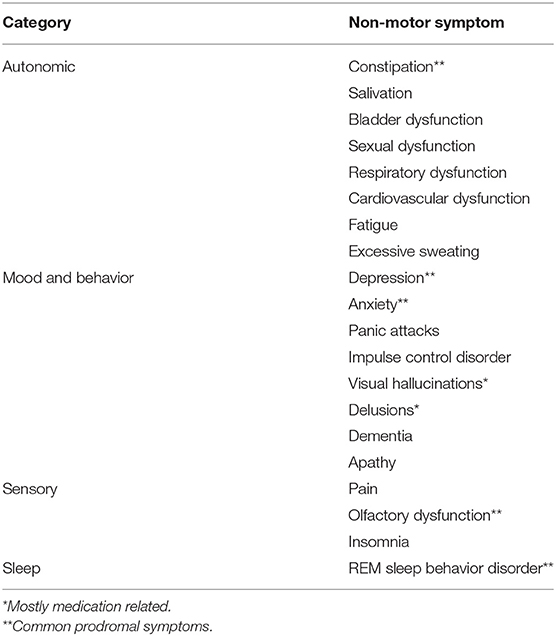
It is now becoming apparent that “Parkinson’s”includes several categories of symptoms, not just rigidity, tremors, and gait, as shown in the table below::

Source for the following table, accessed 11/28/2021:  URL=https://www.frontiersin.org/article/10.3389/fneur.2020.00686

The problem is that treatment and diagnosis are often delayed until PD has already reduced Quality of Life for many folks.

Good evidence for the quality-of-life benefits of existing symptomatic treatment supports the argument for earlier diagnosis at a time when symptoms are already present (emphasis added). This argument would be significantly bolstered by the development of disease-modifying treatments. Benefits of early diagnosis and treatment would affect not only the individual (and their families) but also the wider society and the research community. Ultimately, however, shared decision-making and the principles of autonomy, beneficence, and non-maleficence will need to be applied on an individual basis when considering a “timely” diagnosis.

Therefore, the earlier one can predict the probability or inevitability of PD the sooner one can use treatments – whether pharmacological, surgical, nutritional, or lifestyle in nature – that can either reduce, delay, or defer (and possibly reverse?) the symptoms of PD.

Of all the symptoms associated with PD: tremors, bradykinesia, depression & anxiety, posture, gait issues (difficulties walking), REM Sleep Behavior Disorder (RBD), anosmia (loss of ability to smell), cognitive issues, facial masking, and micrographia (small handwriting) – RBD is the one which is most highly predictive of a later PD diagnosis.

The predictive ‘specificity’ is so strong that if someone has RBD, the chance of being diagnosed with Parkinson’s or related conditions over the next 15 years or more is over 80%

If an 18-21 year old person walked into a physician’s office with RBD, essential tremors, and depression as main symptoms, what would happen? In 1970, probably nothing – one might get treated for depression, but essential tremors are also called “benign”tremors, and were ignored, even if the patient reported being able to feel the tremors while resting, though invisible to the external observer. As for RBD, it would probably also be ignored.

By “a physician,” we are talking about a General Practitioner, or “family doctor,” and not s specialist like a  Movement Disorders Specialist who would be trained to identify varied symptoms, including those that are prodromal. And, of course, the identification of prodromal symptoms has only been investigated within the last decade or so, and are identified as for “research only” purposes – not for clinical diagnosis. A recent survey article (not referenced below) indicated that a majority of general practitioners were either unaware of the Movement Disorders Society’s list of prodromal symptoms, or were not using them to make referrals to Movement Disorders Specialists.

But thanks to the dedication and generosity of folks like Michael J. Fox and others, PD has become a respectable disease for which the person who has it has no reason to be apologetic or ashamed, and can hold their head up (and they ought to, since one symptom is to walk with shoulders stooped down) and proudly proclaim that they have Parkinson’s, which is why they walk funny. And so it goes.

Articles that were quoted above or which contributed to this article are found in the links below.

But first:

I See The Signs of PD

Perspective: Current Pitfalls in the Search for Future Treatments and Prevention of Parkinson’s Disease

An early diagnosis is not the same as a timely diagnosis of Parkinson’s disease

Prodromal REM Sleep Behavior Disorder and PD

10 Early Signs of Parkinson’s Disease / Parkinson’s Foundation

REM Sleep Behavior and Motor Findings in Parkinson’s Disease: A Cross-sectional Analysis

Current Update on Clinically Relevant Sleep Issues in Parkinson’s Disease: A Narrative Review

The prodromes of Parkinson’s disease

Exercise-Induced Neuroprotection of the Nigrostriatal Dopamine System in Parkinson’s Disease

###

What to do?

When it comes to diseases like cancer, the UK medical folks have decided that the “fighting” and “warrior” mentality are counter-productive. For one, this mindset causes people to delay seeking treatment. I don’t have the exact citation at hand, but it is referenced in this blog somewhere, and you’re welcome to search for it. (Thankfully, this is not a dissertation or scholarly article, or I couldn’t have written the previous sentence and gotten away with it).

But when it comes to exercise as a good way to slow, and sometimes reverse the physical or cognitive symptoms of Parkinson’s Disease (PD), there ain’t no doubt in some folks minds that dance is one of the finer things around to combine aerobic exercise, movements, and cognitive challenges to build new connections between neurons in the brain.

From the Digital Commons at Sarah Lawrence College comes this Master’s Thesis:

Rajan, Sneha, “Embodied Medicine: Integrating Dance/Movement Therapy into Physical Medicine & Rehabilitation” (2021). Dance/Movement Therapy Theses. 79. https://digitalcommons.slc.edu/dmt_etd/79

Long story short: “Overall, physiatry and dance/movement therapy have separately helped so many people but developing a synergy between these fields has the potential to transform rehabilitative medicine.”(emphasis added).

Specifically addressing Parkinson’s Disease issues, she writes:

For individuals with Parkinson’s disease, studies have shown that physical rehabilitation is an effective way to manage motor and non-motor symptoms (Mitra et al., 2020). However, maintaining motivation for treatment is difficult because of progressive difficulties with physical disability and co-existing emotional factors, so as a result not many adults engage with enough physical exercise (Mitra et al., 2020). By incorporating cognitive, emotional, and social components, the exercise environment could become more engaging and multidimensional (Mitra et al., 2020). One experimental study examined the effects of dance/movement therapy sessions on the cognition, quality of life, and motor symptoms of patients with Parkinson’s disease (Mitra et al., 2020). They used a variety of techniques such as targeted body exercises, memory games, movement improvisation, guided imagery, rhythm work, contact improvisation, mirroring, body coordination and movement reflexes (Mitra et al., 2020). Music was also used to incorporate rhythm and sensory motor cues (Mitra et al., 2020).

As a result, participants showed a significant increase in cognitive functioning and a decrease in Parkinson’s related health difficulties. Additionally, patients reported improvements in coordination, mood, and memory (Mitra et al., 2020). Another study analyzed the effectiveness of music-based movement therapy on gait related activities in Parkinson’s patients (Dreu et al., 2011). They examined both individual music-based gait training and partnered-dance interventions. The music provides rhythmic cues that help synchronize movements and also facilitates emotional responses in the participants (Dreu et al., 2011). Participants showed improvements in walking velocity and balance (Dreu et al., 2011). (Emphasis added.)

 If I were to judge this Master’s thesis, I would suggest more sources, and more recent ones than the one she used in material about Parkinson’s in the paragraphs before the ones I quoted above. But I’m not on the faculty of Sarah Lawrence College, so that’s their loss.

And the answer to the question posed in the title of this blog entry “What to do?” is simple: Don’t Stop Moving To The Music!


###

Discrete choice experiment

Published in the Australian Journal of Physiotherapy as an open access article, we have an experiment in which several factors were used to determine participants’ preferences in a hypothetical exercise program.

People with Parkinson’s disease are more willing to do additional exercise if the exercise program has specific attributes

Conclusions were:

People with Parkinson’s disease were more willing to participate in exercise programs that cost less, involve less travel, provide physical or psychological benefits and are supervised by qualified professionals. To enable more people with Parkinson’s disease to exercise, health services should provide programs addressing these factors and account for sex differences. [emphasis added. Men were more likely to favor strength training, women were averse to aerobic exercise, and folks already exercising 300 minutes per week were less likely to favor adding more exercises.]

The group to which I subscribe on their YouTube channel, and support in various ways, is Power For Parkinson’s® (PFP). I also am a member of the Georgetown Area Parkinson’s Support group (GAPS) and the Capital Area Parkinson’s Society (CAPS) Both PFP and GAPS sponsor several exercise groups aimed directly at people with Parkinson’s Disease (PD) and their needs, so I am usually working out at least one hour daily. So I might fall into the last group of folks not willing to add more exercises.

On a different tangent, A couple of articles showed up that deal with the idea of Multiple Intelligences. Actually, one is a book excerpt with selected portions available on Google Books, and the other is the cover, Table of Contents, Bibliography, and Index of a different book. Granted, the Index does list Parkinson’s Disease on at least 2 pages. Why bother? Because, as those who have read the earlier blog post(s) on Moses Maimonides and Me, I don’t particularly subscribe to Maimonides’ categories of four ways in which humans strive to achieve perfection.

These books are:

Eastern European Perspectives on Emotional Intelligence

in which some of the available pages include charts of Howard Gardner’s Multiple Intelligences, and some of the results which seem to show a clustering of several factors (using factor analysis). Since that is outside of my area of expertise, I won’t comment on it. (This is all copyrighted material, provided only for personal education, etc.

The other is Mind Ecologies: Body, Brain and World which has the extensive bibliography and index. Probably well worth looking into the bibliography, if one has a mind to do so (but not today). The TOC reads:

1. Life, Experimentalism, and Valuation 16
2. Pragmatism and Embodied Cognitive Science 51
3. Social Cohesion, Experience, and Aesthetics 94
4. Pragmatism and Affective Cognition 124
5. Perception, Affect, World 156
6. Broadening Ecologies 184 

and the whole thing is copyright The Columbia University Press.

My pulmonologist prescribed a nap in the morning and afternoon, and since I missed the morning nap, will head off to do one this afternoon.

###

The link between environmental chemicals and Parkinson’s

Jane Brody of the New York Times wrote a recent review of a new book, co-written by several experts in the field of neurology. These include Dr. Ray Dorsey, neurologist at the University of Rochester; Todd Sherer, neuroscientist with the Michael J. Fox Foundation for Parkinson’s Research; Dr. Michael S. Okun, neurologist at my other hometown at the University of Florida; and Dr. Bastiaan R. Bloem, neurologist at Radboud University Nijmegen Medical Center in the Netherlands.

The book titled “Ending Parkinson’s Disease” calls the occurrence of PD a “man-made pandemic” with references to to many studies that show the high correlation of PD to the exposure to toxic chemicals on farms and in the workplace, as well as animal studies in which PD symptoms were replicated.

Here’s one YouTube video about the book:

Brief overview of the book of Ending Parkinson’s Disease

And here’s a forty minute Zoom presentation by Dr. Michael Okun at the University of Florida on the book’s topics. (unfortunately, there are distracting sounds from participants/attendees who didn’t mute their microphones):

Ending Parkinson’s Disease with Dr. Michael Okun

My next action will be to order the book.

###

Lifestyle effects on PD

In a nutshell: Exercise helps to keep your mitochondria working, and that helps to slow down the loss of your dopaminergic neurons. Here we have an application of the old rat race to a rat model of PD – in which treadmill exercise helped to keep mitochondria functioning properly, while sedentary rats lost dopaminergic cells.

Physical exercise protects against mitochondria alterations in the 6-hidroxydopamine rat model of Parkinson’s disease

These “results suggest a neuroprotective and progressive effect of intermittent treadmill exercise, which could be related to its benefits on mitochondrial biogenesis signaling and respiratory chain modulation of the dopaminergic system in PD.”

But other studies and reviews have shown other factors that affect the progression of PD, so don’t put all of your metaphorical eggs in one basket – a review that covers some of those various factors:

Narrative Review of Lifestyle Factors Associated with Parkinson’s Disease Risk and Progression

###

A review of non-traditional treatments for PD

Exercise is generally accepted as beneficial for the alleviation of Parkinson’s Disease (PD) symptoms. The Clinical Neurologist International has just published an open-access article that reviews the most recent research with a focus on types of exercise and their benefits for specific motor symptoms:

Martinez-Ramirez D, Kraslow M, Armstrong MJ, Ramirez-Zamora A, Almeida L, Besharat A, et al. Update on Non-Traditional Exercises in Parkinson’s Disease: A Motor Symptom-Focused Approach. Clin Neurol Int. 2019; 1(1): 1004.

From the abstract:

… it is crucial to better characterize the benefits of exercise in PD. … we discuss the most recent studies analyzing the clinical effects of various modalities of exercise in PD, including physical therapy, aerobic exercise, strength and resistance training, and nontraditional forms of activity such as tai chi, dancing, aquatics, and boxing. We also provide … expert recommendations based on current evidence and highlight issues that remain unresolved (e.g. the best type of exercise, symptomatic benefits based on different modalities, optimal frequency and duration, and duration of benefit).

It appears that the authors limited their search to those studies that looked into motor symptoms of PD, and perhaps this is why their list of references doesn’t include Rehfield et al.’s 2018 article on the superiority of a dance program to repetitive physical exercise in increasing brain plasticity. Nor do they look into other approaches, such as musical training and practice, as possible ways to improve cognitive function, brain plasticity, and quality of life.

As a person with PD, I personally find that an eclectic and inclusive approach, using medications, Deep Brain Stimulation (DBS), physical exercise (including dance-related, vocal/singing and breathing exercise), diet, and social activities related to specific interests (like native plants and photography) works best for me. For others, the mix will differ.

The authors of this review reach much the same conclusion:

…evidence suggesting that any and all types of exercise can provide short-term clinical and quality of life benefits. More research is needed to help understand if exercise programs provide generalized benefits or what strategies should be used to address particular deficits. Balance, flexibility, and stretching seem to improve motor symptoms and decrease falls, contributing to an improvement in overall function. Aerobic training appears to improve cognition, cardiovascular health, gait, and reaction time. Resistance training provides the strongest benefit in strength. Nontraditional exercise programs, including tango, tai chi, cycling, aquatic therapy, and boxing are potentially beneficial options for each patient

In short: Find out what types of exercise you like to do, do what you like to do, and keep on doing it to help reduce the symptoms of PD.

(Coincidentally, most of the authors are associated with my alma mater, the University of Florida in Gainesville, FL).


Strength training can help with PD symptoms

A review of studies indicates that strength training can help with mild to moderate Parkinson’s cases. (An earlier blog post here noted that a dance training program increased grey matter volume in the brain versus repetitive strength training. So don’t exclude either from your wellness program, is my [non-medical advice).

Review of strength training in people with Parkinson’s Disease

From the abstract:

Objective: To investigate the evidence on efficacy and limits of strength training in rehabilitation of Parkinson’s disease

Method:A comprehensive search on pubmed, clinical keys database using keywords Parkinson’s disease, physical therapy, strength training ,resistance training. The studies including Randomized controlled trails and systematic reviews published since 2005 are reviewed.

Results:36 studies identified through database searching. 25 studies are excluded due to duplicates, irrelevance, based on titles, outcome diversity. 5 systemic reviews and Meta analysis, 6 RCT are included. Review and analysis of articles is going on

Conclusion : The result of this review suggests that strength training program can be effective in people with mild and moderate parkinson’s disease. It can improve functional independency with increased muscle strength, gait parameters, posture and balance, all of these positive role on participation and quality of life