(Posted about a year ago – edited to add the names of the plants), Went out in the yard and beyond today and captured a few items of interest. Didn’t go into the front yard because it was getting close to dinnertime.






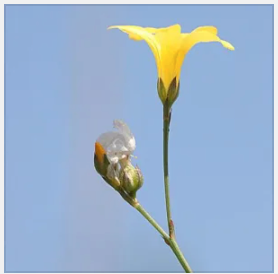
(Posted about a year ago – edited to add the names of the plants), Went out in the yard and beyond today and captured a few items of interest. Didn’t go into the front yard because it was getting close to dinnertime.

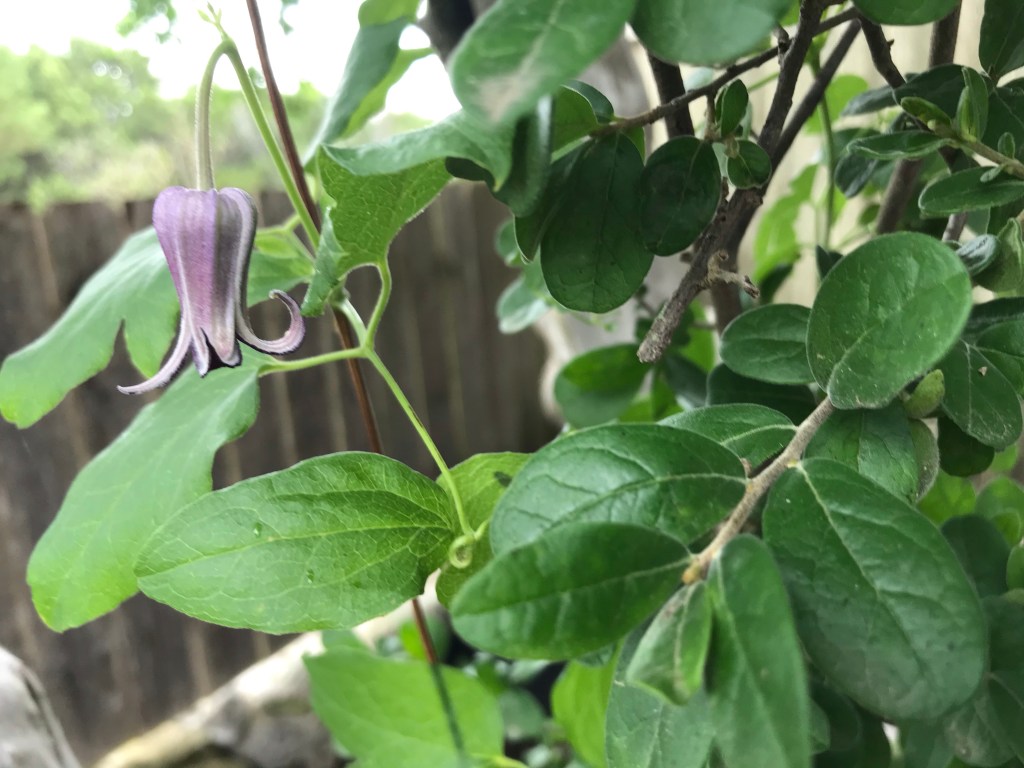
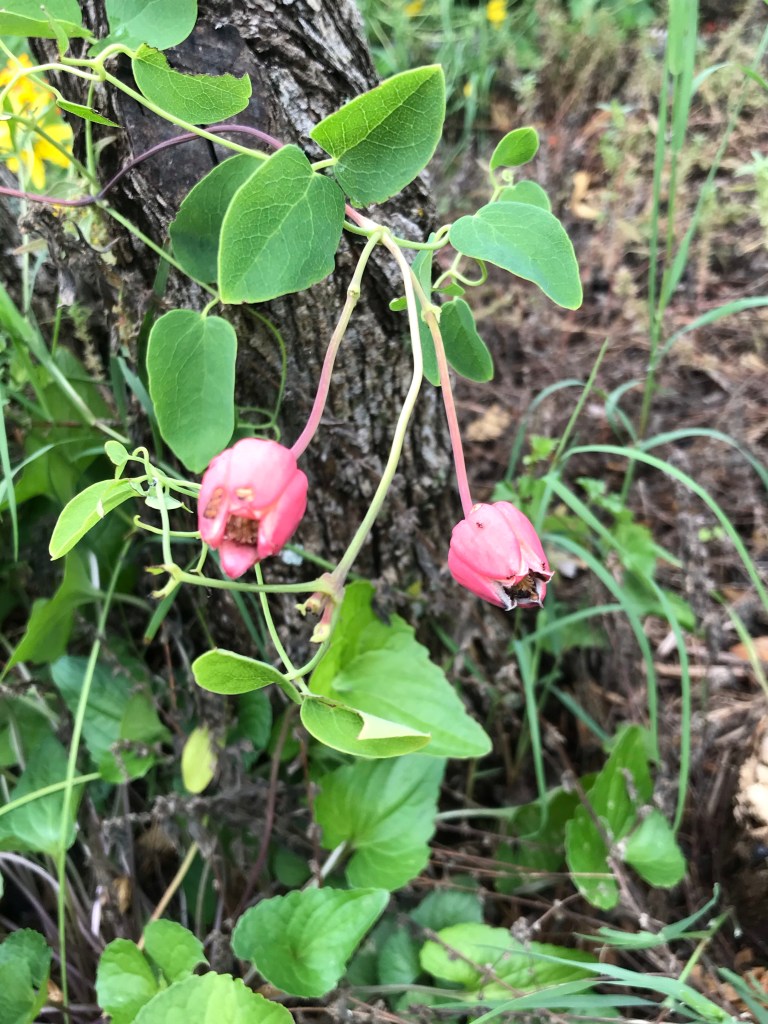
Clematis pitcheri – Purple leather flower
Back in the corner of our tiny lot, next to the compost bins and under the Diospyros texana, is a gallant vine that until now has shown no intentions of putting out any flowers.
Yesterday was the first day a bud showed up, so maybe it will get some followups as it matures, or other flowers come out. The Texas persimmon mentioned by its scientific name above provides the majority of the foliage in the photo above. but the Clematis leaves can be seen, they’re just much larger and out of focus.
Yesterday, while sitting on the back porch/deck, a titmouse came up to the trellis and started poking its head about. As I fumbled with my camera, I was able to get about four poorly focused or poorly framed shots, so my best guess is that it was a tufted and not aa black crested titmouse. As I tried to follow it around the yard after it left the deck, I took several shots of dubious quality. I was surprised to find that instead of the aforementioned bird, the next best shot was of a Carolina chickadee. Naturally, after the initial excitement of tiny birds flitting about the yard, I was left standing holding the camera without any feathered bipeds in sight, though I could still hear them singing – mostly a mockingbird.
Which I guess is why I mostly stick to plant photos – at least they stand still, more or less, except when the wind blows, or even breathes a whisper across them.
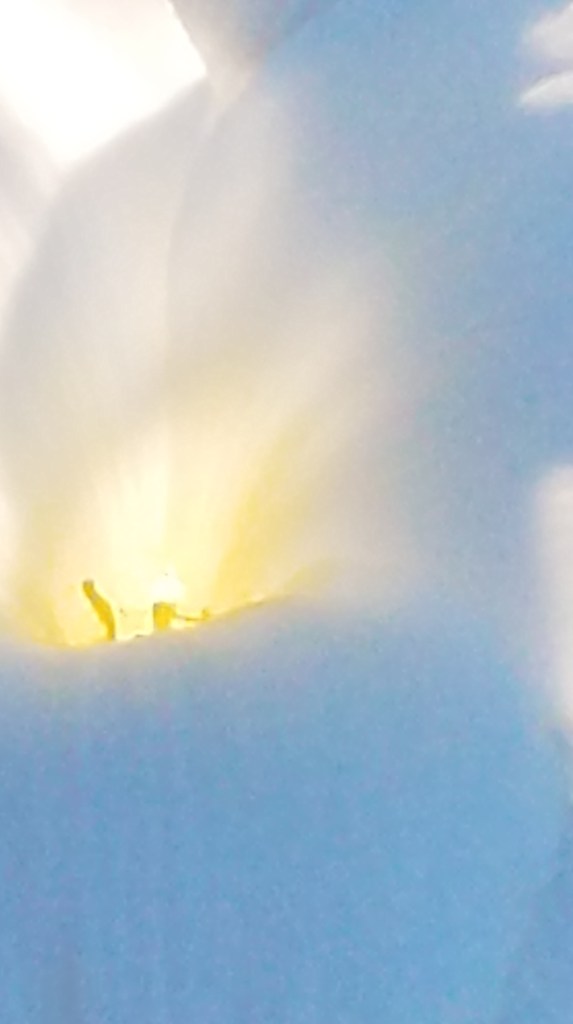
Cooperia pedunculata syn. Zephyranthes drummondii – Rain Lily
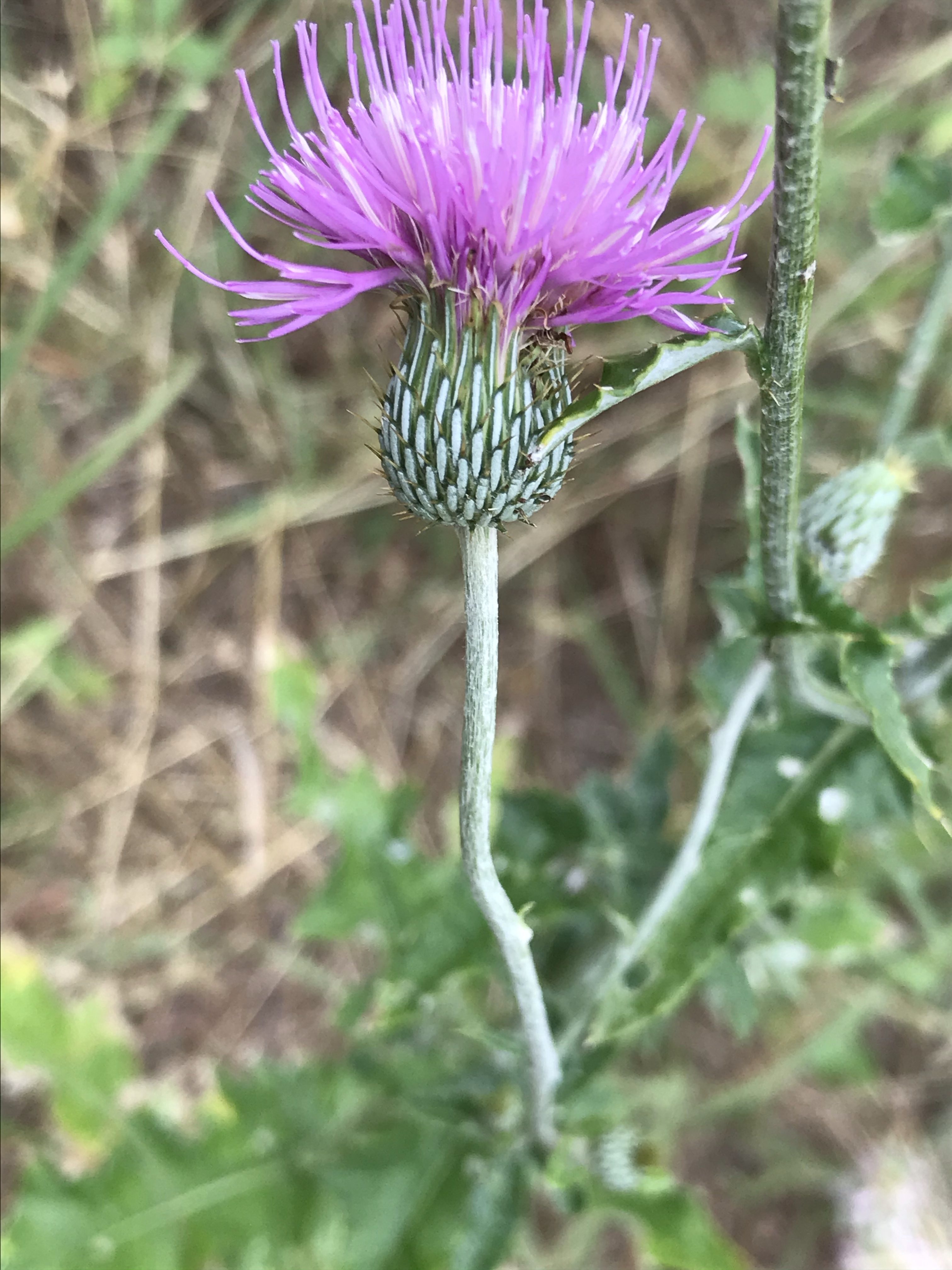
Thanks to some poor hygiene and poor knowledge regarding mowing ( or not mowing) next to a greenbelt, the berm behind my house and the neighboring greenbelt which has a cavern populated by endangered insects, has become overrun with Lolium perenne (annual ryegrass, winter ryegrass), Centaurea melitensis (Malta star thistle), and Bromus japonica (Japanese brome), to name the three worst offenders.
This February I wrote to both my HOA and my Municipal Utility District to report the failure of their mowers to follow the guidelines established in 2013 and 2018 by the Texas Department of Transportation on mowing of roadside vegetation, and vegetation adjacent to natural preserves.
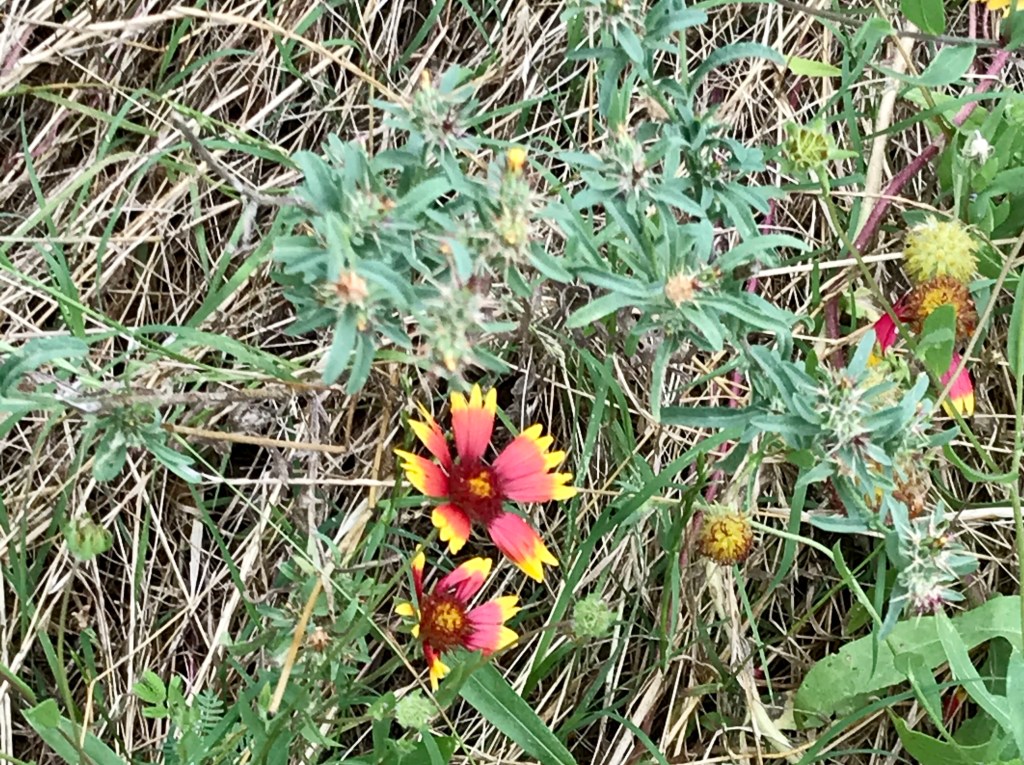
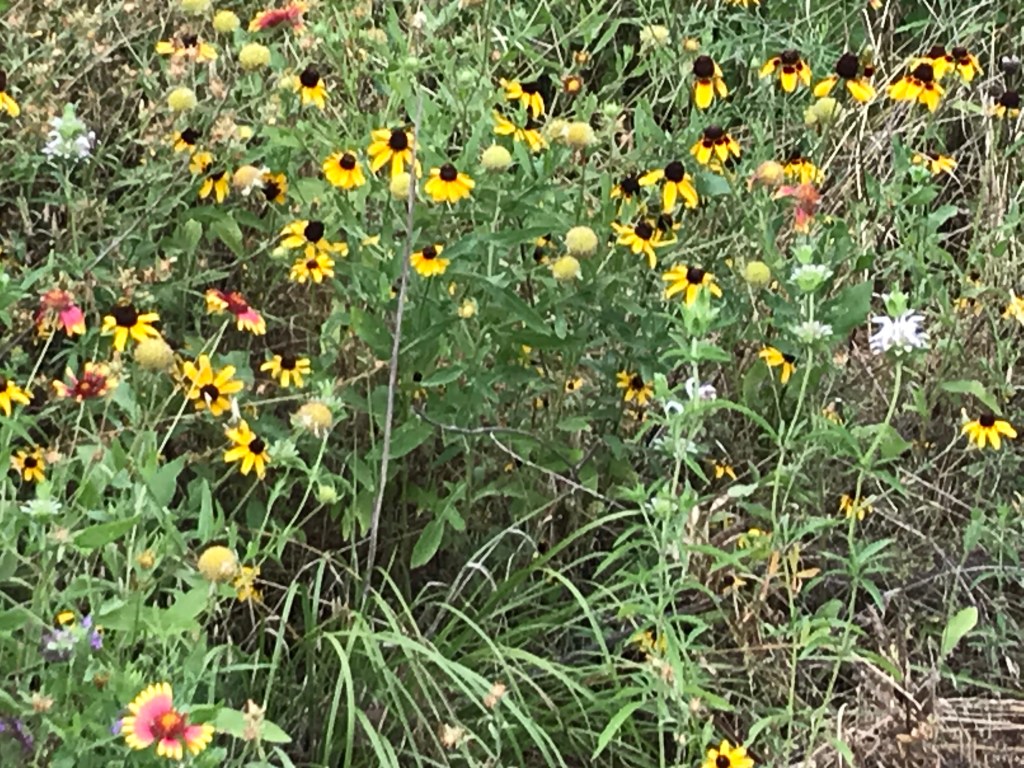
Thankfully, the berm has not been mowed since early February, and I have been able to put in an hour or two, mostly on days following Spring rains, to fill about ten 42 gallon bags with the offending weeds. Although the natural covering of Gaillardia pulchella (Firewheel, Indian Blanket) and Ratibida columnifera (Prairie coneflower, Mexican hat) is greatly reduced at present, and I know that I will have to maintain vigilance and start pulling invasive weeds and grasses earlier next year, I did receive a small reward this past Wednesday.
As I was about to enter the berm to take a photograph of this Rain lily (Cooperia pedunculata, syn. Zephyranthes drummondii), I noticed a small movement. It turned out to be an Eastern cottontail rabbit, munching on the plants in the berm. We both stood still for a few moments while I took some photos with my Android, it then hopped into the greenbelt and the cover of brush.
Then I went in, took a few shots of the Rain lily that would have been blocked from the sunlight by the ryegrass that I had removed, and caught the above photo of the light from the sunset shining through to backlight its stamens.
A small reward, perhaps, but a big warm feeling…
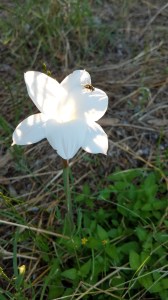
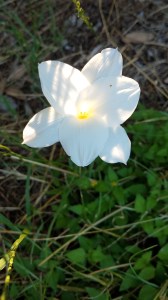
For a fully detailed botanical description see: Studies on the Vascular Plants of Williamson County, Texas
###

Clematis texensis – Scarlet Leatherflower
I just realized that there is an analogy between the pandemic coronavirus now causing troubles throughout the planet’s human organizations and the title and subtitle of this blog – “Return To The Natives – Native Plants Are The Answer.”
C. texensis is endemic to the Texas Hill Country, or the Edwards Plateau, although because of the scarlet flowers, it has been exported to other locations for cultivation. However, it doesn’t seem to be an aggressive plant, so most places outside of Texas where it is found are probably in containers, where they are tended carefully by loving horticulturists.
The example shown above is a next door neighbor example of this phenomenon: Although it it is in Williamson County, TX, it was introduced and is under cultivation. I don’t know of any locations where it is growing in Williamson County without having been introduced by humans. But – it is native to Texas, and to neighboring counties, and who knows? – there might be some undiscovered instances of this species in the Balcones Canyon National Wildlife Refuge.
Unlike some other plants, like Poison Ivy, Malta Star Thistle, Perennial Rye, and Bur Clover, which are aggressive and spread rapidly when they are introduced to an area through human intervention, often by poor mowing practices, this one is unlikely to dominate your garden. But with the right conditions and in the right place, it can and will flourish in Central Texas.
More detailed information on Clematis texensis can be found at Studies on the Vascular Plants of Williamson County, Texas. If that is too much detail for you, there’s always the Native Plant Information Network (NPIN) database at the Lady Bird Johnson Wildflower Center
The analogy mentioned above?
The pandemic virus is like an exotic plant that is introduced to areas where it doesn’t belong – and spreads, unchecked, unless we take quick action to recognize the problem and isolate, treat, and follow up on contacts, to eradicate and mitigate the adverse effects. The same analogy applies to invasive animals, whether Zebra mussels in the lakes of the South, or pythons in the Florida Everglades. It’s hard to get the genie back in the bottle, or to get everything back inside Pandora’s box.
Stay home. Practice good hygiene, whether traveling or working with plants. The only thing that can prevent pandemics is you, to borrow a slogan from a well known fire prevention campaign.
Plant and grow things that are native to the area in which you live – practice proper hygiene when traveling from place to place, being careful not to spread seeds through carelessness, and if you gotta mow, mow only at the right time and the right places that need mowing for the primary reason of safety. Bermuda grass is hard to eradicate once it has spread, and viruses are hard to kill but easily spread through careless hygiene practices.
Don’t “stop to smell the roses” – Learn about the plants that are native to your area, and take the time to enjoy them and their relationships with the wildlife, butterflies, and native bees that are in your six feet of separation.
###
Well, folks, this site was left behind a few years ago, but from my overall WordPress traffic reports, it seems to be visited from time to time. Thus it seems that it might not be a bad idea to start updating it. Could be wrong of course, but here goes nothing: One of my favorite Texas native wildflowers, the Prairie Celestial.
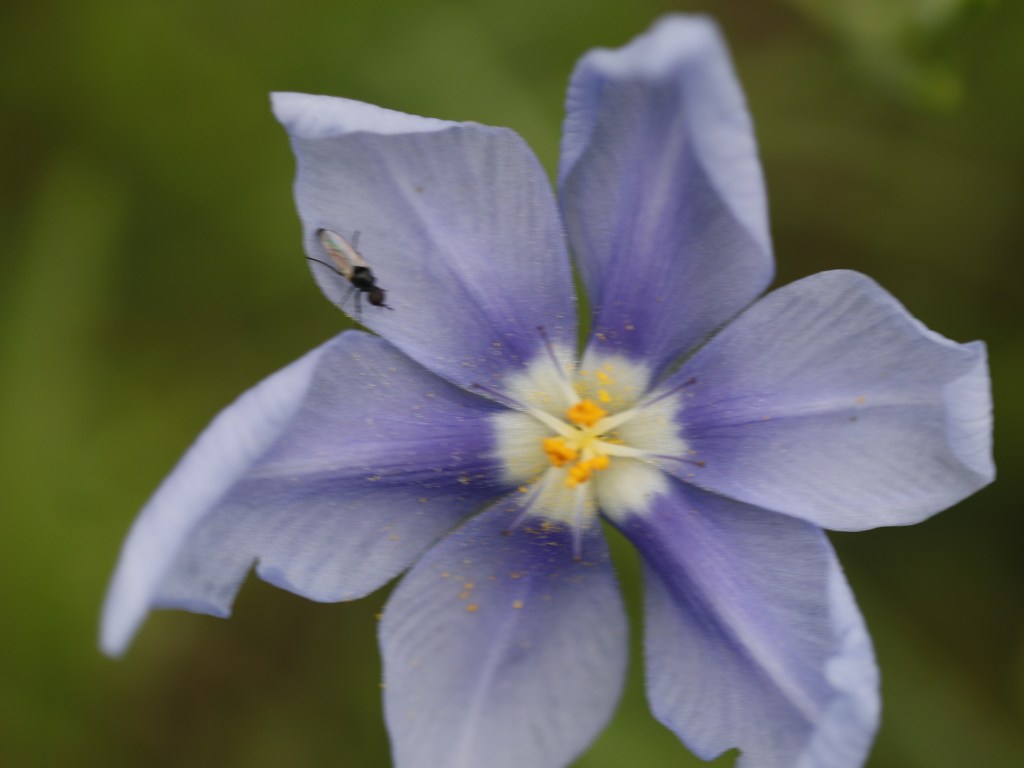
Nemastylis geminiflora – Prairie Celestial
These members of the Iris family bloom for approximately two weeks, beginning with somewhere near the Spring equinox, and ending around April 1st. This year, there was an early “scouting” expedition around the 13th-15th of March, then a gap, followed by the expected blooming around the 19th of March through April 1st, which appeared to have been the last of it. Then, around the 5th through the 10th of April, I discovered some more blooms, stragglers, as it were.
Each flower blooms for just one day, and they often appear in pairs, hence the species name geminiflora. Each plant, which is a deep seated bulb (and hard to dig up, even for scientific sampling), may have several flowers. Another common name is Pleat Leaf Lily, derived from the “pleats” in the leaves, as shown below.
You might also note the bur clover or yellow clover, an invasive weed that forms a carpet and crowds out native plants, especially when mowing is frequent and close to the ground, and mowers move between locations without pressure washing plant materials off the blades of their mowers.
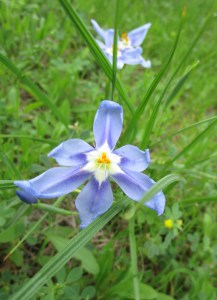
Nemastylis geminiflora – Pleat Leaf Lily

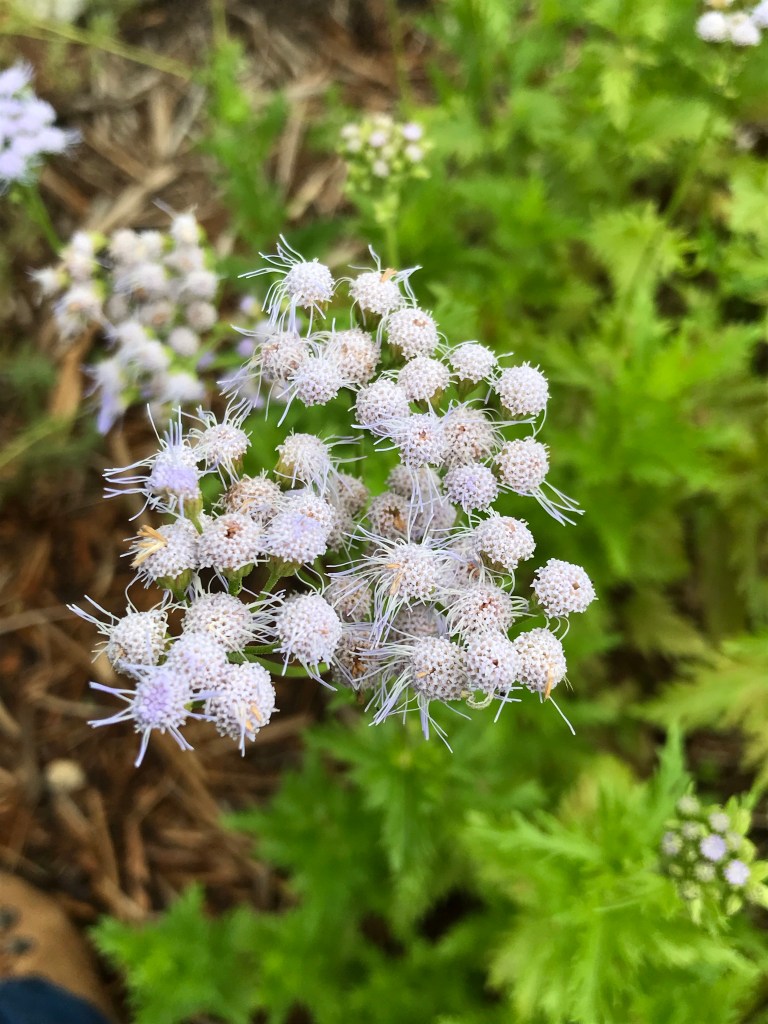
Gregg’s mistflower (Conoclinium greggii)
It has been a while since I posted anything on this blog, and so now we can compute just how long “a while” is.
Of course, this picture was taken several months earlier when I was fooling around with a different camera and lens, and trying to transfer learning between one of two systems (in alphabetical order: Canon and Nikon) without recourse to written instruction. This picture appeared on at least one Native Plant Society of Texas blog, and reappears in these pages because it is quicker and easier than processing some other photo.
Sad to say, the result shown here was probably more a matter of luck than transfer of skill. But it is skill in choosing native plants appropriate to the region that results in the Queen (Danaus gilippus) and Monarch (Danaus plexippus) butterflies that have been seen recently. I did manage to get a shot of the Monarch, but haven’t gone after the Queens yet – it has been windy, and they rarely stay still for long. Why a Monarch is in my neck of the woods in mid-July seems to be one of those outliers to the norm mysteries for which the answer may never be known for sure.

Old man’s beard (Clematis drummondii)
It’s getting on past halfway through summer and the Clematis drummondii are starting to show off their old man’s beards – which is interesting, since this plant has both male and female plants – the stamens are sterile on the female plants, and the stigma on the male plants are probably sterile too, I would guess – haven’t seen it documented anywhere yet.
Another common name for these flowers is Virgin’s Bower, or Texas Virgin’s Bower. Go figure.
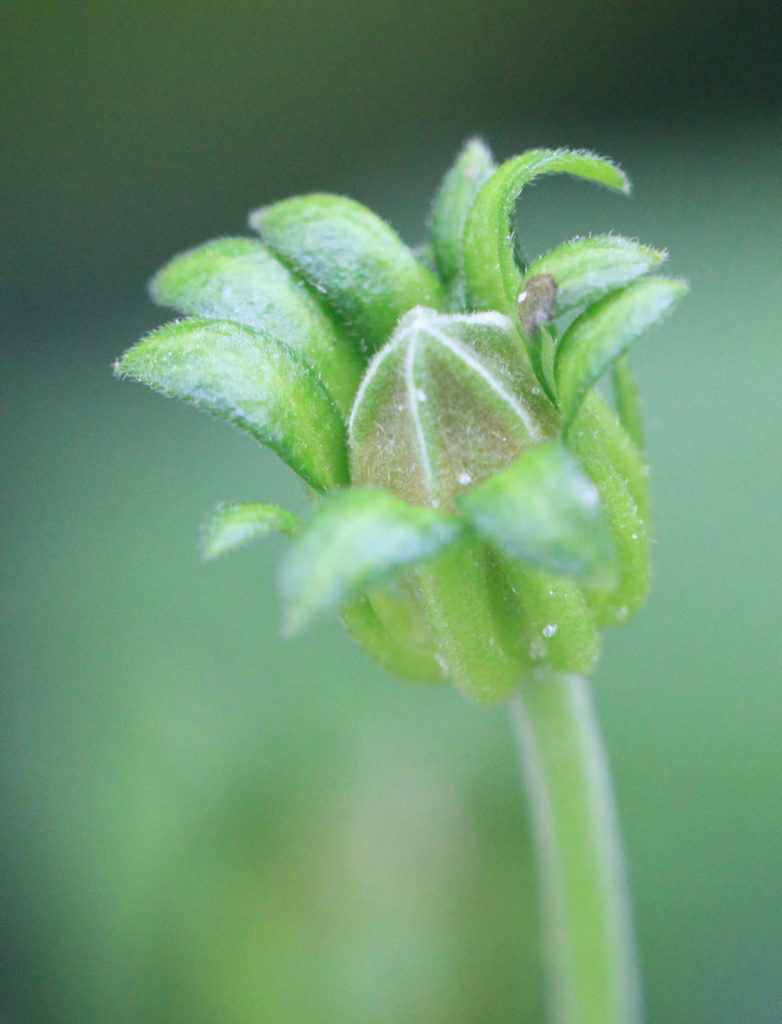
Malvaviscus arboreus var drummondii – Turkscap
Usually one sees this in “full” bloom, although the hibiscus-like flowers never do open up completely. However, the blooms are only just now beginning to show up, and you might miss this bud – if so, this bud’s for you.
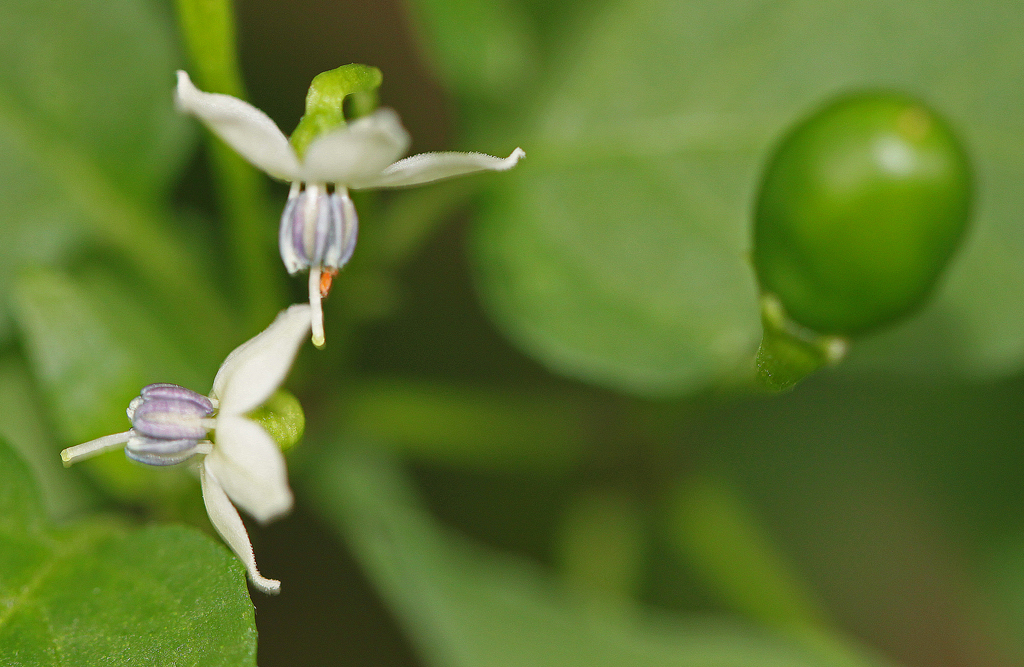
Capsicum annuum – Chile Pequin
Hadn’t really looked at the tiny flowers of the Chile Pequin before, but here they are, with a slight touch of purple in them.
Off to the right is the fruit, which turns a bright shiny red when it has fully ripened. Easy to grow, withstands drought, edible, attracts nectar feeders when in bloom and birds after bloom has turned to fruit. Reseeds itself if allowed to.

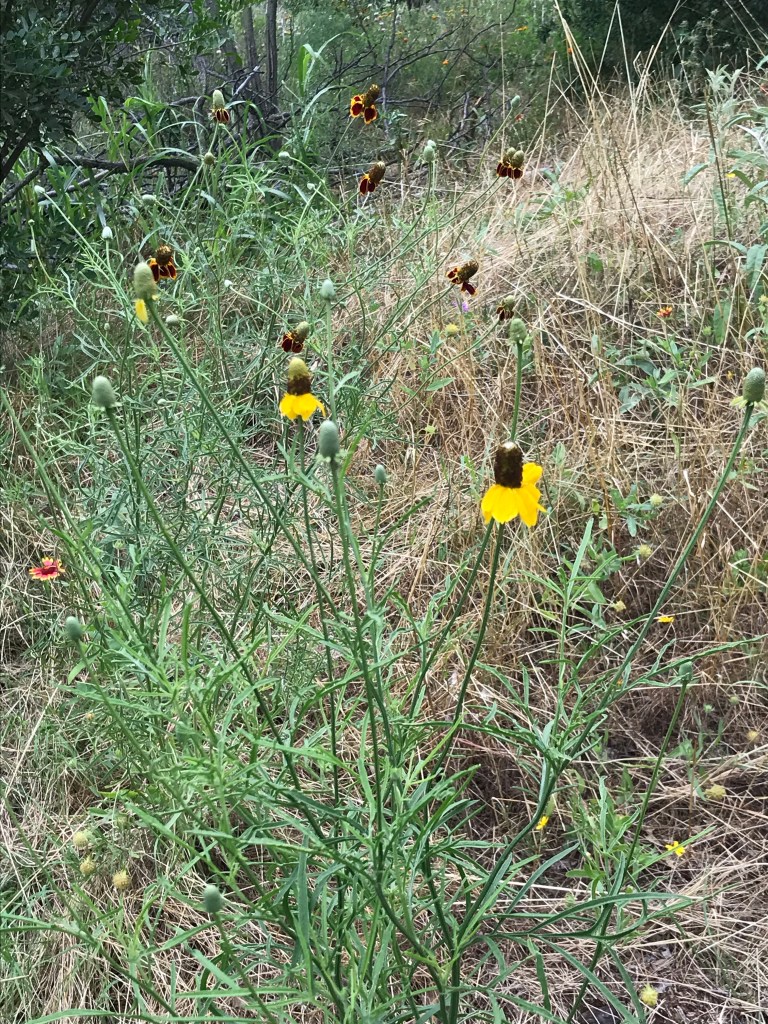
Ratibida columnifera- Mexican Hat
Also known as Prairie Coneflower, this perennial also comes with yellow petals instead of the orange, brown, and yellow petals shown here. In their native environment, they can form large colonies, sometimes interspersed with similarly colored Gaillardia pulchella Firewheel. Whether seen singly or en masse, it is singularly and strikingly sttractive. It is drought tolerant and can grow in a wide variety of soil types.
 bob's brain: living well with a movement disorder and other comorbidities