Exercise & Sleep disorders and Parkinson’s – Oh my!

My first draft of this got lost in the computer (Thanks, all you coders who think you know how to create intuitive, ease to use interfaces). So here’s another attempt to get stuff from one location to another. We’ll see how it it goes…

A while back I posted a Powerpoint presentation on research on music, dance, and singing, which cited a review in the Movement Disorders Society (2018, I believe), in which the conclusion was that exercise did not affect Parkinson’s Disease (PD) symptoms. Since then, there have been many more studies on the effects of different modalities of exercise. In this first article, a meta review of publications, found that exercise is good for you if have PD.

Yang Y, Wang G, Zhang S, et al. Efficacy and evaluation of therapeutic exercises on adults with Parkinson’s disease: a systematic review and network meta-analysis. BMC Geriatrics. 2022 Oct;22(1):813. DOI: 10.1186/s12877-022-03510-9. PMID: 36271367; PMCID: PMC9587576.

The purpose of the review was to compare and rank the types of exercise that improve PD symptoms by quantifying information from randomised controlled trials.  Out of 10,474 citations, 250 studies were included involving 13,011 participants. The results (drumroll, please):

  • Power training (PT) had the best benefits for motor symptoms
  • Body weight support treadmill training showed the best improvement in balance, gait velocity  and walking distance
  • Robotic assisted gait training had the most benefits for freezing of gait
  • Dance showed the best benefits for depression
  • Only Yoga significantly reduced anxiety symptom compared with controls
  • Only resistance training significantly enhanced sleep quality and cognition
  • Physical Therapy showed the best results for muscle strength
  • Five types of therapy showed improvement in concerns about falling versus control groups.

If interested, the full free text is available at the linked citation above. Other reviews have shown different results. Best recommendation is to find a variety of exercises that you enjoy, and do them as often as you can. But don’t try so hard that you wind up hurting yourself.

The second meta review alluded to in the title has to do with sleep disorders.

Xu Z, Anderson KN, Pavese N. Longitudinal Studies of Sleep Disturbances in Parkinson’s Disease. Current Neurology and Neuroscience Reports. 2022 Oct;22(10):635-655. DOI: 10.1007/s11910-022-01223-5. PMID: 36018498; PMCID: PMC9617954.

Fifty-three longitudinal studies of sleep in PD were identified, which included:

  • Excessive daytime sleepiness,
  • Insomnia,
  • Obstructive sleep apnea,
  • Rapid eye movement sleep behavior disorder (RBD),
  • Restless legs syndrome, and
  • Shift work disorder were studied in addition to other studies that had focused on either multiple sleep disorders or broadly on sleep disorders as a whole.

RBD is now considered an established prodromal feature of PD, but other sleep disorders do not clearly increase risk of subsequent PD.

I’ll throw in one last citation. Not just because it plays on the title to one of Bob Dylan’s songs, but also because it is one of many nutritional supplements prescribed to aid in cleaning out neural cell debris in (where else?) Bob’s Brain:

Kalyanaraman B. NAC, NAC, Knockin’ on Heaven’s door: Interpreting the mechanism of action of N-acetylcysteine in tumor and immune cells. Redox Biology. 2022 Oct;57:102497. DOI: 10.1016/j.redox.2022.102497. PMID: 36242913; PMCID: PMC9563555. 

and that ends this day.

Prodromal symptoms, Parkinson’s Disease (PD), and that old song and dance…

Here’s a few studies that came up in my news feed from  PubMed Central (PMC) or elsewhere for articles recently published on the topics in which I’m interested – namely, prodromal symptoms related to PD, the relationship of REM sleep disorder and depression to PD, and, of course, the use of singing and dance therapies as complementary approaches to dealing with the symptoms of PD.

Prevalence and duration of non-motor symptoms in prodromal Parkinson’s disease

The prevalence and duration of non-motor symptoms (NMS) in prodromal Parkinson’s disease (PD) has not been extensively studied. The aim of this study was to determine the prevalence and duration of prodromal NMS (pNMS) in a cohort of patients with recently diagnosed PD.

…subtracted the duration of the presence of each individual NMS reported from the duration of the earliest motor symptom. NMS whose duration preceded the duration of motor symptoms were considered a pNMS. Individual pNMS were then grouped into relevant pNMS clusters based on the NMSQuest domains. Motor subtypes were defined as tremor dominant, postural instability gait difficulty (PIGD) and indeterminate type according to the Movement Disorder Society Unified Parkinson’s Disease Rating Scale revision.

Results: Prodromal NMS were experienced by 90.3% of patients with PD. … males reporting more sexual dysfunction, forgetfulness and dream re-enactment, whereas females reported more unexplained weight change and anxiety. There was a significant association between any prodromal gastrointestinal symptoms and urinary symptoms  and the PIGD phenotype.[n.b.: phenotype includes inherent traits or characteristics that are observable]. [Emphases added].

Citation:  Durcan R, Wiblin L, Lawson RA, Khoo TK, Yarnall AJ, Duncan GW, Brooks DJ, Pavese N, Burn DJ; ICICLE-PD Study Group. Prevalence and duration of non-motor symptoms in prodromal Parkinson’s disease. Eur J Neurol. 2019 Jul;26(7):979-985. doi: 10.1111/ene.13919. Epub 2019 Mar 1. PMID: 30706593; PMCID: PMC6563450.

Associations of Sleep Disorders With Depressive Symptoms in Early and Prodromal Parkinson’s Disease

Purpose: To explore the effect of sleep disorders, including the probable rapid eye movement (REM) sleep behavior disorder (pRBD) and the daytime sleepiness, on depressive symptoms in patients with early and prodromal PD.

5-year follow-up study showed that sleep disorders, including pRBD and daytime sleepiness, were associated with the increased depressive-related score in individuals with early and prodromal PD.

Conclusion:Sleep disorders, including pRBD and daytime sleepiness, are associated with depression at baseline and longitudinally, …  partially mediated by the autonomic dysfunction in early and prodromal PD, …  implication that sleep management is of great value for disease surveillance.

Citation: Ma J, Dou K, Liu R, Liao Y, Yuan Z, Xie A. Associations of Sleep Disorders With Depressive Symptoms in Early and Prodromal Parkinson’s Disease. Front Aging Neurosci. 2022 Jun 10;14:898149. doi: 10.3389/fnagi.2022.898149. PMID: 35754965; PMCID: PMC9226450.

Group therapeutic singing improves clinical motor scores in persons with Parkinson’s disease

Abstract
Background Previous reports suggest that group therapeutic singing (GTS) may have a positive effect on motor symptoms in persons with Parkinson’s disease (PD).

Objective To determine the effect of a single session of GTS on clinical motor symptoms.

Methods Clinical motor symptom assessment was completed immediately before and after 1 hour of GTS in 18 participants.

Results A significant decrease in average scores for gait and posture and tremor, but not speech and facial expression or bradykinesia was revealed.

Conclusion These results support the notion that GTS is a beneficial adjuvant therapy for persons with PD that warrants further research.

Citation: Stegemoller E, Forsyth E, Patel B, et al. Group therapeutic singing improves clinical motor scores in persons with Parkinson’s disease BMJ Neurology Open 2022;4:e000286. doi: 10.1136/bmjno-2022-000286

RBD and other things PD-related

Diagnosis of PD is often not made until a person is in their 60s. With all the attention that has been focused on the disease(s) in the last 20 years or so, I suspect that more people are getting diagnosed at an earlier age, although most cases of young onset PD are likely to be genetic in origin.

However, an “early” diagnosis may not be a timely diagnosis, as  the title of one opinion piece I read some time ago said (see link below).

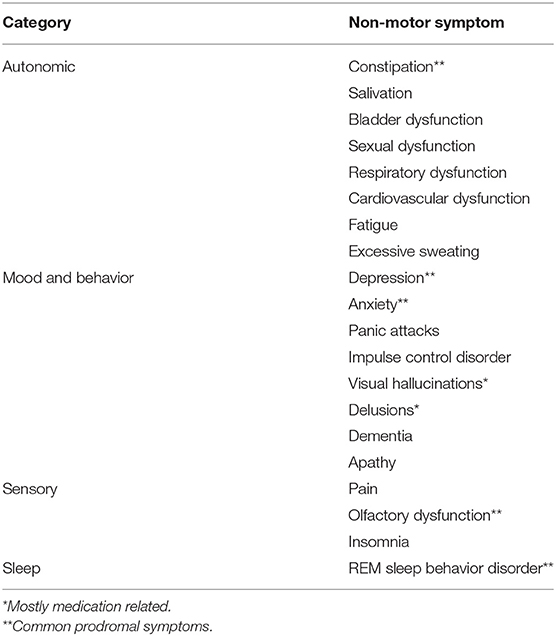
It is now becoming apparent that “Parkinson’s”includes several categories of symptoms, not just rigidity, tremors, and gait, as shown in the table below::

Source for the following table, accessed 11/28/2021:  URL=https://www.frontiersin.org/article/10.3389/fneur.2020.00686

The problem is that treatment and diagnosis are often delayed until PD has already reduced Quality of Life for many folks.

Good evidence for the quality-of-life benefits of existing symptomatic treatment supports the argument for earlier diagnosis at a time when symptoms are already present (emphasis added). This argument would be significantly bolstered by the development of disease-modifying treatments. Benefits of early diagnosis and treatment would affect not only the individual (and their families) but also the wider society and the research community. Ultimately, however, shared decision-making and the principles of autonomy, beneficence, and non-maleficence will need to be applied on an individual basis when considering a “timely” diagnosis.

Therefore, the earlier one can predict the probability or inevitability of PD the sooner one can use treatments – whether pharmacological, surgical, nutritional, or lifestyle in nature – that can either reduce, delay, or defer (and possibly reverse?) the symptoms of PD.

Of all the symptoms associated with PD: tremors, bradykinesia, depression & anxiety, posture, gait issues (difficulties walking), REM Sleep Behavior Disorder (RBD), anosmia (loss of ability to smell), cognitive issues, facial masking, and micrographia (small handwriting) – RBD is the one which is most highly predictive of a later PD diagnosis.

The predictive ‘specificity’ is so strong that if someone has RBD, the chance of being diagnosed with Parkinson’s or related conditions over the next 15 years or more is over 80%

If an 18-21 year old person walked into a physician’s office with RBD, essential tremors, and depression as main symptoms, what would happen? In 1970, probably nothing – one might get treated for depression, but essential tremors are also called “benign”tremors, and were ignored, even if the patient reported being able to feel the tremors while resting, though invisible to the external observer. As for RBD, it would probably also be ignored.

By “a physician,” we are talking about a General Practitioner, or “family doctor,” and not s specialist like a  Movement Disorders Specialist who would be trained to identify varied symptoms, including those that are prodromal. And, of course, the identification of prodromal symptoms has only been investigated within the last decade or so, and are identified as for “research only” purposes – not for clinical diagnosis. A recent survey article (not referenced below) indicated that a majority of general practitioners were either unaware of the Movement Disorders Society’s list of prodromal symptoms, or were not using them to make referrals to Movement Disorders Specialists.

But thanks to the dedication and generosity of folks like Michael J. Fox and others, PD has become a respectable disease for which the person who has it has no reason to be apologetic or ashamed, and can hold their head up (and they ought to, since one symptom is to walk with shoulders stooped down) and proudly proclaim that they have Parkinson’s, which is why they walk funny. And so it goes.

Articles that were quoted above or which contributed to this article are found in the links below.

But first:

I See The Signs of PD

Perspective: Current Pitfalls in the Search for Future Treatments and Prevention of Parkinson’s Disease

An early diagnosis is not the same as a timely diagnosis of Parkinson’s disease

Prodromal REM Sleep Behavior Disorder and PD

10 Early Signs of Parkinson’s Disease / Parkinson’s Foundation

REM Sleep Behavior and Motor Findings in Parkinson’s Disease: A Cross-sectional Analysis

Current Update on Clinically Relevant Sleep Issues in Parkinson’s Disease: A Narrative Review

The prodromes of Parkinson’s disease

Exercise-Induced Neuroprotection of the Nigrostriatal Dopamine System in Parkinson’s Disease

###

Late Stage Parkinson’s (LSP): Undertreated?

This paper (or rather a chapter in a thesis) landed in my newsfeed recently. In it, the authors describe a study done to see whether people with Parkinson’s in the later stages are getting adequate treatment and whether they could benefit from more specific treatment. (A link to the PDf file is at the end of this post).

A person in Late Stage Parkinson’s has more than one of the following:

  • Motor symptoms not controlled despite medication.
  • Levadopa-related dyskinesias or dystonia,
  • PD dementia (defined according to MDS Task Force definition (Dubois et al. 2007), and
    not treated with cholinesterase inhibitors,
  • Depression not adequately treated,
  • Neuropsychiatric symptoms, such as agitation/ aggression; anxiety and irritability,
  • Orthostatic hypotension, pain, constipation, urinary symptoms, insomnia or daytime sleepiness (autonomic systems degeneration),
  • Falls on a regular basis,
  • Other symptoms related to risk of choking, speech issues, or producing too much saliva,
  • Inadequate Home environment.

Basically, the study provided a list of recommended activities and treatment on a sheet of paper (the control group) and actually providing the treatments and activities recommended, (the treatment group).

Not surprisingly, the treatment group did better at the end of the study than the controls. The conclusions were that people in late-stage Parkinson’s are often undertreated and could benefit from implementation of movement disorder specialists’ recommendations. (One would hope that the control group would also be provided with the treatments after the study ended. Perhaps, leading to another report)?

I’ve paraphrased the table used to describe late stage Parkinsonism in order not to infringe on their copyright. The title of the entire thesis is “Impairment and Disability in Late Stage Parkinsonism” and the overall author is Danny Hommel. I couldn’t find an email to ask for permission in writing to reproduce anything verbatim.

Other chapters include:

  • The late-stage of parkinsonism’s – motor and non-motor complications
  • The prevalence and determinants of neuropsychiatric symptoms in late-stage parkinsonism
  • Prevalence and prescribed treatments of orthostatic hypotension in institutionalized peoples with Parkinson’s disease (the chapter discussed in this post)
  • Optimizing treatment in undertreated late-stage parkinsonism: a pragmatic randomized trial
  • General discussion/English summary

Published as: ALAJ Hommel, MJ Meinders, NJ Weerkamp, C Richinger,
C Schmotz, S Lorenzl, R Dodel, M Coelho, JJ Ferreira, F Tison, T Boraud,
WG Meissner, K Rosqvist, J Timpka, P Odin, M Wittenberg, BR Bloem,
RT Koopmans, A Schrag and the CLaSP consortium.
Optimizing treatment in undertreated late-stage parkinsonism: a pragmatic
randomized trial.
J Parkinsons Dis. 2020;10(3):1171-1184.

Cannabis and Parkinson’s Disease (PD)

This article popped up in my email alerts. Although I do not have access to the journal in which it appeared, I thought I would post it anyway, along with several article titles that appeared in the same journal. (If my former employer would grant me access to their technical library, I would be most grateful, and might even forego any patent filing awards that I would be eligible for if I hadn’t retired. I come across at least one new Human-Computer Interface issue that could be solved each week, But I digress). (The actual link to the article was in Medscape News).

Despite high interest (no pun intended(?)) in the use of cannabis as a treatment for Parkinson’s Disease symptoms, this study  finds that actual use remains low (at least in Germany). The article appeared in  Journal of Parkinson’s Disease: Yenilmez, Ferhat et al. ‘Cannabis in Parkinson’s Disease: The Patients’ View’. 1 Jan. 2021 : 309 – 321. 11, no. 1, pp. 309-321, 2021.

Sadly, it is not available as open access, but fortunately the methods and results provide adequate data regarding the study.

Abstract:

Background: Little is known about the patients’ view on treatment with medical cannabis (MC) for Parkinson’s disease (PD). Objective: To assess the PD community’s perception of MC and patients’ experience with MC.Abstract:

Methods: Applying a questionnaire-based survey, we evaluated general knowledge and interest in MC as well as the frequency, modalities, efficacy, and tolerability of application. Questionnaires were distributed nationwide via the membership journal of the German Parkinson Association and locally in our clinic to control for report bias.

Results: Overall, 1.348 questionnaires (1.123 nationwide, 225 local) were analysed. 51% of participants were aware of the legality of MC application, 28% of various routes of administration (ROA) and 9% of the difference between delta9-tetrahydrocannabinol (Δ9-THC) and cannabidiol (CBD).

PD-related cannabis use was reported by 8.4% of patients and associated with younger age, living in large cities and better knowledge about the legal and clinical aspects of MC. Reduction of pain and muscle cramps was reported by more than 40% of cannabis users. Stiffness/akinesia, freezing, tremor, depression, anxiety and restless legs syndrome subjectively improved for more than 20% and overall tolerability was good. Improvement of symptoms was reported by 54% of users applying oral CBD and 68% inhaling THC-containing cannabis. Compared to CBD intake, inhalation of THC was more frequently reported to reduce akinesia and stiffness (50.0% vs. 35.4%; p < 0.05). (emphasis added) Interest in using MC was reported by 65% of non-users.

Conclusion: MC is considered as a therapeutic option by many PD patients. Nevertheless, efficacy and different ROA should further be investigated.

Some other articles on the same issue that might be of interest (All are at the above link):

The Subjective Experience of Living with Parkinson’s Disease: A Meta-Ethnography of Qualitative Literature

Does Gut Microbiota Influence the Course of Parkinson’s Disease? A 3-Year Prospective Exploratory Study in de novo Patients

Association Between Thyroid Diseases and Parkinson’s Disease: A Nested Case-Control Study Using a National Health Screening Cohort  ” The rates of levothyroxine treatment for more than 3 months, hypothyroidism, and hyperthyroidism were higher in the PD group than the control group (3.2%, 3.8%, and 2.8% vs. 2.5%, 2.9%, and 1.9%, respectively, p  < 0.05). The adjusted odds ratios (ORs) in model 2, which was adjusted for all potential confounders, for hypothyroidism and hyperthyroidism in the PD group were 1.25 (95% confidence interval (CI) 1.01–1.55, p  = 0.044) and 1.37 (95% CI 1.13–1.67, p  = 0.002), respectively. 

Subthalamic Stimulation Improves Quality of Sleep in Parkinson Disease: A 36-Month Controlled Study

Diet Quality and Risk of Parkinson’s Disease: A Prospective Study and Meta-Analysis

Identification of Pre-Dominant Coping Types in Patients with Parkinson’s Disease: An Abductive Content Analysis of Video-Based Narratives

Dissonance in Music Impairs Spatial Gait Parameters in Patients with Parkinson’s Disease Conclusion: Our observations suggest that dissonant music negatively affects particularly spatial gait parameters in PD by yet unknown mechanisms, but putatively through increased cognitive interference reducing attention in auditory cueing.”

###

Sleep, drowsiness, DBS and PD

Here are a few links to articles that look at the effects of Deep Brain Stimulation (DBS) on sleep, and daytime drowsiness, which could be a side effect from poor sleep. Or it could be something else.

Long term effects of DTN DBS on sleep

10 year study on daytime drowsiness and PD

REM Sleep Behavior Disorder is one of the more highly correlated conditions that end up with Parkinson’s.I remember having to spend the night on the floor of a motel when traveling with the college marching band. I was dreaming about a girl, and reached out to put my arm around her,  waking the guy who was sharing the queen bed with me.  It’s funny, now. I’ve had worse dreams. Still act out some of them.  Which as a lead-in to:

The largest clinical investigation to date of Prodromal Parkinsonism and Neurodegenerative Risk Stratification in REM Sleep Behavior Disorder

Abstract from a chapter in a book on sleep disorders:

 Significant progress has been made in understanding the pathophysiology of sleep and wake disruption in alphasynucleinopathies during the past few decades. Despite these advancements, treatment options are limited and frequently associated with problematic side effects. Further studies that center on the development of novel treatment approaches are very much needed. In this article, the author discusses the current state of the management of disturbed sleep and alertness in PD and MSA. © 2017 International Parkinson and Movement Disorder Society (emphasis added)

accessed at this link:

Management of sleep disorders in Parkinson’s disease and multiple system atrophy

As someone once wrote: To sleep, perchance to dream…

Just the facts, ma’am

As Sergeant Friday used to say on Dragnet: Just the facts.

Well, here they are.

Narcolepsy-Fact-Sheet

Which answers all those questions that keep you up at night:

What is narcolepsy?
Who gets narcolepsy?
What are the symptoms?
What are the types of narcolepsy?
What causes narcolepsy?
How is narcolepsy diagnosed?
What treatments are available?
What behavioral strategies help people cope with symptoms?
What is the state of the science involving narcolepsy?
What research is being done?
How can I help research?
Where can I get more information?

Then again, a little background information doesn’t hurt, and reading a historical review just might be what you need to put you to sleep:

Historical review of narcolepsy

To sleep, perchance to dream… or to stay up all night, that is the question

Other than the sound of Shakespeare rolling in his grave at that title, what else might be involved in insomnia? (disregarding the occasional benefits such as hearing Isaac Hayes’ version of “By The Time I Get To Phoenix” on a radio show titled “For Mushrooms and Night People,” or reading through James Joyce’s “Finnegan’s Wake” in one sleepless night).

Insomnia related to PD – according to this study abstract, the authors found that insomnia disorder co-morbid with Parkinson’s Disease was consistent with that of folks without PD, and they recommend a cognitive behavioral therapy approach to help treat people with this problem.

Insomnia co-morbid with Parkinson’s Disease

On the other hand, insomnia can lead to daytime drowsiness. And that, as this author can attest, can be co-morbid with REM Sleep Behavior Disorder (RSBD) or as narcolepsy for many years without a diagnosis.

Here are a couple of other articles on longitudinal studies related to PD and sleep issues. They are open access, so one can read and draw one’s own conclusions. As usual, one of the conclusions one might reach is that further research is needed on the topic.

Long term effects of STN DBS on sleep     In this study, it was found that DBS improved nocturnal sleep quality but had no effect on excessive daytime sleepiness.

10 year study on daytime drowsiness and PD   In this long term study, it was found that daytime drowsiness did not improve, even while other symptoms of PD progressively got worse.

The author refers you to the paragraph above in which RSBD was co-morbid and precedent to PD diagnosis, as well as narcolepsy, which was only diagnosed in recent years. Although symptoms may be associated with Parkinson’s, they might not be a part of the Parkinson’s Disease, and other causes must be ruled out in order to arrive at accurate diagnoses. For this, a team of medical personnel is required, and not specialists, each working alone in their own silo. (Opinions provided free of charge).