Clematis and Milkweeds, welcome to the family…

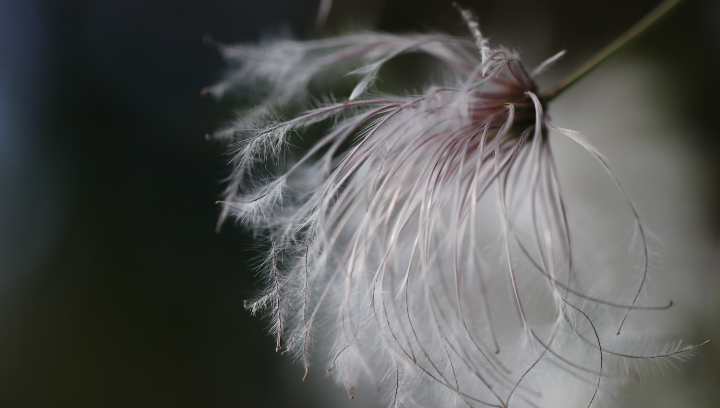
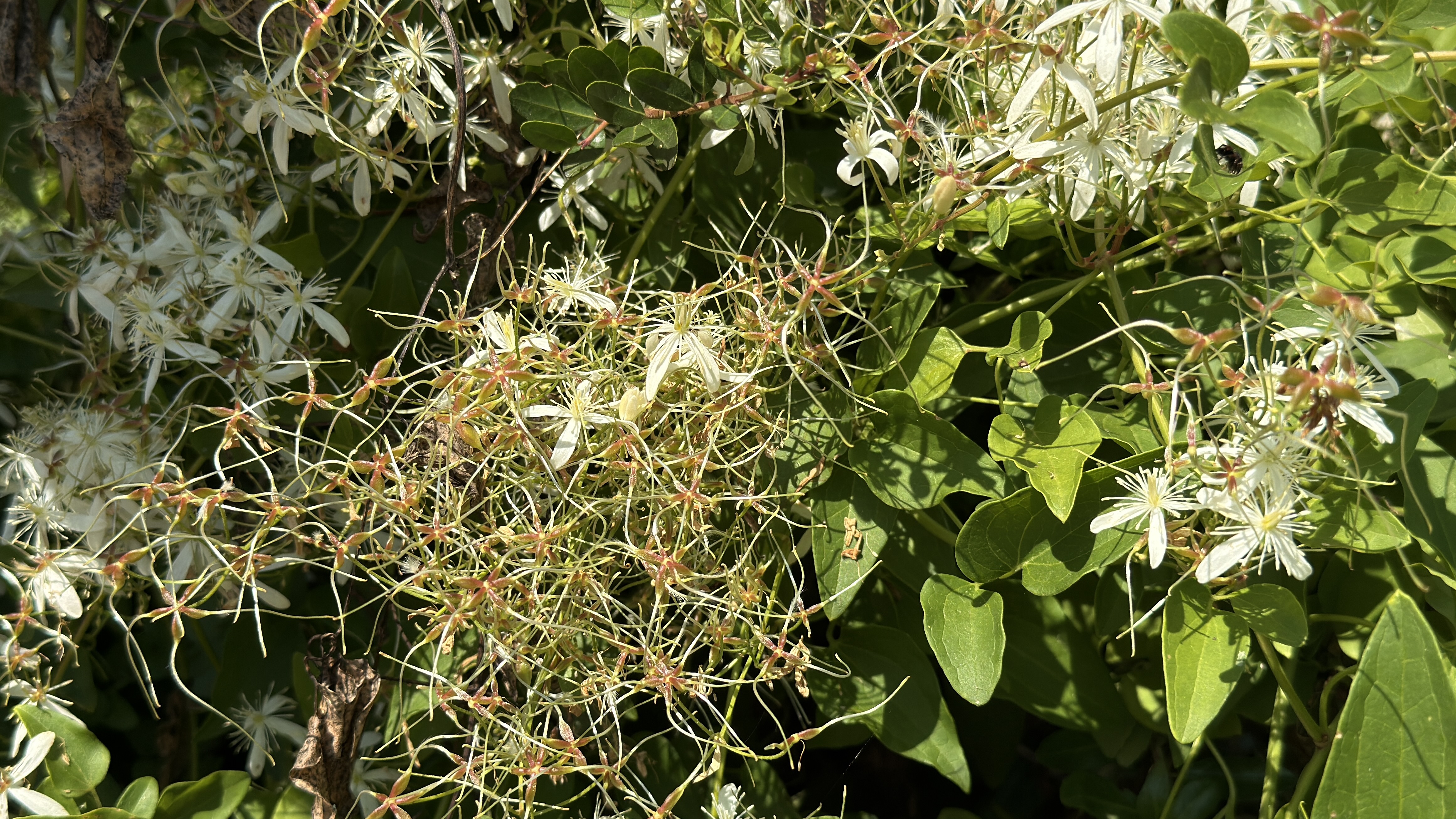
One of my favorite “flowers” is the female Clematis drummondii which is most noticeable in the late summer as the achenes turn into cascades of clouds that give it one of its common names, Old Man’s Beard. The actual flower is shown in the first photo following, the achenes in the other two:

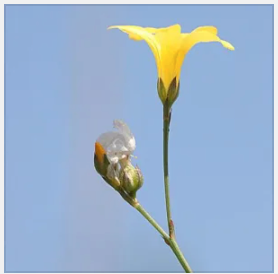
Another favorite plant is Matelea reticulata, commonly known as Pearl Milkweed Vine, due to the “pearl” in the middle of its flower. It, too, is native to Central Texas, where I no longer reside, having “pulled up roots” to move a bit further to the North.

I was pleasantly surprised to find, recently, a different Clematis, native to Central Oklahoma. Clematis terniflora, or Autumn Clematis, as it’s commonly known, is smaller than its Texas cousin, but still provides striking clouds of white flowers and achenes along the roadsides and in ditches. In this case, the flowers provide the show, and the achenes are less showy than those of C. drummondii, as seen in the third photo following:
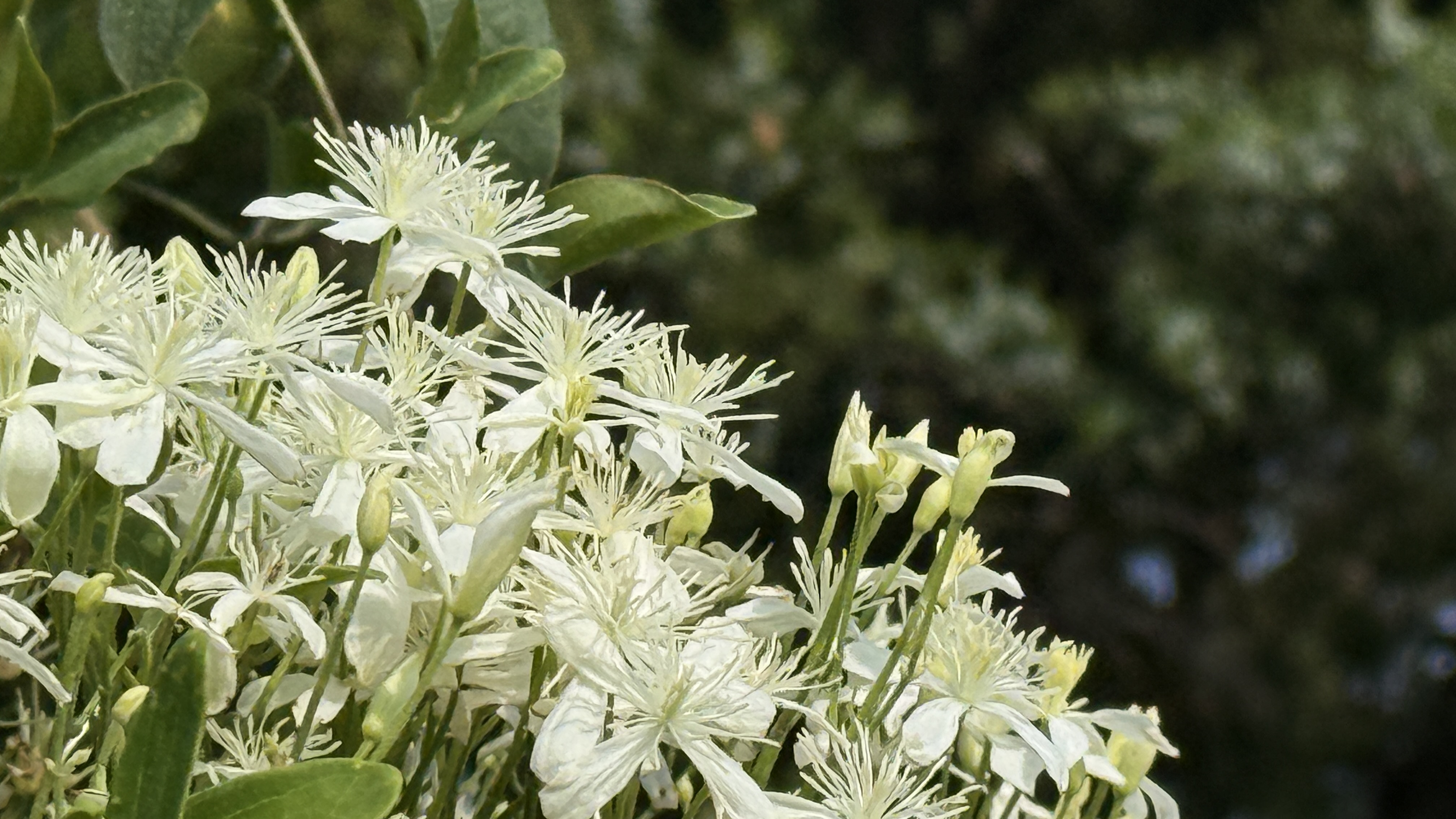
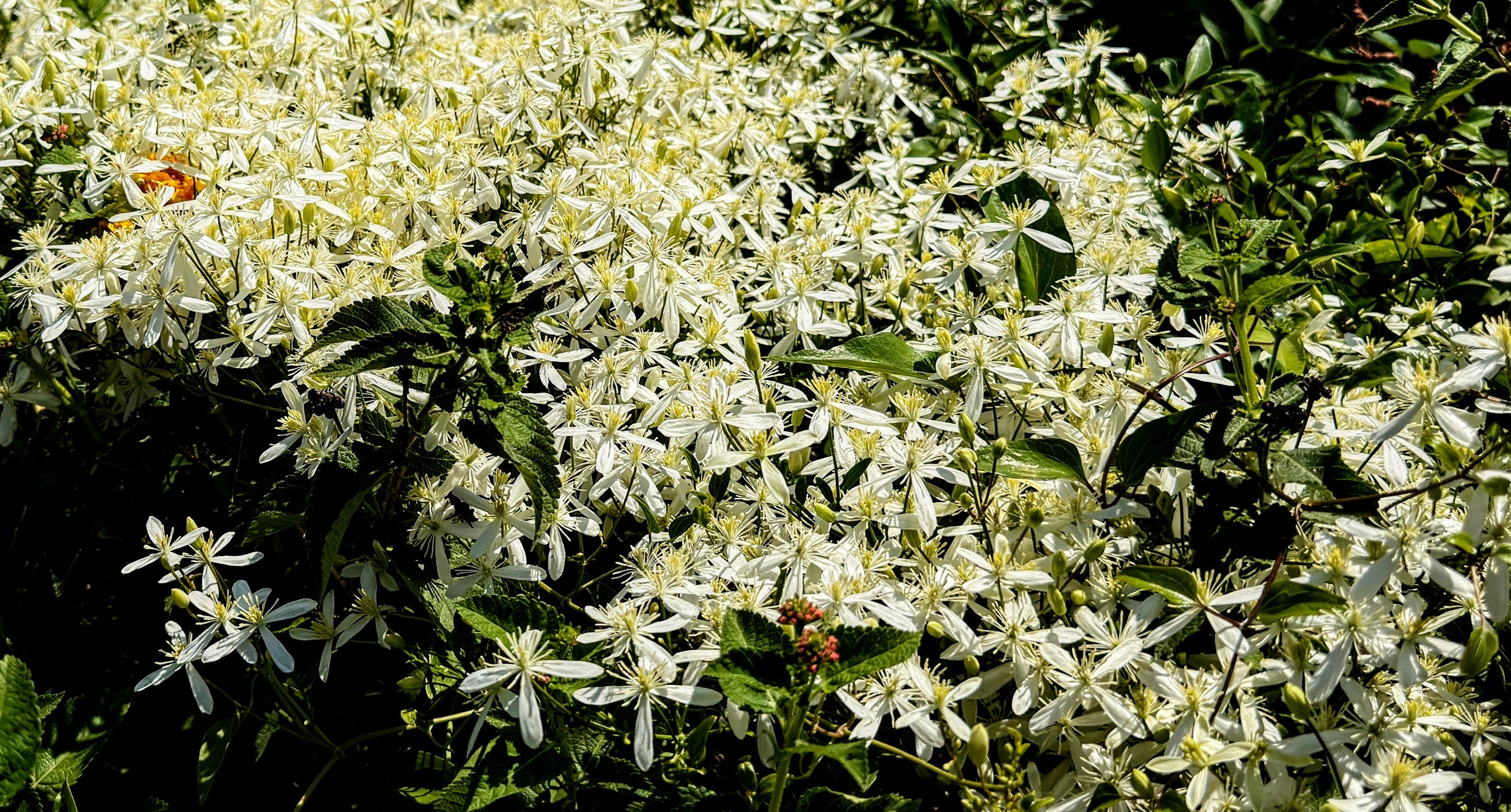
Cynanchum laeve, common name Honey Milkweed Vine, has been observed in several locations around here, notably near the airport and a few miles away. As suggested by the common name, the flowers give off a strong, sweet smell attractive to humans and pollinators alike.

While they’re not the same species one has become accustomed to, the “new” species are familiar enough to provide a sense of a welcoming environment.

###

Spring Photos of Three Oklahoma Tree Species

 A few photos from Bethel Acres in Central Oklahoma during. the Spring of 2025.

The first focuses on the long needles and early cones before they’ve matured. According to an Audubon Society Field Guide published in 1980, this species is native only to the Southeastern tip of Oklahoma. The Wildflower Center’s Native Plants database page, updated in 2022, repeats this information. The location where this photo was taken, of a tree distributed without human intervention, shows the effects of global warming in the extension of its range northward. (Assuming the species is identified correctly.)

LobLolly Pine
LobLolly Pine (Pinus taeda)


Next is what appears to be a Post Oak, with a three lobed leaf shape. The leaves are about 5 to 8 inches long, but shape and size are highly variable.

Post Oak (Quercus stellata)

Blackjack Oak (Quercus marilandica)

Finally, here’s a Blackjack Oak, which has much larger catkins than the Post Oak. The two different species are known to hybridize easily. Perhaps we will post some photos in the future. Observed what appeared to be a Post and a Blackjack oak, growing next to each other, and each showing leaves resembling the “template” form for both pf the species. The typical Blackjack Oak leaf has a “duck foot” shape, almost triangular, without any deep indents. The Post Oak, on the other hand, has a “head” lobe with two deep indents above and below what look like “arms,” tapering a little into the form of a (vaguely) human body.

But that’s a task for another day.

Creating Art with Musk Thistle: Van Gogh Inspired Filters

Or rather, the same photo done in more ways than one…

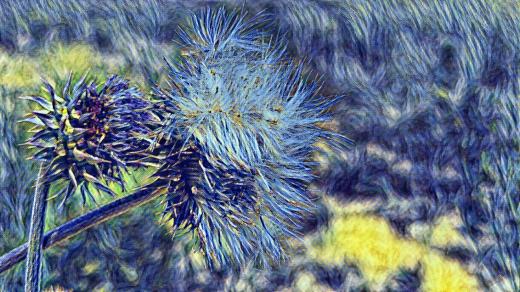
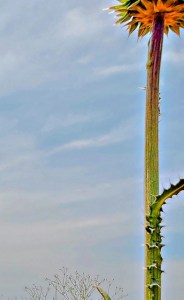
Musk Thistle (Carduus nutans) is an invasive plant native to Europe, Central  Asia, and North Africa. In the photo above we see on the left a flower getting ready to bloom, and behind it a bloom already ggone to seed. The yellow in the background are either Coreopsis or Brown Eyed Susans, or both, out of the depth of field.


The second version was created using a “psychedelic” set of filters.

The third attempts to recreate Vincent Van Gogh’s general style – again, using software filters.

The third variation (and fourth version of the same photo), also uses a Van Gogh approach, this time using a filter that attempts to imitate his Starry Night painting.

And finally, a “normal” shot accentuating the height of the stem as seen from below. If these photos have pricked your interest about Carduus nutans, you can click on the preceding link to check out the Wikipedia page for more information.

###

You learn something new every day…

… or die trying. (Don’t know if that’s an actual quote, or if I just made it up.)

Actually, looks like I’m the author that specific quotation.

 Ralph Waldo Emerson said “Knowledge is when you learn something new every day. Wisdom is when you let something go every day. (at least that’s what Google search told me – kind of a “Jesus loves me, this I know, because the Bible tells me so” moment. Do I believe Google, or do I do further research to locate when and where he wrote or “said” the phrase, or do I I trust my source, and just let it go?

Letting things go, which I have a difficult time doing, is something I’ve had to learn, sometime as a new thing to learn, on a daily basis. One technique learned is to let go of an old book whenever a new book is brought into the house. Or so I claim. This has been difficult for a person who had at least 22 linear feet of of bookshelves, and only brought eight feet with him to Oklahoma.

And so it goes….

The following picture is a manipulated photo of sinus discharge, of which I have experienced more over the last week than I would wish on anyone during their lifetime.

###

Shoes: Vincent’s, Bob’s, and Carl’s

I once had the pleasure (or punishment) of reading from Jacques Derrida’s “A Derrida Reader: Between the Blinds, ” a collection of essays and lectures translated from the original French  while doing volunteer work with Vocal Eyes, a group at the University of Florida in. Gainesville Florida, which read various textbooks which were not available through Books on Tape, Recordings for the Blind, or other sources, in order to provide assistance to others who may have had impairments or disabilities, such as partial or full blindness, years of promotion through a coach’s pressure on academics instead of insisting they be taught to read at their grade level (for the sake of the young person and not for the sake of the coach’s desire to have a winning team – and if you think this is a run on sentence, you should definitely try reading this book, which can be found on the internet archive (but only available for vision impaired people), or can be found at various used bookstores for under $12.00. 

The purpose of mentioning this somewhat dense and difficult to read book (although I must admit, by the time I had reached his discussion of Vincent Van Gogh’s painting of a pair of shoes, I had gotten into the rhythm of the lecture and had started reading with feeling, emotion, and meaning, which hopefully helped whoever was having to listen to this book as an assignment).

Nope, the reason for this lengthy prologue was to introduce a couple of photos, one from the book Van Gogh: The Complete Paintings, and the other, a photo of my own hiking boots, which had reminded me of the essay about. the boots, so I manipulated my photo to imitate (sort of) Van Gogh’s pair of shoes. Whose shoes Vincent had painted, I do not know. I actually had some shoelaces showing in the original picture of my shoes, but they were cut off during the cropping.

Vincent Van Gogh: Pair of Shoes / Bob Kamper: Hiking Boots

Vincent Van Gogh: Pair of Shoes / Bob Kamper: Hiking Boots

Kinda anti-climactic, no?

Oh well, I can always end the post with a song and a question:

Who wrote “Blue Suede Shoes?”

and a reprise:

Carl Perkins with Eric Clapton, George Harrison, Ringo Starr, Dave Edmunds, and many more…