January 2022: different state, same natives, other different plants

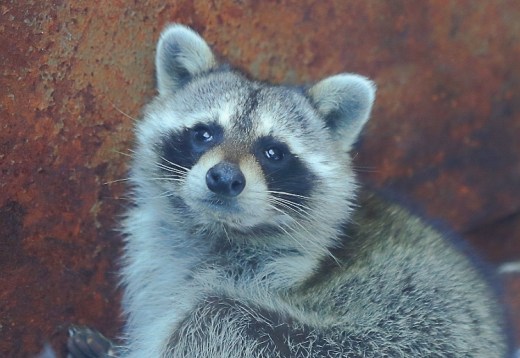
Raccoon

In January 2022, made my first trip out of state of TX to sometime sunny North Central Florida. since the pandemic. Checked the CDC Covid alert, and found that all of the counties we would be going to were rated at the highest level as a hot spot. So it was like going from the frying pan into the fire. Fortunately we had our HazMat gear on hand, and managed to go to and fro without (apparently) contracting any viral infections, according to the Covid-19 15 minute results tests.

After landing in Florida, saw some species familiar in central Texas. Also saw a few that were not familiar.

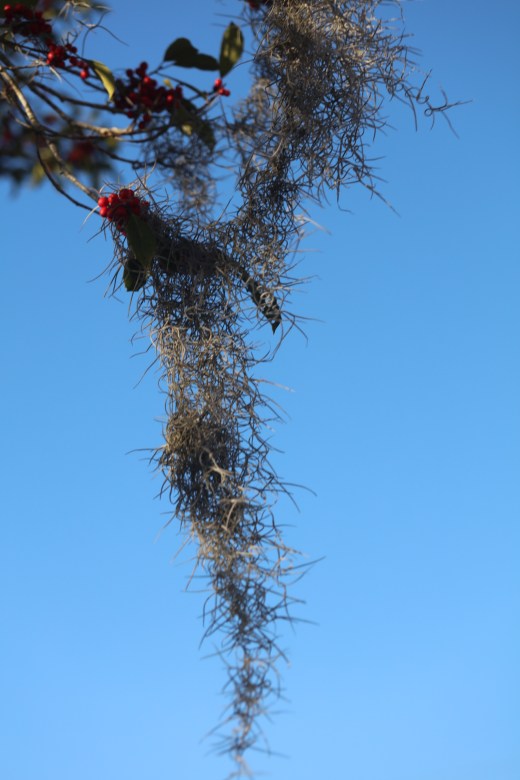
2022-01-15-003574

Mistletoe, a parasite in Texas, also thrives in Florida.

2022-01-17-003660-raccoon

This little critter was pointed out to me by a gentleman in a parking lot. Apparently It had been looking for tasty morsels in the large garbage bins, and was unable to get out on its own. Hopefully, someone gave him or her a ramp  to get out of the bin before the next garbage pickup.

2022-01-17-003640

I believe that this was a Yaupon Holly, or a cultivated variation thereof, as it was in the same parking lot as the raccoon. Could have been Ilex decidua, and just not dropped its leaves yet, due to a shorter Fall and Winter in Florida (if there is one). As a cultivated/planted plant, I didn’t bother to check it in iNaturalist.org.

2022-01-17-003643

Spanish Moss

I suppose there is Spanish Moss in abundance in South and Gulf Coast Texas, but what we see here is mostly Ball Moss. So this was a distinctive and omnipresent reminder that we weren’t in the Greater Austin Metro Area anymore. (Of course, there were lots of Southern Oaks present, from which the Spanish Moss was hanging. We have them here, though other oak species are more common in Central TX.

A new one to me was this interesting little reddish plant. common name Tassel Plant. After encountering this one in the motel parking lot, I began to notice them all over Gainesville. An exotic or introduced plant.

Found in many places in the Gainesville area. An exotic or introduced plant

Tassel Plant

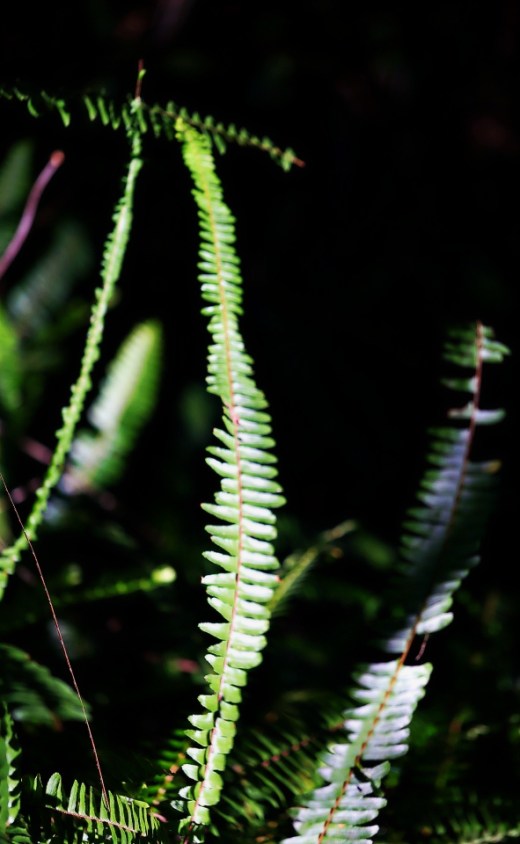
Finally, a fern which I had not yet known the name of A fern with the aptly descriptive common name of “Fishbone Fern.” This was shot in the jungle-like surroundings of Bivens Arm Nature Park on the South side of Gainesville, just north of Paynes Prairie. This photo  (below) was chosen because it demonstrates the leaf pattern that gives the fern its name.

2022-01-18-003708-fishbonefern

Though it was nice to go “home”again, it was also nice to get back “home” again.

###

#nativeplants #Texas #Florida #GainesvilleFlorida

Return of the Celestials (or, A Day In The Life)

Fully open early in the day Nemastylis geminiflora

 I had been looking for Nemastylis geminiflora, commonly known as Celestials, among other names, since the middle of March. On March 23, 2021, I saw the first bloom or two. On the 24th, nothing blooming. Even went out later in the afternoon to see if anything had come up after the earlier jaunt, but still nothing new to show.

Note: I once contacted a seed source company to enquire if they had any seeds or bulbs for this plant. They indicated that they had a small amount sometime in the past, but they had quickly sold out. IF you have a large colony on your property, you might consider checking with a reputable native seed source to see how one might go about collecting seeds. I do not recommend trying to dig them up. They have bulbs which are buried deep in the soil which here in Central Texas is very rocky. Please refer to the Native Plant Society of Texas’s policy on the “taking” of plants.

First of all, what to look for?
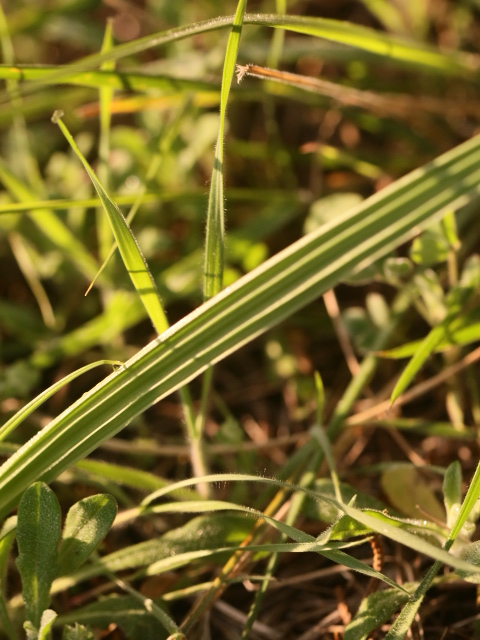
Pleatleaf Lily, one of the common names of N. geminiflora, comes from the distinctive shape of its leaves

Pleatleaf Lily, one of the common names of N. geminiflora, comes from the distinctive shape of its leaves.

Somewhere around midwinter the plant starts sending up a leaf or two. This inferred from the apparently chopped off tips of some of the leaves, following a presumed mowing. and probable weed-eater-ing of the berm, probably in January, which kept the berm shorn to less than 3 inches in height and scalped to bare soil in several places (but that’s a different post). Or maybe it was deer browse or rabbit nibbles.

In Central Texas, somewhere around mid-March, I am now beginning to scout out the individual plants, supposedly so I can find them later. In 2017 and 2020, I photographed plants in bloom around the 15 or 16th of the month, but most years they have appeared right about the Spring Equinox. Last year, the first plants appeared around the 15th-17th of March, then no blooms until around the 27th-29th. Then nothing, until I stumbled across a few around April 10th.This year, 2021, the first blooms did not appear until the 23rd, and these two or three seem to have been early bloomers. The majority of the plants in the area in which I am familiar were still just pleated leaves.

Eventually one will observe the stems with the pre-blossoms (for want of the correct botanical term) coming up, and from that, if one is lucky, the unfurled blossom in the early morning hours. 
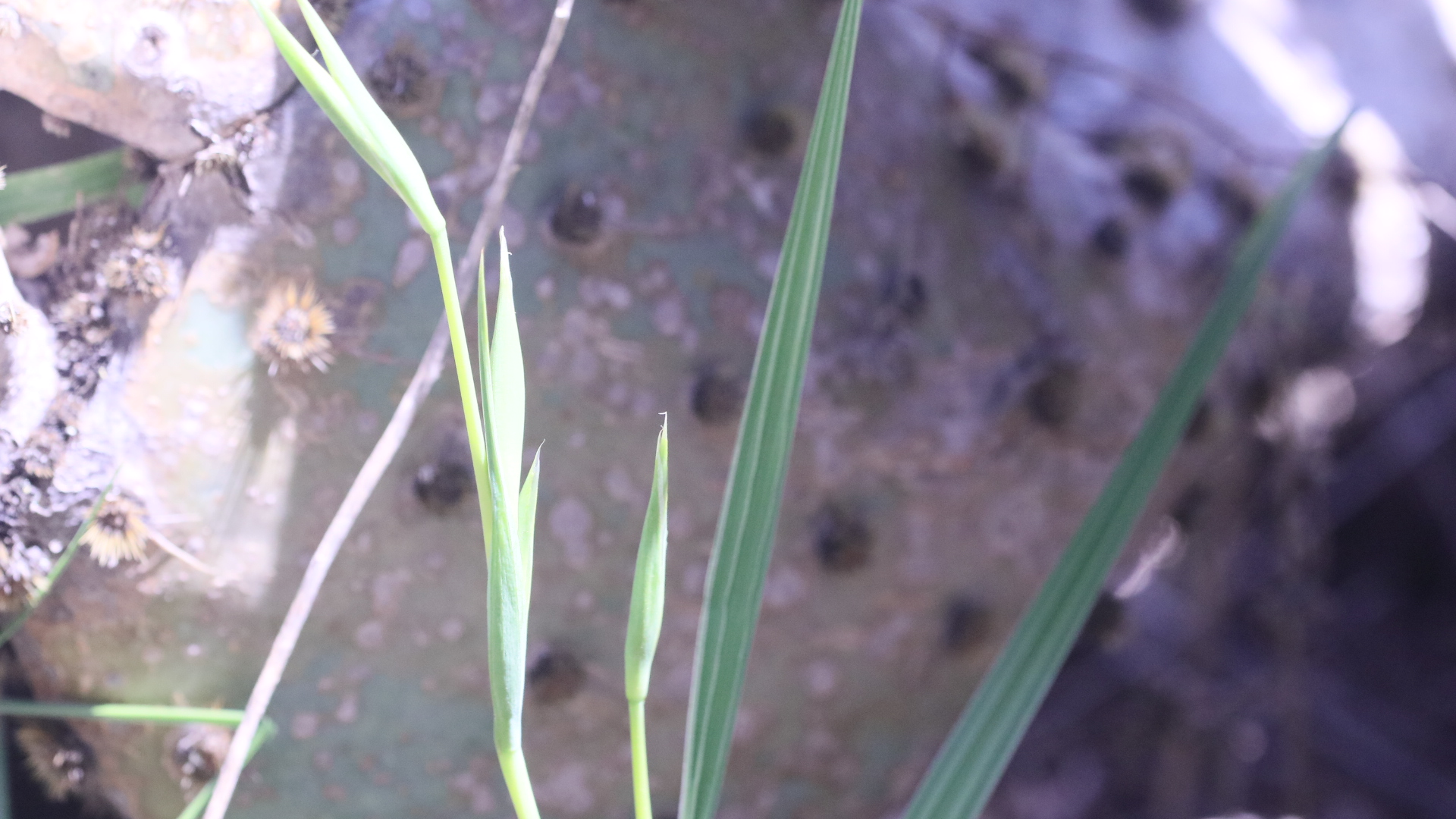
Celestial before blooms open (leaves to the right, stems with unopened inflorescences on the left)
Celestial before blooms open (leaves to the right, stems with unopened inflorescences on the left)

Inflorescence, still unfurled

Inflorescence, still unfurled

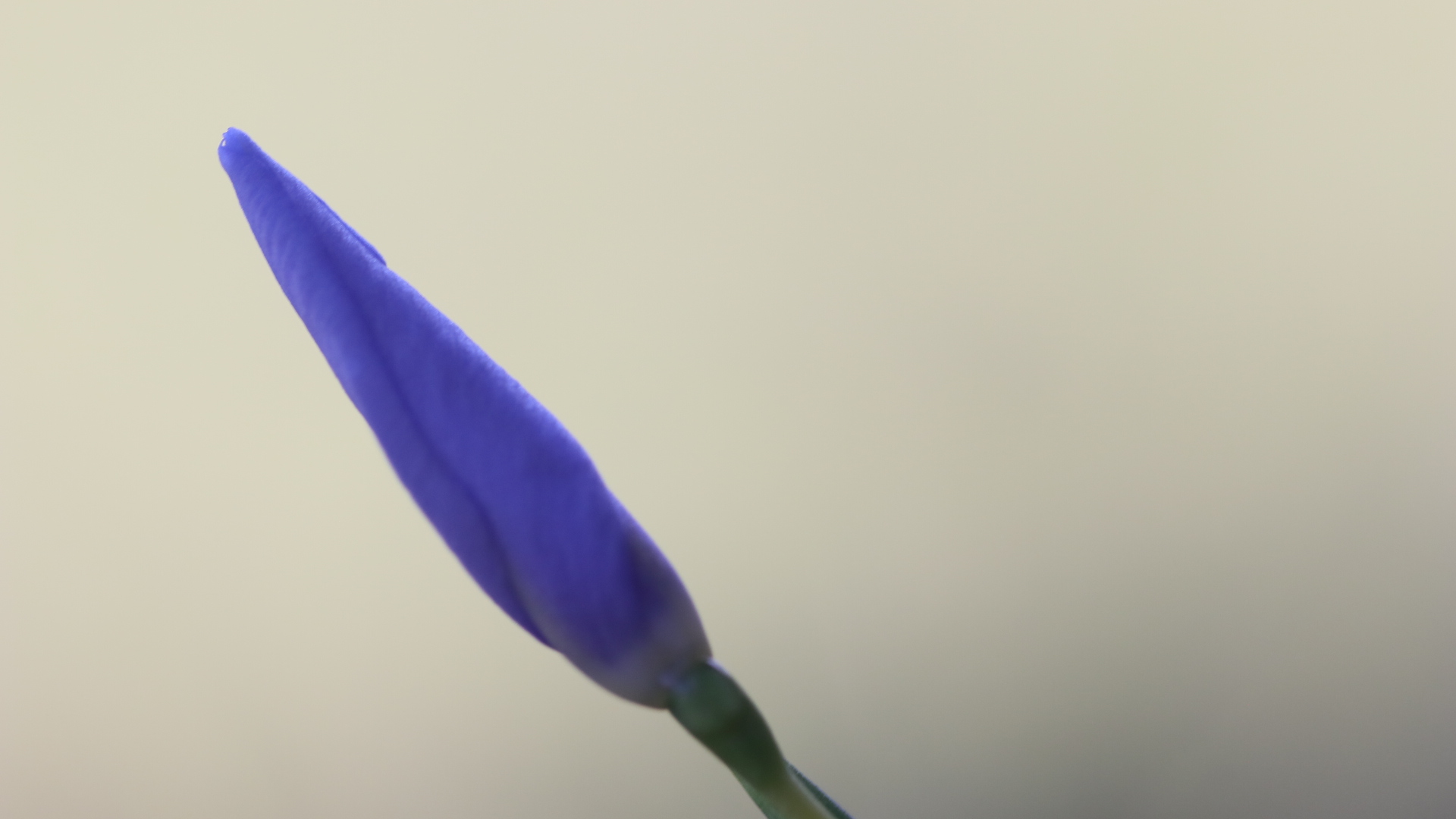
Then, usually the day before or earlier in the morning that the inflorescence fully extends, you’ll see a purple or bluish “flag,” not yet unfurled. 
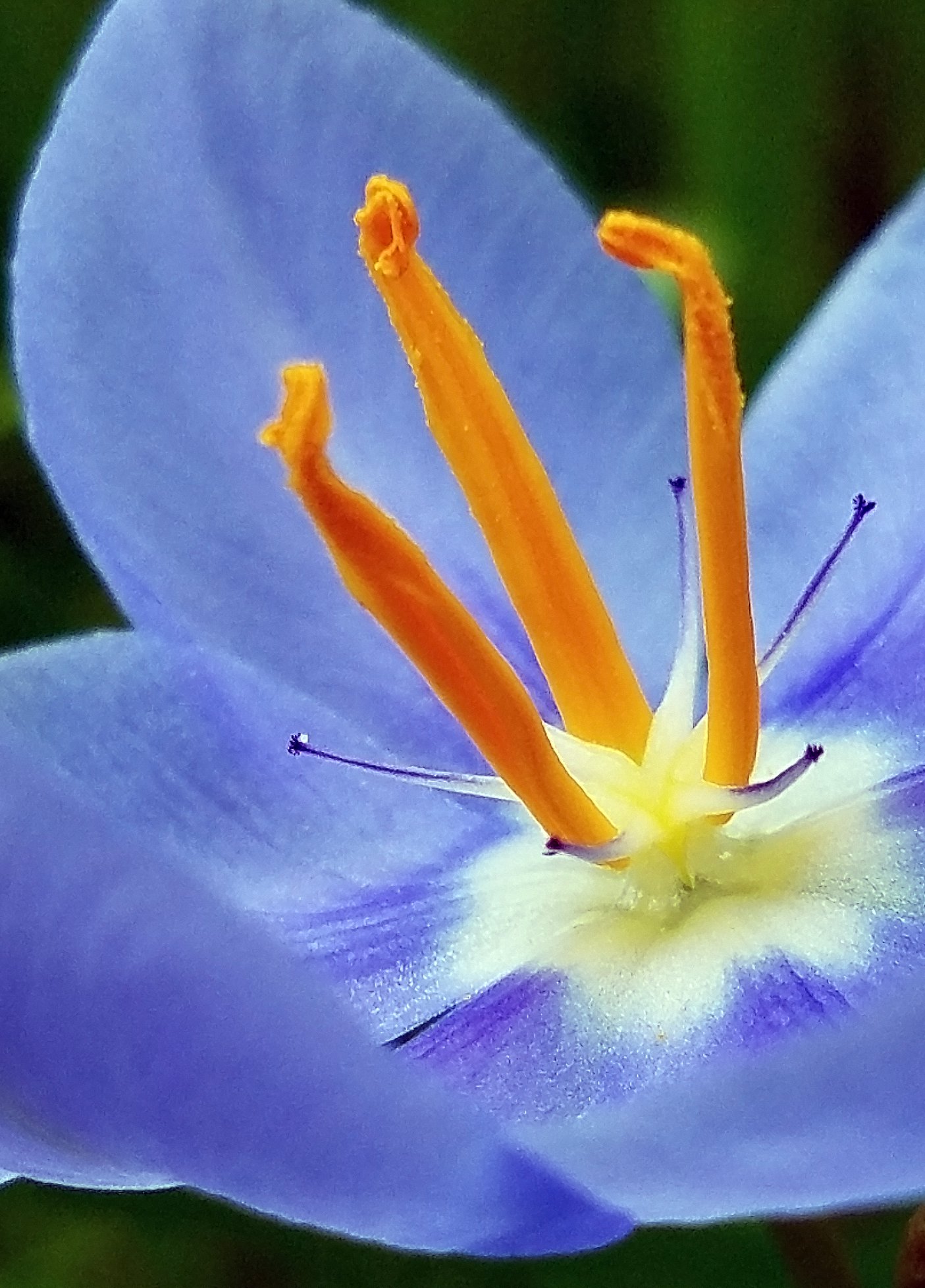
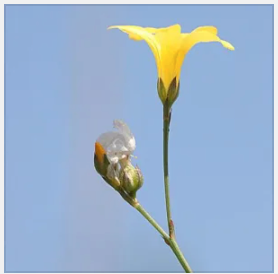
Fully open early in the day Nemastylis geminiflora

Fully open early in a day in the life of a Nemastylis geminiflora.

Either the next day or later the same day, depending upon the sort of day it is (cloudy days they seem to remain closed until after noon. Sunny days they seem to open earlier).

Later in the day, the three tall yellow stamens will have curled up and descended/curled up towards the six stigma spread out at the bottom of the flower as show below. This particular photo taken around 2:30 PM CDT, on a fairly sunny day this March 27th or 28th.

Stamens curled up as a pollinator of undetermined species is busy at work in mid afternoon.
Stamens curled up as a pollinator of undetermined species is busy at work in mid afternoon.

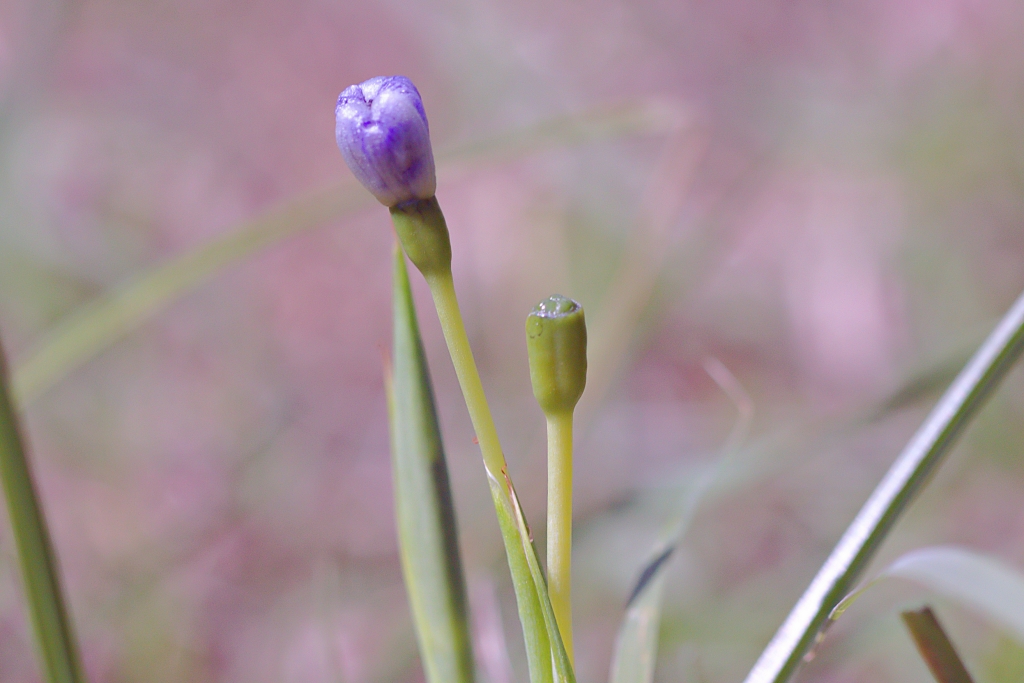
Tomorrow, and tomorrow... the petals have folded, and then the fruit begins to form, as seen left to right.

Yesterday, today, and tomorrow… the tepals have folded, and then the fruit begins to form, as seen left to right.

Although each flower blooms for a single day, a plant may have several flowers. Above, you can see what looks like a potential inflorescence to the left, either today or yesterday’s flower folded in on itself in the center, and to the right, the immature fruit which will eventual mature and provide seeds for future generations. When dry, they dehisc, popping out the small black seeds into the near vicinity.

So: That’s the life cycle of. the Nemastylis geminiflora, which usually blooms for a few short weeks from around the Vernal Equinox until the beginning of April – although sometimes it will fool you as I was last year when I chanced upon some late bloomers around the 10th of April. (I know, the Beatles’ song “Fool On The Hill” comes to mind – if not yours, in my mind, and “In My Life” at least).

Two takeaways:

  1. Do not pick the flowers – this prevents them from going to seed and producing new flowers for the next year. 
  2. Do not try to dig them up. Although they are called Prairie Celestials, the soil in which these are found is rocky and the bulbs are buried deep below the surface, so any attempt to dig them up will likely as not result in damaging the stem or the bulb, thus rendering such efforts useless.

 And a third:

Do get out to a local park or trail where native plants have not been discouraged by putting green level mowing practices, and take a leisurely walk (wearing a face mask, and maintaining a safe social distance). Even if you don’t see any Celestials, you just might see some other native plants and wildflowers. (In Central Texas, they were a little late in their blooming, so maybe they will extend it a little further into April. Who knows? Plants apparently don’t read field guides or any other books, so they don’t seem to follow the “rules” all the time).

###
Loss of roadside vegetation

My previous post mentioned a September set of observations – unfortunately, the observations were not posted to this blog but on Facebook. Sad to say, the situation has gotten worse – Although the native (mostly) plants  were left alone while in bloom in September, the blooms had disappeared a few. months later, and this first week of March 2021, I observed that the plants, for the most part, appeared to have been removed.  Thanks to the ongoing pandemic and my age, I try not to go out too often. but will have to go out and see if any Winecups are in evidence (there was at least one rosette in the video). Maybe take a few home to ensure the preservation of the species. The folks running City Hall don’t seem to care about preserving native plants… as far as I can tell. Oh well. Watch it and weep.

The irony of the last few slides are that they show the invasive Crepe Myrtle and Heavenly Bamboo or Nandina, used as landscaping in the property just south of. the one now being bulldozed for a parking lot and who knows what kind of business. I suspect that a similar lack of consideration for native plants, birds, and other wildlife will guide the development of this property.

#RoundRock #OldChisholmTrail #NativePlants #HabitatDestruction

Endemic in a time of a pandemic

2020_04_10_Clematis_texensis_1521

Clematis texensis – Scarlet Leatherflower

I just realized that there is an analogy between the pandemic coronavirus now causing troubles throughout the planet’s human organizations and the title and subtitle of this blog  – “Return To The Natives – Native Plants Are The Answer.”

C. texensis is endemic to the Texas Hill Country, or the Edwards Plateau, although because of the scarlet flowers, it has been exported to other locations for cultivation. However, it doesn’t seem to be an aggressive plant, so most places outside of Texas where it is found are probably in containers, where they are tended carefully by loving horticulturists.

The example shown above is a next door neighbor example of this phenomenon: Although it it is in Williamson County, TX, it was introduced and is under cultivation. I don’t know of any locations where it is growing in Williamson County without having been introduced by humans. But – it is native to Texas, and to neighboring counties, and who knows? – there might be some undiscovered instances of this species in the Balcones Canyon National Wildlife Refuge.

Unlike some other plants, like Poison Ivy, Malta Star Thistle, Perennial Rye, and Bur Clover, which are aggressive and spread rapidly when they are introduced to an area through human intervention, often by poor mowing practices, this one is unlikely to dominate your garden. But with the right conditions and in the right place, it can and will flourish in Central Texas.

More detailed information on Clematis texensis can be found at Studies on the Vascular Plants of Williamson County, Texas. If that is too much detail for you, there’s always the Native Plant Information Network (NPIN) database at the Lady Bird Johnson Wildflower Center

The analogy mentioned above?

The pandemic virus is like an exotic plant that is introduced to areas where it doesn’t belong – and spreads, unchecked, unless we take quick action to recognize the problem and isolate, treat, and follow up on contacts, to eradicate and mitigate the adverse effects. The same analogy applies to invasive animals, whether Zebra mussels in the lakes of the South, or pythons in the Florida Everglades. It’s hard to get the genie back in the bottle, or to get everything back inside Pandora’s box.

Stay home. Practice good hygiene, whether traveling or working with plants. The only thing that can prevent pandemics is you, to borrow a slogan from a well known fire prevention campaign.

Plant and grow things that are native to the area in which you live – practice proper hygiene when traveling from place to place, being careful not to spread seeds through carelessness, and if you gotta mow, mow only at the right time and the right places that need mowing for the primary reason of safety. Bermuda grass is hard to eradicate once it has spread, and viruses are hard to kill but easily spread through careless hygiene practices.

Don’t “stop to smell the roses” – Learn about the plants that are native to your area, and take the time to enjoy them and their relationships with the wildlife, butterflies, and native bees that are in your six feet of separation.

###