Creating Art with Musk Thistle: Van Gogh Inspired Filters

Or rather, the same photo done in more ways than one…

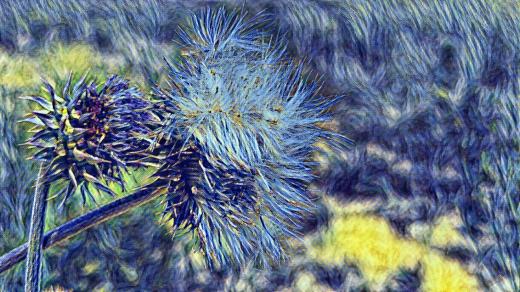
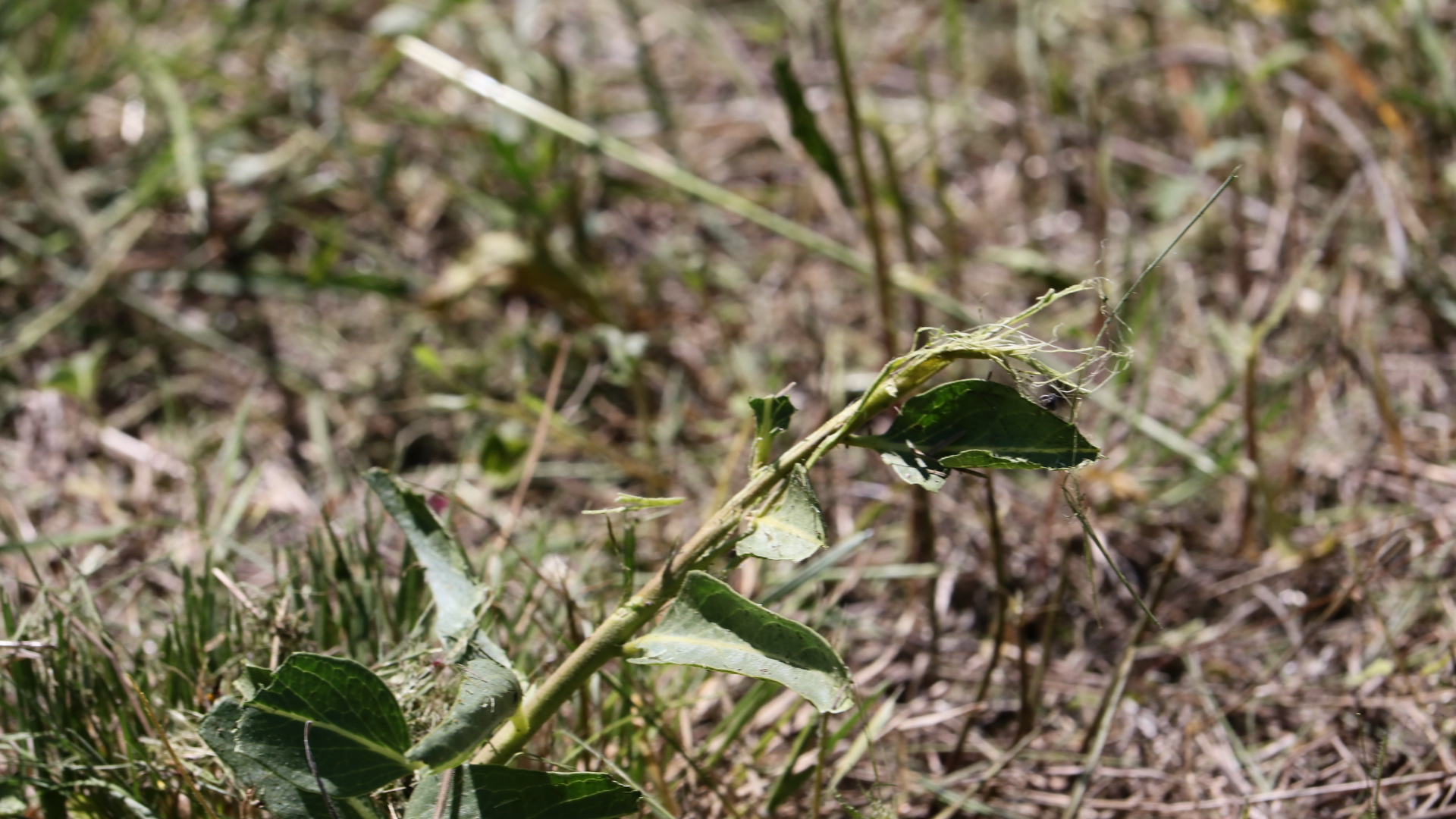
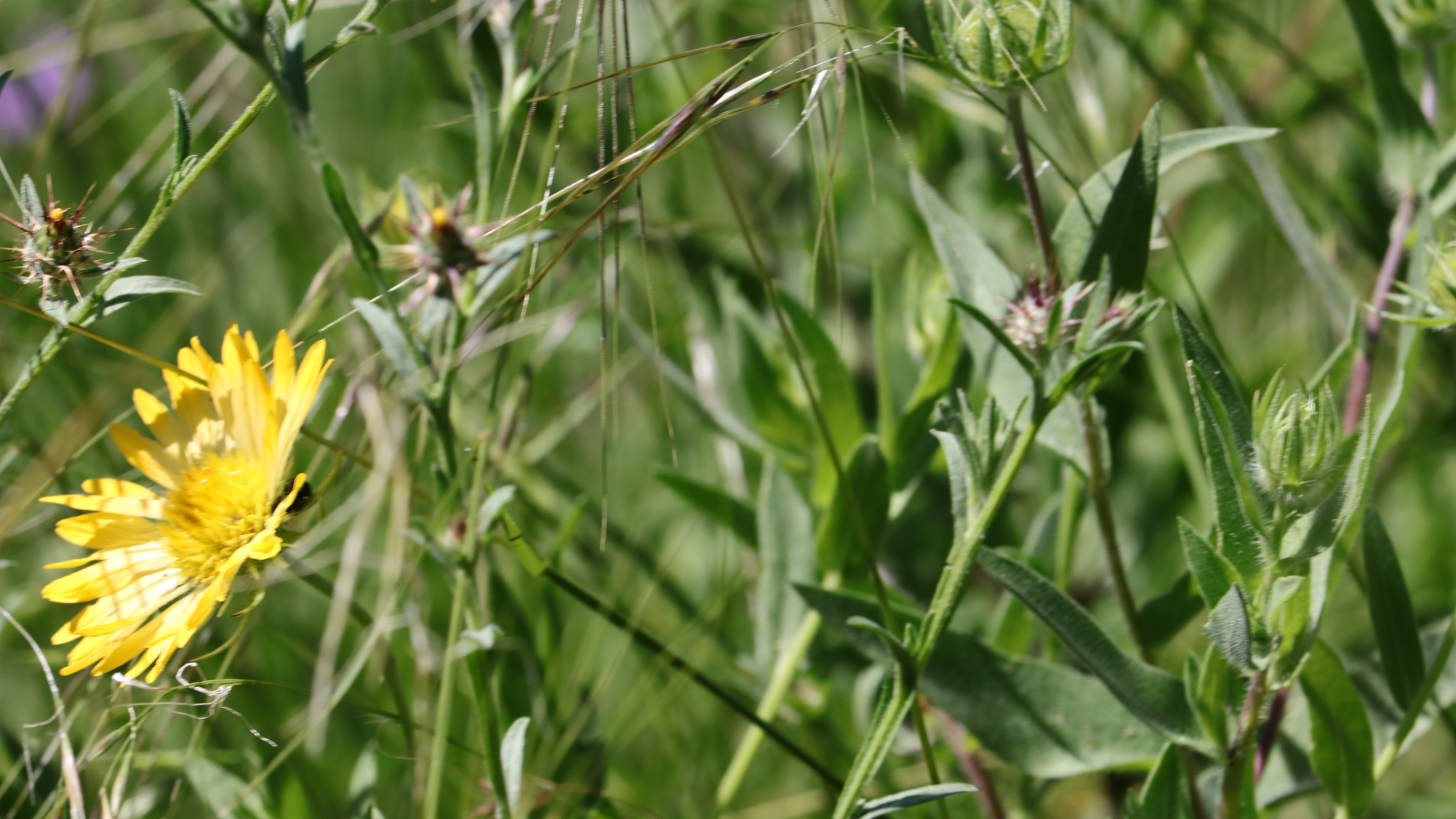
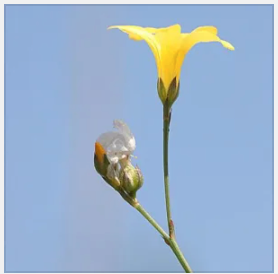
Musk Thistle (Carduus nutans) is an invasive plant native to Europe, Central  Asia, and North Africa. In the photo above we see on the left a flower getting ready to bloom, and behind it a bloom already ggone to seed. The yellow in the background are either Coreopsis or Brown Eyed Susans, or both, out of the depth of field.


The second version was created using a “psychedelic” set of filters.

The third attempts to recreate Vincent Van Gogh’s general style – again, using software filters.

The third variation (and fourth version of the same photo), also uses a Van Gogh approach, this time using a filter that attempts to imitate his Starry Night painting.

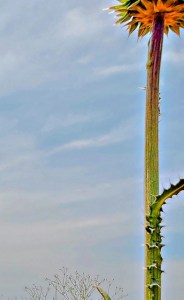
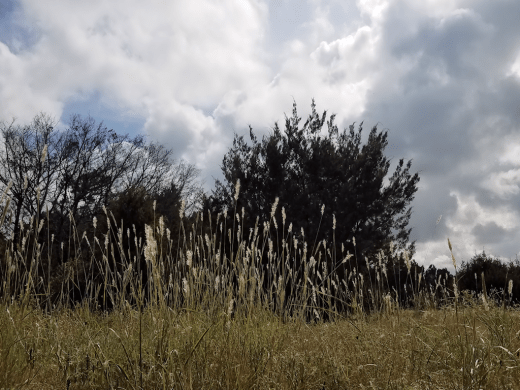
And finally, a “normal” shot accentuating the height of the stem as seen from below. If these photos have pricked your interest about Carduus nutans, you can click on the preceding link to check out the Wikipedia page for more information.

###

Where have all the (native) flowers gone?

Prosser, R.S., Brain, R.A. Where have all the flowers gone? A systematic evaluation of factors driving native terrestrial plant decline in North America. Environ Sci Pollut Res (2024). https://doi.org/10.1007/s11356-024-34349-9 

Prosser and Brain have done the research and  have come up with the following conclusions:

  • Habitat alteration and non-native species are the most important drivers of the decline in native terrestrial plant diversity in North America.
  • No listed species in the U.S. or Canada faced a singular threat. In the recovery plans for all listed species, several threats were identified as contributing to their risk of extirpation or extinction.
  • Pesticides, specifically herbicides, represent a micro-scale contributor to the decline of plant biodiversity in North America relative to other drivers.

(Note: the above three points are taken verbatim from text in the article, although they are not presented as bullets in the subject article. Emphasis using bold and italics has been added).

In their conclusion, they argue that pesticides and herbicides make an easy target for litigation, even though they contribute minimally to the extirpation or extinction of native plants .

On the other hand, Paraquat is an herbicide that not only has been banned in over 50 other nation-states, and has been linked as a probable cause of Parkinson’s Disease in the book Ending Parkinson’s Disease: A Prescription For Action  and in this February 2024 article on the EarthJustice website: This Weed Killer Is Linked to Parkinson’s. Why Isn’t It Banned Yet?

I would suggest that the authors of the article on causes contributing to reduction of native plant species are failing, in their words, to see the forest by focusing on the trees. I am a native plant advocate who also has Parkinson’s Disease. I don’t know whether I have been exposed to Paraquat in the past. Just because pesticides and herbicides are not a major factor in the reduction of native species doesn’t mean I should just ignore the bigger picture of the effect of herbicides like Paraquat on the species Homo sapiens, many of whom, including myself, have displaced other native occupants of this territory, like the Apaches, the Tonkawas, and other tribal groups who are members of the same Genus and species.

This post has covered most of my main interests: scientific research, Parkinson’s Disease, and native plants. All that’s missing is some music:

The Parkinson’s Anthem (We Ain’t Givin’ Up Hope)

#nativeplants  #research #parkinsonsdisease #advocacy

A possible explanation to Monarchs’ dallying around Texas this year

This article came up in my newsfeed recently,.

It suggests  why some Monarch butterflies seem to be hanging around Texas this year – the popularity of Tropical milkweed (Asclepias curassavica). The article further goes on to explain that

” Tropical milkweed becomes a problem when planted in temperate areas where it does not die back in winter. A protozoan parasite of monarch butterflies, Ophryocystis elektroscirrha or OE for short, can travel with monarchs visiting the plants and become deposited on leaves. When caterpillars hatch and start eating the plant, they ingest the OE. High OE levels in adult monarchs have been linked to lower migration success in the eastern monarch population, as well as reductions in body mass, lifespan, mating success, and flight ability.”

Milkweeds native to the region die back after blooming, and with them, the OE. Thus each new flight of Monarchs gets to lay their eggs on new, uninfected milkweeds.

Interestingly, the article was written over three years ago…

Tropical Milkweed is a No-Grow – by the Xerxes Society

On the other hand, I have now seen and photographed Monarchs in my backyard from late March through November . I went to vote  on Tuesday, November ,2, and  observed more than a few Monarch butterflies, both in the greenbelt and in the demonstration garden. Sadly,  many of the flowers being used didn’t appear to be natives.  I also noticed that the milkweeds at the community center garden appear to be Tropical milkweed. (They have yellow flowers instead of orange flowers).

Some plants and wildlife in October:

What a difference a year makes… for the better, this time.

After having managed to prevent the mowing down of a stand of wildflowers back in May, I had been busy bagging Centaurea melitensis (Maltese Star Thistle) from the berm between my house and the green belt, until last week, when I woke up Saturday morning with an excruciating pain which was diagnosed as a sciatic nerve issue. Haven’t done much weed-pulling since then. It’s not perfect yet, but I think we’ve made some progress.

So I think it’s about time to show how much better the berm looks this year (after thistle removal).

###

Oh no! They (almost) did it again!?!

May 7, 2021: I was just about to go out into the greenbelt for some photo taking when I heard the sound of a mower on the berm. I quickly came back running and shouting for him to stop.

Pointing out all of the native Texas wildflowers still in bloom, I explained that one should NEVER mow down a stand of wildflowers in bloom (as was done last year while I talked on the phone with their home office). I mentioned that I was trying to eliminate the invasive weeds so that the native wildflowers would have a chance to return, including the Bluebonnets, some of which had not set seed yet. (And to which he replied something along the lines of yeah, I thought I saw some back there, indicating the area that he had just mowed, and which now showed no evidence of Bluebonnets).

For an idea of what happened in 2020, refer to these two posts: May 25, 2020 May 28, 2020

Last year I managed to pull most of the Perennial ryegrass (Lolium perenne) that had covered the berm. This time around, Maltese star-thistle (Centaurea melitensis) was the infestation of the year, and as of May 11, 2021, I have removed about 10 bags of this from the berm behind my house. Of course, it has already infested the greenbelt.

To their credit, the mowers backed off, apparently called someone for instructions on what to do, and then proceeded not to mow any more of the berm behind my fence, although he did have to drive through the area, choosing a path that would minimize the damage to the wildflowers. And crushed a good deal of the thistles to the ground, along with some wildflowers.

Thankfully, in spite of the C. melitensis, the wildflower population was much more numerous than last year. The recessive gene all-yellow Gaillardia pulchella (Indian blankets) for which I have coined the common name “Sunwheels” in contrast to the all-red pigmented “Firewheels” have also bloomed again, this time almost entirely on the berm. In previous years I have seen them in a few nearby locations, but for the last three years I have observed them directly behind my house, on the berm or in the greenbelt. (Of course, when you only have to step out the back yard to see them, you are not motivated to search very far for them).

But enough blah blah blah. Here are some pictures worth a thousand words, especially when compared with the posts from 2020.

2021-05-05-7870

Asclepias asperula (Antelope Horns) after the mowing.

2021-05-05-7885

Gaillardia pulchella (“Sunwheel”) surrounded by Centaurea melitensis (Maltese star thistle)

2021-05-05-7803

Berm behind my house – native plants plus invasive weeds

2021-05-14-8172-greenbelt2-1024pxl

The green belt – Gaillardia pulchella in bloom

2021-05-14-8146

The mower mows, leaving nothing behind. Looking South from behind my house, greenbelt to the left, berm behind my fence in the foreground.

May all your weeds be wildflowers.

#BCMUD

###

Loss of roadside vegetation

My previous post mentioned a September set of observations – unfortunately, the observations were not posted to this blog but on Facebook. Sad to say, the situation has gotten worse – Although the native (mostly) plants  were left alone while in bloom in September, the blooms had disappeared a few. months later, and this first week of March 2021, I observed that the plants, for the most part, appeared to have been removed.  Thanks to the ongoing pandemic and my age, I try not to go out too often. but will have to go out and see if any Winecups are in evidence (there was at least one rosette in the video). Maybe take a few home to ensure the preservation of the species. The folks running City Hall don’t seem to care about preserving native plants… as far as I can tell. Oh well. Watch it and weep.

The irony of the last few slides are that they show the invasive Crepe Myrtle and Heavenly Bamboo or Nandina, used as landscaping in the property just south of. the one now being bulldozed for a parking lot and who knows what kind of business. I suspect that a similar lack of consideration for native plants, birds, and other wildlife will guide the development of this property.

#RoundRock #OldChisholmTrail #NativePlants #HabitatDestruction

Native plants are the answer…

Maybe it’s just me, but it seems to me that there are far too many crepe myrtles (Lagerstroemia sp.) in use for the good of the planet, especially for the good of wildlife in the United States.

The same could be said of other exotic plants, such as Privet or Ligustrum (Ligustrum sp.), Heavenly Bamboo (Nandina domestica),   Chinaberry (Melia azedarach), and others. Even plants native to one area might become invasive if introduced and allowed to spread in another ecoregion.

Best advice, of course, is to plant plants that are native to your ecoregion. And with Climate Change (or Climate Chaos, which seems to be a more accurate description), even plants native to one’s ecoregion might be getting squeezed out or moving further north, or moving higher up, or retreating into ecological niches (if they haven’t been paved over or bulldozed into oblivion).

img_0413

Texas Lantana (Lantana urticoides)

Take, for instance, Texas Lantana (Lantana urticoides) which can often be found, even in the “big box” stores. However, its cousin Lantana camara which is similar but has different colored flowers and somewhat different leaf texture (I am told) can also be found in those same stores which don’t offer plants grown only in the local region. So it shouldn’t have surprised me when I found several of the L. camara in the greenbelt this past fall, growing right beside what I took to be L. urticoides. And while trying to get photos of a stand of native Solidago sp., (aka Goldenrod), I chanced upon a young Chinaberry (Melia azedarach) sapling. Nearby there are several invasive Chinese pistache (Pistacia chinensis). And that’s just directly behind my house and/or my neighbors’ houses.

This, in a greenbelt that is protected because there is a cavern underneath it within which live one or two endangered species.

The conclusion is the title to this post.

PLANT GRASSES, FLOWERS, SHRUBS AND TREES THAT ARE NATIVE TO THE AREA IN WHICH YOU LIVE. NOTHING ELSE.

If you want a Crepe Myrtle in your yard, then move to Southeast Asia, or wherever it is that they’re from. And take the big-box store nurseries with you. Please. Thank you.

p.s. drove past the construction site where I had taken photos on September 23, 2020, and it appears that most of the native plants have been the subject of “brush clearing.” Don’t know for sure. Didn’t stop and inspect. Would think the Winecups might be in bloom, either now or soon.

###.

Some research that might be of interest…

My Google Scholar alert feed tossed a couple of items my way  that might be of interest. They are in PDF format, so you can read them online or download them for future reference:

Tricky partners: native plants show stronger interaction preferences than their exotic counterparts.

Citation: Coux, C., I. Donoso, J. M. Tylianakis, D. Garcı´a, D. Martı´nez, D. M. Dehling, and D. B. Stouffer. 2021. Tricky partners: native plants show stronger interaction preferences than their exotic counterparts Ecology 102(2):e03239. 10.1002/ecy.3239

Main takeaway (my interpretation): Increasing presence of exotic plants may put rare native plants at higher risk of extinction.

(Caveat: my browser says the site is not secure. However, I have several security programs that (hopefully) would mitigate. the risks).

That being said, the article is from a group of scientists from New Zealand, Germany and Spain who looked into the interactions that native and exotic plant species had with other plant species.

Exotic species interact with many partners with which they have not coevolved, and it remains unclear whether this systematically influences the strength of neutral processes on interactions, and how these interaction-level differences scale up to entire networks. To fill this gap, we compared interactions between plants and frugivorous birds at nine forest sites in New Zealand varying in the relative abundance and composition of native and exotic species, with independently sampled data on bird and plant abundances from the same sites

The results found that native plants’ interactions with birds were both more positive (preference for) and negative (avoidance of). Their analysis suggests that the blending of species communities through dispersal of exotics into native plant communities might result in an increase of neutral interactions between birds and native plants or exotic plants.

This could make rare species more vulnerable to this loss of selectivity and to greater randomness in the identity of their interaction partner.

So there’s another argument for getting rid of invasives.

Moving right along, here comes

Where Have the Native Grasses Gone: What a LongTerm Repeat Study Can Tell Us about California’s Native Prairie Landscapes

…found that native grass cover decreased dramatically (especially on the valley floor), exotic grass cover fluctuated widely over time, while both native and exotic forb cover increased over time. The findings support the notion that prior grazing management practices may have supported the former stands of Stipa pulchra.

… Several trends became apparent when the data from the three periods are viewed together. Both native and exotic forbs increased between each data collection. There were consistently more native forbs than exotic ones and native grasses decreased in cover. Though exotic grasses fluctuated, they always made up a greater amount of cover than their native counterparts. Lastly, cover of bare ground fluctuated and shrubs declined. The Fisher’s Exact test of the increases and decreases of forb and grass cover across quadrats from 1981 to 2015 had a p-value of 0.00012 indicating that we can reject the null hypothesis of independence…

… native bunchgrasses have declined dramatically since the end of the ranching era. Simultaneously, native forbs have increased (at least temporarily), especially on the valley floor. Our findings also suggest that the historical ranching practices in LJV likely supported the excellent stands of Stipa observed in the valley prior to release from grazing. These findings are in agreement with those of previous long-term studies in other parts of California that also found a decline in Stipa cover on lands released from grazing. (emphasis added).

If one were to generalize the conclusions of this study to Texas, where this writer resides, I would say that the presence of large stands of Prickly Pear (Opuntia sp.). and Texas Cedars (Juniperus ashei) as the dominant species in large parts of Central Texas is probably due to past practices of overgrazing, similar to the presence of the native bunchgrasses in California has been attributed to the previous grazing practices in the study cited above.

However, I do not believe that the answer to the problem is to bulldoze the soil away and to cover the land with non-permeable surfaces like buildings and asphalt parking lots.  One can develop land while leaving large portions of native plant species intact, and without replacing them with crappy myrtles and Nandina plants.

postscript:

One of the references used in the article on California grasses was California’s Fading Wildflowers  by Richard A. Minnich. The table of contents and lists of illustrations and tables and preface are available for open access, but the book itself costs a hefty $128.00.  Another reference was Terrestrial Vegetation of California. California Native Plant Society Special Publication Number 9 (pp. 733–760). Sacramento, California., which is not on the web.

###
Oops! They did it again.

As in, “They mowed the berm between the greenbelt and the houses when it didn’t need mowing.” (See slideshow at the end of the post).

I had just gotten back inside the house, after taking some photos of plants in my yard, and had gone out into the berm, to document the healthy growth of Silver Bluestem that had risen up after the most recent massacre at the end of May. While not as thick as one might wish, it was good to know that my removal of the Perennial Rye and Malta Star Thistle had allowed the native grass to come back.

Looking on the bright side, it appeared that the mower’s blades had been set at a higher level than before. Whether they pressure washed the blades before mowing, I don’t know. Since I have not received the courtesy of a reply to my emails in February and June,  I don’t know. And the Johnson Grass, which I’ve been pulling out or removing the inflorescences from so they don’t go to seed, were mowed down, leaving the Poison Ivy more or less intact, so that it will be easier to go out and apply an herbicide to eradicate. And at least they mowed while the ground was dry.

So while I am still not happy with the apparent frequency of scheduled mowing, it seems that my attempts to enlighten and educate those responsible has made a small dent. Persistence will tell the tale.

Natives returning, along with a few undesirables

A month after the Wildflower Massacre at the hands of untrained/poorly trained mowers (who are not to blame, for the are just pawns in the game), the native plants are making a strong comeback, as well as a couple of unwelcome plants, both exotic and native. Among the invasive or undesirable plants are Johnson Grass (Sorghum halepense), Bermuda Grass (Cynodon dactylon), and Poison Ivy (Toxicodendron radicans). Interestingly enough, most of the “new” natives are coming up in the area in which I had already pulled some 10 bags of grasses and weeds of the exotic and invasive persuasion. But enough talk, here’s a slideshow to illustrate what I’m talking about.


The low blade mowing (under 7 inches) according to a personal source expert on eradicating non-native species from parks and preserves, is a great way to spread the Poison Ivy (a native, but one which one prefers left in preserves, untouched by mower blades). I suspect that cutting below 7 inches also encourages the spread of Bermuda Grass. The Johnson Grass is an opportunistic plant that likes disturbed soils such as construction sites or “scalped” roadways and in my case, berms. But it can be easily defeated by pulling it out after every rain, and letting native grasses take over.