[updated April 8, 2025]
Some folks may recognize the title as an allusion to an old interview with Bob Dylan in which a reporter asked about him being considered a protest singer and/or the voice of a generation. If not, do a search on YouTube for the interview – probably in San Francisco, 1965, maybe – If my memory serves me well.
A hallmark of human movement is volitional control – the freedom to move easily, automatically, and safely within the changing demands of daily living. Clinical signs characteristic of Parkinson’s disease (PD) include rigidity and tremor, hypokinesia, stooped posture, vocal alterations, facial masking, and progressive loss of peri- and extrapersonal use of space . These movement aberrations are one of many factors that increase the risk of falling and point to the need for improving fall prevention strategies . These disease-related limitations experienced by people with Parkinson’s disease (PPD) increasingly rob them of movement freedom. Quality of life declines as conscious attention and effort in everyday living replace spontaneity of communication and safety in navigation.
Reading those words in the introduction to this article flowed off of the page like they were written in my soul. Many times I have avoided falling by using dance steps learned in my Rhythm and Moves class from Power for Parkinson’s® (PfP) (taught by Nancy Bain) located in nearby Austin, Texas. And certainly the improvisational dance techniques used in the class have improved my quality of life, allowing me to be more spontaneous. Following a fall in April of 2023, I have been on a 6 month journey of rehabilitation, and certainly my quality of life has deteriorated somewhat due to the conscious attention and effort in performing activities of daily living. But dance, music, and improvisation continue to be the core of my spirit as I strive to improve against this incurable (yet!), progressive, degenerative, neurological disease. Even though I don’t get around much anymore…
This study reported on one of the co-authors’ method in teaching dance to mild-to-moderate stage People with Parkinson’s over a 3-year period (2013–2015). She is a tenured university dance professor also trained in the Mark Morris Dance for PD® program.
Another (modified) quote from the article is this table, which I find reflects many of the implicit and explicit principles used in dance classes. Verbal Auditory Cueing (VAC) is the acronym used in the table. Color coding has been added to separate the different methods more clearly:
Principles
|
and Methods
|
|
Non-judgment
|
Class advertised as movement class
|
|
|
Greeting at entrance by teacher
|
|
|
Class offered free of charge
|
|
|
Inclusion of carepartners as students
|
|
|
VAC that there are no mistakes, only new movement options
|
|
Non-competitiveness
|
All movement is seen as an honest effort
|
|
|
VAC focused on action, not quality of movement
|
|
|
VAC “Yes, and …” replaces “Not that” or “Rather try this”
|
|
Curiosity and
playfulness
|
Awareness of movement possibilities
|
|
VAC “Stay curious in what you are doing” or “Keep going”
|
|
VAC “Nothing is precious”
|
|
Pacing of VAC does not allow self-editing
|
|
Risk taking
|
Selection of class environment
|
|
|
Student self-selection of participation level
|
|
|
VAC to validate self-selected level of participation
|
|
|
Adaptation of exercises to sitting or at the barre as needed
|
|
|
Structured, directive (non-improvised) activity transitions
VAC to attend to constraints of an activity rather than invoke fear
|
Another point used in the method was to increase challenge by gradually increasing the variety and complexity of movement tasks. In this way, the participants maintained safety while increasing their sense of confidence. In PfP classes, this is called “Fun.” They even have a t-shirt with the definition of Fun printed on the back.
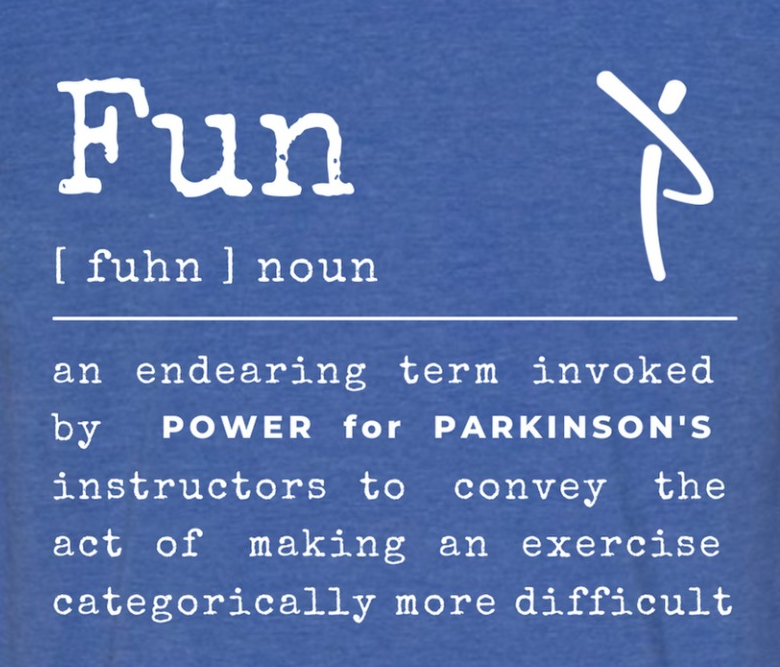
This particular study was published back in 2016, and most of the authors were associated with Wake Forest University in Winston-Salem North Carolina.
Here’s the citation and a link to the open access article, which goes into more detail about the principles and the practice of the improvisational dance classes.
Batson G, Hugenschmidt CE, Soriano CT. Verbal Auditory Cueing of Improvisational Dance: A Proposed Method for Training Agency in Parkinson’s Disease. Front Neurol. 2016 Feb 17;7:15. doi: 10.3389/fneur.2016.00015. PMID: 26925029; PMCID: PMC4756105.
More information about Power for Parkinson’s®, their classes, and YouTube channel can be found at:
https://powerforparkinsons.org
Another 501(c)(3) charitable organization which happens to be focused on improvisation as a means to offer People with Parkinson’s (and their caregivers) to a safe environment using many of the principles listed above is Yes, and… Exercise (if that sounds familiar, take a look at the methods related to non-competitiveness in the table above) at https://yesandexercise.org.
And since the title says it, here’s a song about dance that I loved as a kid (still do, and probably still will, if I ever grow up)(note 2025-04-08: the original link is no longer available, so I just created a link to a song that I also loved during my wasted youth, besides, I don’t remember what the original link was about.)
The Contours “Do You Love Me (Now That I can dance?)”
###







 bob's brain: living well with a movement disorder and other comorbidities