Keep on Dancing, folks!

Conclusions first:

Conclusions
This study highlighted the challenges associated with the feasibility of using an RCT design in this setting, demonstrated the acceptability of implementing a dance program inspired by the Dance for PD® model in Belfast, Northern Ireland for people living with Parkinson’s, and made suggestions for future research. The results support existing evidence demonstrating that dance may improve functional mobility and symptoms of depression in people living with mild to moderate Parkinson’s, though these findings should be carefully interpreted in the context of the study design and limitations. The small sample size limits the generalizability of the statistical results, though it was not among the aims of this study to test the efficacy of the intervention. The findings also support the idea that meeting and dancing with other people living with Parkinson’s is motivating and fosters a sense of belonging, and that dancing has the potential to support several aspects of physical, emotional, mental, and social health. (emphasis added).

Working back in the article, the authors are very honest about the limitations, including not being able to  establish a large enough group of participants so that they might be able to compare the dance intervention against another form of exercise.

Only ten Parkinson’s Disease diagnosed participants were recruited, which makes generalization difficult, but modest improvements were seen. (I saw no mention of statistically significant results in the 12 week, 20 session study). Some participants noted that the dance intervention made them more aware of certain deficits, such as posture, and that the classes motivated them to make more mindful efforts to correct these outside of the classes.

Some participants also described using tools learned in class in everyday life. For example, one participant reported using breathing exercises when anxious or fatigued, and another reported using the warm-up exercises outside of class to “stop the stiffness” and “feel better as a result of that. (emphasis added).

So: Small number of participants. Some improved scores, but no statistically significant differences. Positive statements from exit interviews. Nothing to contradict other evidence that dance interventions have a positive effect on the lives of people with Parkinson’s Disease.

Don’t stop moving to the music / keep on dancing,  folks

The article is open access and may be downloaded for free at:

Evaluating the effects of dance on motor outcomes…

Citation for this article:

Carapellotti, A.M., Rodger, M. & Doumas, M. Evaluating the effects of dance on motor outcomes, non-motor outcomes, and quality of life in people living with Parkinson’s: a feasibility study. Pilot Feasibility Stud 8, 36 (2022). https://doi.org/10.1186/s40814-022-00982-9
Participants needed for Narrative Study in Parkinson’s Disease – study starts February 26, 2022

Robert Cochrane is recruiting participants for a new Parkinson’s Disease study. See below. Note the three categories of PD people needed:
” We are recruiting male and female persons diagnosed with idiopathic (unknown cause) Parkinson’s disease between and fit ONE of the following criteria:
– They have been diagnosed within the last year,
– are early onset (diagnosed before the age of 50)
– are active or former members of the U.S. military. “”
Here’s the full recruitment flyer:
Participants needed for Narrative Study in Parkinson’s Disease Principal Investigator, Dr. Gabriele Wulf, and Robert Cochrane, PhD student at UNLV, are looking for persons with Parkinson’s disease to participate in an online research study of heroic narrative upon Parkinson’s disease. Study participants will be asked to share their perceptions and experiences about Parkinson’s from the time they were diagnosed to today, and how they feel about their future quality of life expectations. They will be taught heroic storytelling structure and practical tools of how to explore and incorporate it into their own lives. Heroic storytelling is based on the works of Joseph Campbell’s monomyth. Campbell’s work is broken into a 12-step journey for this class that participants will follow and use to write their own heroic journey with Parkinson’s disease. Participation in this study will require completion of 12 sessions, meeting once a week on Saturday mornings from 9a-10:30a (Pacific Time). Participants Will also be required to write a one-page personal assessment each week outside of class. Finally,online surveys at the beginning, middle and end of the 12-session period will be required. All sessions will take place online via Zoom. All sessions will be recorded. Participants must have a WiFi enabled device in a safe location (e.g. participants’ home) for these sessions. Sessions will include writing, theatrical improvisation and lectures from guest subject matter experts in fields such as dance, art and mythology. We are recruiting male and female persons diagnosed with idiopathic (unknown cause) Parkinson’s disease between and fit ONE of the following criteria:
– They have been diagnosed within the last year,
– are early onset (diagnosed before the age of 50)
– are active or former members of the U.S. military. Participants must be between 1-3 on the Hoehn and Yahr scale. This assessment should be given by participants’ neurologist or movement disorder specialist prior to acceptance into the program. We cannot accept persons who have an inability to communicate verbally, are uncomfortable writing, or are unable using the Zoom platform. Please email Robert Cochrane at cochra58@unlv.nevada.edu with questions or to express your interest in participating.This program was made possible, in part, by a grant from the Parkinson’s Foundation. Thank you!

January 2022: different state, same natives, other different plants

Raccoon

In January 2022, made my first trip out of state of TX to sometime sunny North Central Florida. since the pandemic. Checked the CDC Covid alert, and found that all of the counties we would be going to were rated at the highest level as a hot spot. So it was like going from the frying pan into the fire. Fortunately we had our HazMat gear on hand, and managed to go to and fro without (apparently) contracting any viral infections, according to the Covid-19 15 minute results tests.

After landing in Florida, saw some species familiar in central Texas. Also saw a few that were not familiar.

2022-01-15-003574

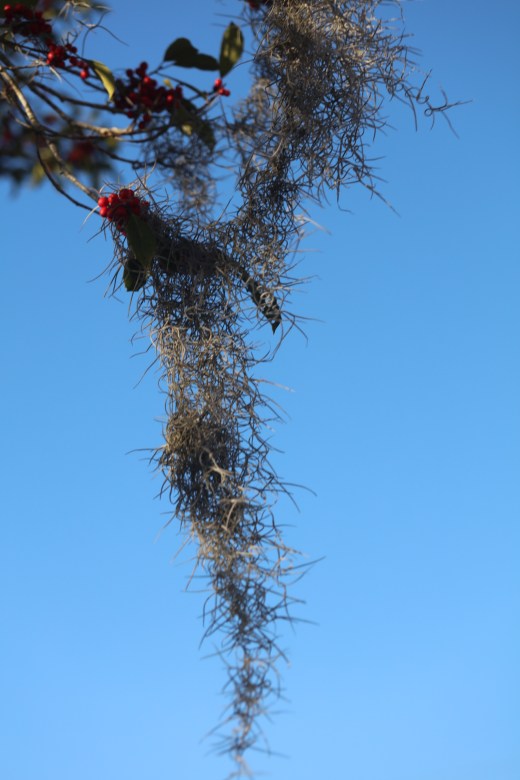
Mistletoe, a parasite in Texas, also thrives in Florida.

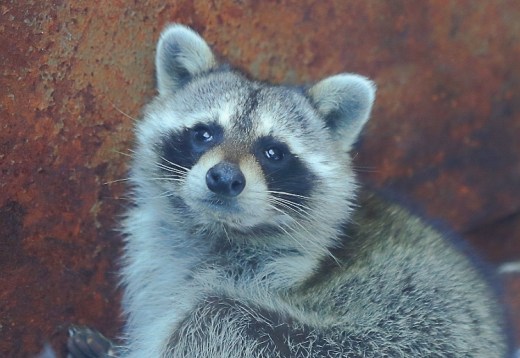
2022-01-17-003660-raccoon

This little critter was pointed out to me by a gentleman in a parking lot. Apparently It had been looking for tasty morsels in the large garbage bins, and was unable to get out on its own. Hopefully, someone gave him or her a ramp  to get out of the bin before the next garbage pickup.

2022-01-17-003640

I believe that this was a Yaupon Holly, or a cultivated variation thereof, as it was in the same parking lot as the raccoon. Could have been Ilex decidua, and just not dropped its leaves yet, due to a shorter Fall and Winter in Florida (if there is one). As a cultivated/planted plant, I didn’t bother to check it in iNaturalist.org.

2022-01-17-003643

Spanish Moss

I suppose there is Spanish Moss in abundance in South and Gulf Coast Texas, but what we see here is mostly Ball Moss. So this was a distinctive and omnipresent reminder that we weren’t in the Greater Austin Metro Area anymore. (Of course, there were lots of Southern Oaks present, from which the Spanish Moss was hanging. We have them here, though other oak species are more common in Central TX.

A new one to me was this interesting little reddish plant. common name Tassel Plant. After encountering this one in the motel parking lot, I began to notice them all over Gainesville. An exotic or introduced plant.

Found in many places in the Gainesville area. An exotic or introduced plant

Tassel Plant

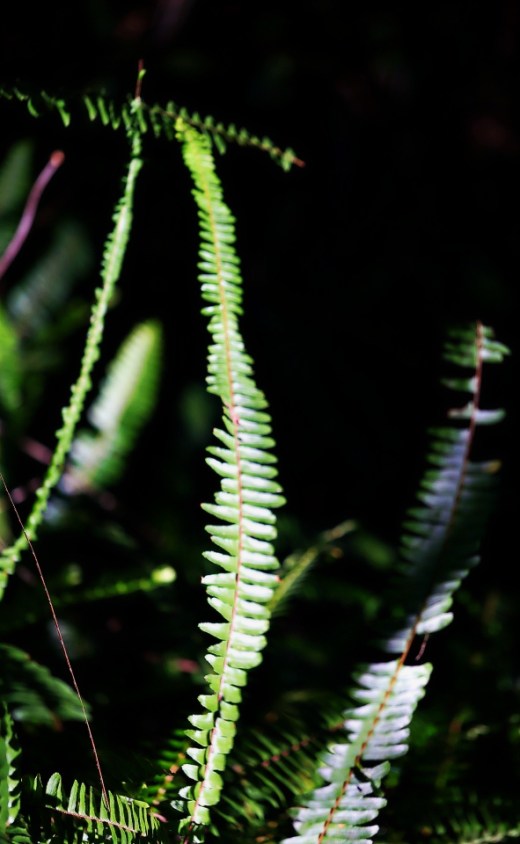
Finally, a fern which I had not yet known the name of A fern with the aptly descriptive common name of “Fishbone Fern.” This was shot in the jungle-like surroundings of Bivens Arm Nature Park on the South side of Gainesville, just north of Paynes Prairie. This photo  (below) was chosen because it demonstrates the leaf pattern that gives the fern its name.

2022-01-18-003708-fishbonefern

Though it was nice to go “home”again, it was also nice to get back “home” again.

###

#nativeplants #Texas #Florida #GainesvilleFlorida

Keep on moving to (and making) music

The evidence that rhythm, movement, and making music continues to accumulate as a therapeutic approach to address the symptoms and Quality of Life issues related to Parkinson’s Disease (PD).

Today we look at an article just out in Frontiers of Human Neuroscience, titled

Rhythm and Music-Based Interventions in Motor Rehabilitation: Current Evidence and Future Perspectives  

Over the last quarter of a century, increasing research results point to rhythm and music as effective and useful tools for treatment and rehabilitation of people with neurological disorders. This article reviews the evidence for four different approaches, what the consensus is at the present time, and, of course, suggests future directions.

The authors look at four different approaches:

  1. Rhythmic Auditory Stimulation (RAS)
  2. Music-Supported Therapy (MST)
  3. Therapeutic Instrumental Music Performance therapy (TIMP) and
  4. Patterned Sensory Enhancement (PSE)

The consensus of recent meta-analyses and systematic reviews is that, for Parkinson’s Disease (PD), is that RAS is an effective tool for improving gait, stride, and speed – folks walk faster and with longer steps with RAS. Additionally, evidence is showing that it also reduces freezing of gait (FOG), improves balance and reduces the occurrence of falls.

Neither MST nor TIMP have been studied much beyond the rehabilitation of stroke patients. They involve practicing on a keyboard or drums, beginning with the patient’s comfort level and increasing in difficulty. Some studies have begun to be used to investigate effectiveness as treatments for PD.  Some have shown improvements in motor dexterity. More research is needed, but in the meantime, learning to play drums or keyboards can’t hurt, and may enrich one’s quality of life (QOL).

Growing evidence in neurological and brain imaging have shown increased activity in the auditory and motor areas of the brain, indicating that brain plasticity might be achieved through music and rhythmic interventions. The authors note that RAS has been well studied with stroke and PD populations, but not with other movement disorders and Alzheimer’s populations. In addition MST and TIMP have only begun to be investigated as a means of restoring fine motor coordination.

The authors also call for neuroimaging use in studies, to better understand the physiological basis of the rehabilitation process. They point out the gaps in research and hope to provide a framework for future research – not so much a roadmap, I would think, but a laying out of what we know and what we don’t know, and what kinds of studies are needed to answer the questions about what we don’t know..  They state that “musical rhythm is a powerful tool” for therapy, and our understanding and exploration of how it modulates brain networks is in the initial stages.

 In other words, “We’ve only just begun.”

Meanwhile: Don’t stop moving to the music.


Citation:
Braun Janzen T, Koshimori Y, Richard NM and Thaut MH (2022) Rhythm and Music-Based Interventions in Motor Rehabilitation: Current Evidence and Future Perspectives. Front. Hum. Neurosci. 15:789467. doi: 10.3389/fnhum.2021.78946