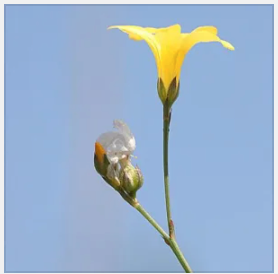
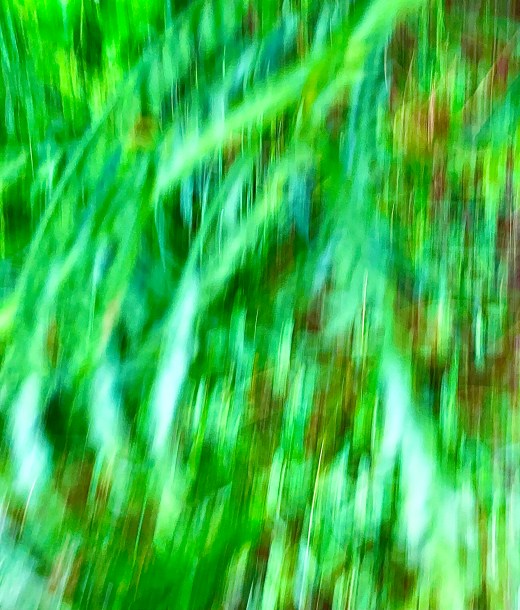
This is photography on Parkinson’s

This is photography on Parkinson’s… sometimes. Sometimes you accidentally hit the button due to herky-jerky movements, sometimes you manage to get the shot you envisioned in the viewfinder. Some days your vision is blurred and it’s hard to say whether or not you have the item you want in focus, in focus. More often than not, it’s blurred, and the background or foreground isn’t focused instead. Of course, one can always use autofocus, but that has the same issues as manual focus with blurry vision. The best one can do in that situation is to click the shutter as soon as the screen blinks red, indicating that everything’s in focus. And then, of course, somedays you get the focus right and the shutter speed and it all works. Then again, when life hands you bitter citrus, sometimes you can make a Margarita. Or better yet, KeyLime Pie.

Verbal fluency, DBS, and parkinson’s

How many animals can you name in one minute?

Wait one year, and do the same test. 

How did you do? better or worse? Basically, that’s what this post is about.

Several articles in this post (all free PubMedCentral articles):

  1. Changes in Verbal Fluency in Parkinson’s Disease
  2. Semantic and phonemic verbal fluency in Parkinson’s disease: Influence of clinical and demographic variables
  3. The Verbal Fluency Decline After Deep Brain Stimulation in Parkinson’s Disease: Is There an Influence of Age?
  4. Worsening of Verbal Fluency After Deep Brain Stimulation in Parkinson’s Disease: A Focused Review
  5. Striatal volume is related to phonemic verbal fluency but not to semantic or alternating verbal fluency in early Parkinson’s disease

The first two studies looked at verbal fluency as measured by counting the number of animals one could name during a timed minute. Basically, the further along folks were in the stage of the disease, the lower their verbal fluency, and the lower their quality of life. Analysis indicated that several other factors were involved, such as depression, age, and executive functioning. People with Parkinson’s (PWP) with higher verbal fluency scores had better quality of life and lower caregiver burden, as measured by scores on standardized rating scales such as the PDQ-29 and The Modified Caregiver Strain Index (MCSI)

In the  second pair of articles, The first suggests that age might be accountable for the reported decline in Verbal Fluency (VF) following Deep Brain Stimulation (DBS) surgery, and provides data to support that hypothesis. The second article is a review of the literature, which notes that the effect seems to be moderate, and that studies to find the reason for the observed decline in VF have been inclusive overall.

Based on recent and earlier meta-analyses, there is reliable evidence for a worsening of both phonemic and semantic VF after DBS. This primarily pertains to STN-DBS…  …disease progression does not seem to be able to account for the worsening of VF in DBS patients. Also, DBS-related reductions in dopaminergic medication (mainly in STN-DBS patients) cannot account for the VF decline. …it seems that either surgery or stimulation itself or both together in combination with the electrode positions are driving factors. However, the evidence in this relation is inconclusive and sparse…. …recommendations for future studies on VF include optimizing study designs to include both ON and OFF stimulation as well as baseline measures, calculating reliable change indices (RCI) for neuropsychological results, and acquiring diffusion-weighted MRI on patients for tractography of cortical and subcortical connections to and from STN/GPi

The fifth article reports on brain imaging studies which indicate that the verbal fluency decline is related to different areas of the brain for VF and semantic fluency.

The fact that phonemic fluency, but not semantic or alternating fluency, was associated with caudate gray matter volume at early stage PD suggests that different fluency tasks rely on different neural substrates, and that language networks supporting semantic search and verbal-semantic switching are unrelated to brain gray matter volume at early disease stages in PD.

Since previous research on dance have indicated increased gray matter volume in dancers (somewhere earlier in this blog, search on “dance” to find it); this would suggest that one way to combat the decline in VF is to dance, preferably in classes that are specifically geared towards Parkinson’s symptoms.

At least that’s my take-away from these articles. Your mileage may vary.

### 

All my weeds are wildflowers (I wish)

Passiflora incarnata/Ruellia nudiflora hybrid?

A couple of native plant species have begun to spread like weeds in the narrow area separating my subdivision plat from my neighbor’s house.

Passiflora incarnata, or Purple Passionflower, has sprung up where a corkscrew passionflower vine used to be, and through rhizomes has managed to propagate itself all along the Southern side of the house. I’ve done some pulling of the pups as the poke up through the mulch, and have been able to give away a few of them for others to try to get their own vines going.

The flowers of the Passion flower vine are about three inches in diameter, with the petals forming a wavy fringe. Stamens and stigmas also are striking in appearance as well. Several different types of butterflies use this as a larval host, most notably the Gulf Fritillary (Agraulis vanillae ) and Variegated Fritillary (Euptoieta  claudia ) butterflies. 
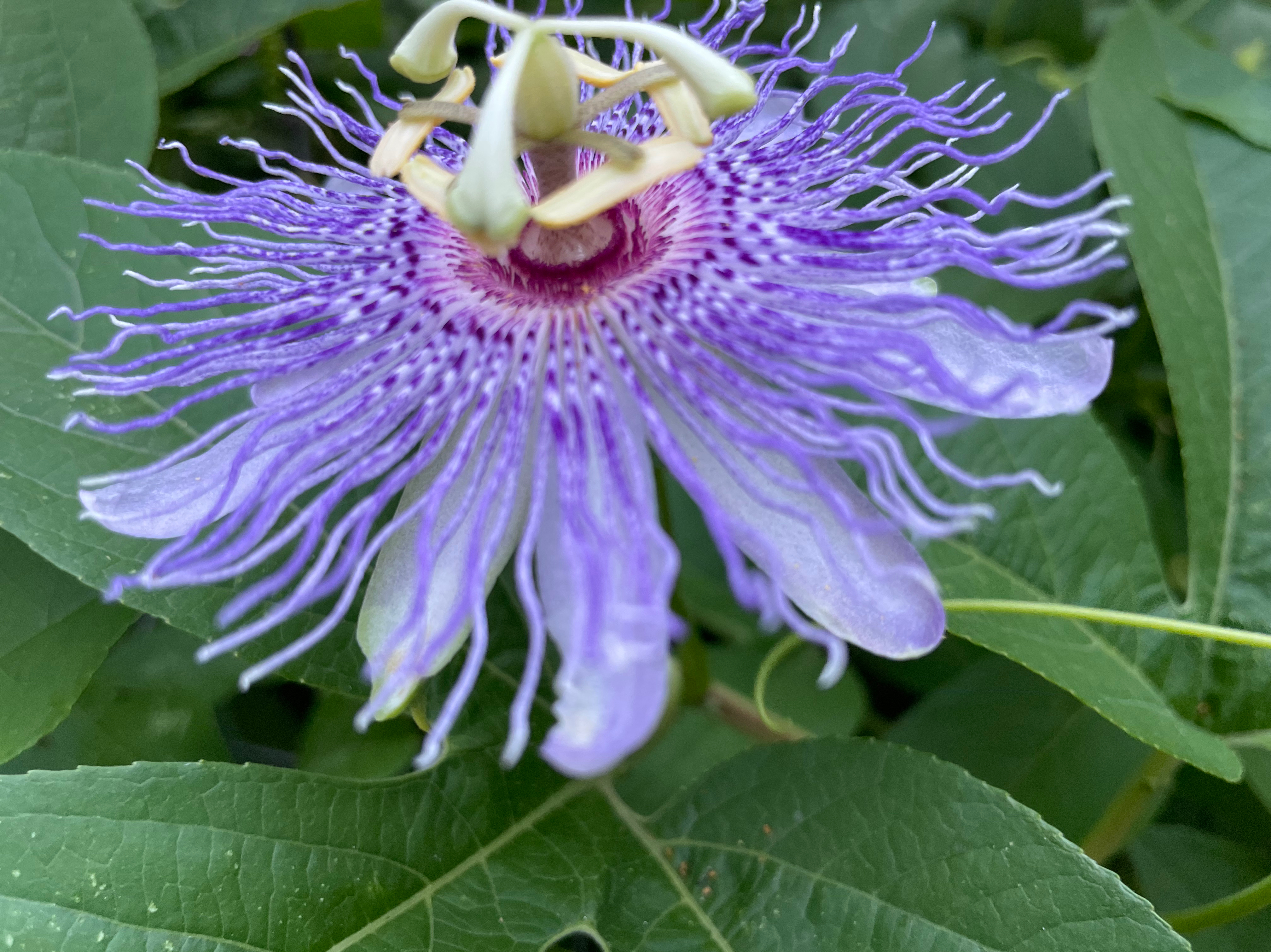
Passiflora icarnata infloresence, tri-lobed leaves, and tendril

Passiflora icarnata inflorescence, tri-lobed leaves, and tendril

The Ruellia nudiflora, or Wild Petunia, also has a purple to lavender flower, but it is trumpet-shaped. And it’s not a vine, but a sub-shrub perennial . After having transplanted this volunteer several years ago, it has now decided to propagate itself, like a weed, in the mulched bed and in the gravel path. Although its inflorescences look much like those of the cultivated Petunia, it is in the Acanthus Family, while the cultivated Petunia is in the Potato Family. The blossoms open in the morning, falling off in the afternoon. Like several other of my favorite wildflowers, its flowers are ephemeral, lasting for just a day.
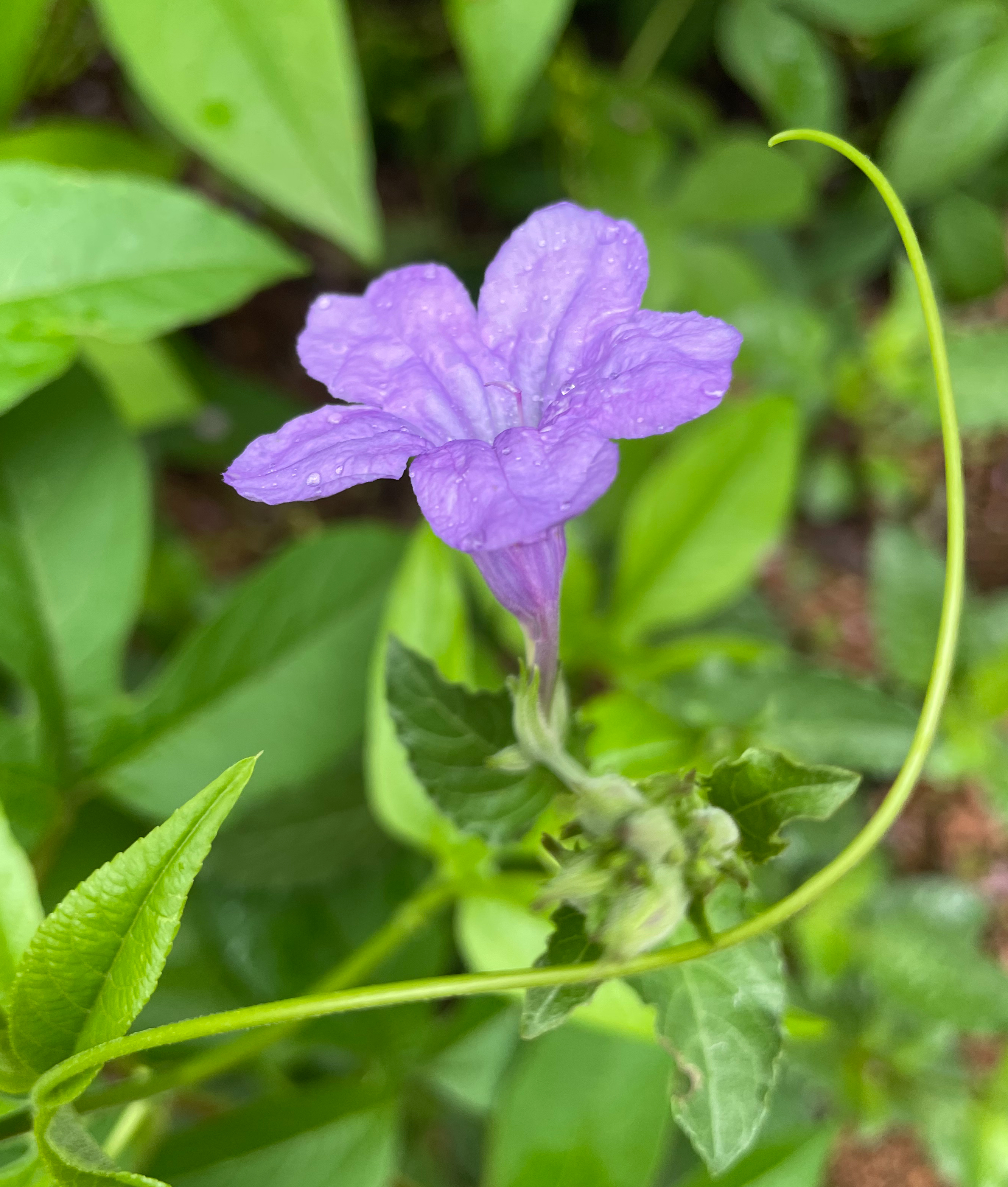
Ruellia nudiflora inflorescence, surrounded by Passiflora leaves and tendril

Ruellia nudiflora inflorescence, surrounded by Passiflora leaves and tendril

As if having to “weed” native species wasn’t bad enough, as one can see from the top photo in this post, it looks as though the two plants have begun to hybridize to form a new species. Fortunately, (or unfortunately), that’s not the case: A blossom from the Ruellia has been captured by a tendril from the Passiflora, making it look (almost) like it belongs to the vine. 

Not sure what I’d do if they actually did start to hybridize – probably get a botanist or two to take a closer look. And get a nursery to work with to develop and patent the new species. And sit back and watch the money roll in (ha!).

###